Role models of greatness.

Here you will discover the back stories of kings, titans of industry, stellar athletes, giants of the entertainment field, scientists, politicians, artists and heroes – all of them gay or bisexual men. If their lives can serve as role models to young men who have been bullied or taught to think less of themselves for their sexual orientation, all the better. The sexual orientation of those featured here did not stand in the way of their achievements.

Saturday, February 11, 2012

Carl Van Vechten

At the turn of the century Harlem was a mecca for Afro-Americans from all over the country. Nowhere else was there so large an area populated entirely by Blacks. A virtual city within a city, Harlem was populated by hordes of energetic, gifted youth. Writer/photographer Carl Van Vechten is credited with bringing the worlds of uptown Afro-American Harlem and downtown Whites together.

Following WW I, the Afro-American community countered Prohibition and White racism with self-conscious pride and militancy. Black soldiers had been treated with respect and near equality while serving in Europe, and those experiences influenced their expectations when they returned home. Participation in the war effort had given the Black community a sense of involvement in the American process that demanded participation in the mainstream of American life.

This rise of a proud Black identity coincided with a nationwide surge of White interest in Afro-American culture. They listened to the jazz of Duke Ellington, Fletcher Henderson and Fats Waller. The Charleston and the Black Bottom, dances previously limited to the jazz halls, became national crazes. Shuffle Along, an all-Black musical, was a smash success on Broadway. White authors and playwrights began to use race and racial prejudice as serious subject matter.

This vogue for the Negro manifested itself primarily in a huge influx of Whites infiltrating the Harlem's nightclubs. The Cotton Club was packed nightly with Whites drinking bootleg liquor while watching talented Black entertainers. A trip to Harlem represented an escape to an exotic community where the locals were uninhibited, passionate and demonstrative – all only a taxi ride away!

The person primarily responsible for this influx of White tourists to Harlem was the tall, blond author/photographer Carl "Carlo" Van Vechten (1880-1964). He was a witty, talented and bisexual man (twice married to women) who shamelessly engaged in homosexual activity. He had worked for years as a New York Times music and dance critic before achieving acclaim as an author, and his finger was on the pulse of all that was avant-garde, intellectual and artistic. He rediscovered Herman Melville and introduced Ronald Firbank and Gertrude Stein to American audiences (Van Vechten became Stein’s literary executor). His social circle included George Gershwin and Paul Robeson. Throughout the 1920s he produced a series of novels that were sparkling, frothy and exceedingly camp. Van Vechten's novels became popular with homosexuals, who sensed a kindred spirit in his preciousness.

In 1924 Van Vechten began to frequent Harlem’s nightclubs and bars, quickly becoming a regular. His circle of friends included most of educated Harlem. As an influential critic, he helped launch the careers of numerous talented Blacks. Van Vechten garnered notoriety for his 1926 novel, naively titled Nigger Heaven*, which told the tragic love story of a Black male writer and his Harlem girlfriend. While it was intended to give a sympathetic view of Harlem and its residents, the majority of Harlem was outraged. The White reading public, however, had the opposite reaction, and the novel quickly became a best seller. After reading the novel, many Whites hurried to Harlem to see the real thing.

*The title refers to the upper balcony seating that African Americans were relegated to in theaters.

The Jazz Age was a time when homosexuals began to acquire new territories for themselves, and Greenwich Village and Harlem were at the epicenter of gay New York. Their lifestyle was not only tolerated but often flaunted. Composer of the blues classic "T’aint Nobody's Bizness”, debonair Porter Grainger and writer Richard Wright were intimates of Van Vechten's. Grainger was not judged for his private life, nor was Harlem Renaissance poet Langston Hughes. Alain Locke, the Howard University professor who heralded the Renaissance in 1925 with his seminal anthology The New Negro, received no censure for never marrying, nor for his predilection for intelligent, male students. The community was certainly aware of poet Countee Cullen's lifelong relationship with Harlem schoolteacher Harold Jackman, but people remained tactfully silent.
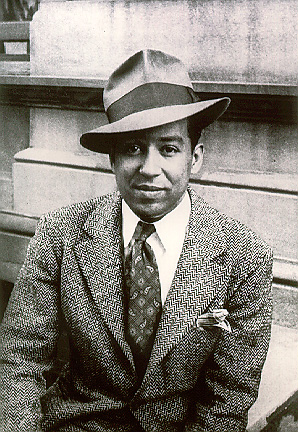
Van Vechten's portrait of Langston Hughes (1939)

An influential patron of Langston Hughes and Countee Cullen, Van Vechten also promoted African-American culture in his photography. His provocative, often homoerotic photographs taken from 1932 until his death documented important African-American figures in the arts. In addition to his seven novels, Carlo, as he was known by friends, wrote articles on music and literature in Vanity Fair and The New York Times that advanced the discovery of the New Negro Movement by Whites.

Note: This post is compiled from information in an essay by Eric Garber included in Black Men, White Men, Afro-American Gay Life and Culture, titled “T'aint Nobody’s Bizness, Homosexuality in 1920's Harlem”.

Jonathan Katz at Smithsonian National Portrait Gallery


Homoerotic portrait of Marlon Brando (1949):


1940 portrait of choreographer Antony Tudor (above left) and his lover, dancer Hugh Laing, holding hands.

Thursday, February 9, 2012

Ari Gold

He describes his own sound as "smooth, soulful, jazzy and funky." Born and raised in the Bronx by parents who were Orthodox Jews, he first gained recognition as a singer when he performed a solo at the age of five for his brother’s Bar Mitzvah. A guest at the Bar Mitzvah happened to be putting on a Jewish children's song festival and invited Ari Gold to participate. He performed along with his two older brothers, and they won first prize. From there, the festival engineer told him about an audition, and Ari got the lead. Then he got an agent and was regularly taken out of Yeshiva to go to work.

Soon he had 400 jingles under his belt, and he sang backup for Diana Ross (on her Swept Away album), well on his way to a successful professional singing career. He was also harboring the secret that he was gay, even from a very young age. Gold finally came out to his best friend at Yeshiva high school when he was 16, and to everyone else at age 18. It was not a huge surprise, because he had a shrine to Madonna in his room and had mostly played with girls (and their Barbies) when he was younger. He admits all that likely did not escape his parents’ attention. "C'mon, they're not clueless. They were pretty sophisticated Orthodox Jews."

His parents were fairly accepting, but along with coming out, he stopped being observant. That was more difficult for his parents to accept than his revealing his homosexuality.

Ari released his self-titled debut album in 2000, receiving acclaim from Billboard, HITS and VIBE for being the first openly gay pop singer who was out from the beginning of his musical career. The debut album included something unprecedented in R&B/pop: explicit gay love songs. He has released five albums, the most recent being Between the Spirit & the Flesh (2011). "This one was a big deal for me," he says, "every level of my identity: as a Jewish person, as a homosexual and where we are in the gay civil rights movement – all these layers of my identity." Assuming the role of a vampire for the video to "Make My Body Rock" panders to the metaphor of revelation and transformation.

Ari attended Yale and graduated with honors from NYU. He gives talks at community centers, synagogues and universities about growing up gay and Orthodox and is a contributing writer to the anthology CRISIS: 40 Stories Revealing the Personal, Social, and Religious Pain and Trauma of Growing Up Gay and Religious in America. Sir Ari received his Knighthood at the 24th Annual Night Of 1000 Gowns by the Imperial Court of New York for his commitment to LGBT issues and HIV/AIDS. Ari's activism and charity work also includes the HRC, UJA, Soulforce, Ali Forney Center, ACLU, Bialy House, amFAR, Live Out Loud and GMHC on HIV/AIDS awareness and research, homelessness and human rights. His career has also encompassed turns as a songwriter, music producer, actor and model. Whew!

He continues his tireless work as an advocate for the gay community and the pursuit of equal rights. "Music is political, and I don’t like when people try to pretend it’s not," he says, always using his platform as an out gay artist. "It’s never too late to learn and that’s something that both my parents (who were teachers) have always taught me." But between his responsibility to nourish his spirit and feed the flesh, Sir Ari still finds time to dance.

Ari celebrates a birthday this Saturday, February 11, when he will turn 35. He still lives in Manhattan, where he is a fourth generation Lower East Sider.

My Favorite Religion
(music video, the third from the album Between the Spirit & the Flesh, released a few days ago)

To say that this video is edgy is understatement. It contains both full rear nudity (Mr. Gold has a sexy, muscular butt – as you’ll note at the 2:21 timing mark), a Tallit (Jewish prayer shawl, at the 3:40 mark) and implied sex with a Christian cleric (at 3:04). And you can dance to it. Have a look and listen:

Tuesday, February 7, 2012

Tate Taylor

42-year-old Tate Taylor is the openly gay director/writer of the Academy Award nominated film, The Help, based on Kathryn Stockett's civil rights-era novel of the same name. Stockett, who has known Taylor since they were in a Presbyterian Church preschool together in Jackson, Mississippi, gave him rights to make the film adaptation in 2008, before the book was published. Actually, Taylor started writing the screenplay before a publisher was found, deciding he’d make an independent film based on an unpublishable manuscript.

Last month the film received four Academy Awards nominations, including Best Picture and acting noms for Viola Davis, Jessica Chastain and Octavia Spencer. The film won the Screen Actors Guild Award for Outstanding Performance by a Cast in a Motion Picture. Made on a $25 million budget, The Help has grossed more than $200 million so far.

On February 19 Taylor is set to receive the Writers Guild of America West's Paul Selvin Award for his adapted screenplay. The Selvin Award recognizes written work which embodies the spirit of constitutional rights and civil liberties.

“The studios, other than Dreamworks, didn’t want to produce it, because I insisted on directing it,” Taylor said. “… I can’t say that I blame them. You know, on paper, you just don’t let someone with limited experience go down there with a pile of money and start making a complicated ensemble piece. I’m not a sure-fire hit in the Hollywood economics and business model, but it happened because I was being stubborn and Dreamworks studios was being really cool by saying, ‘You know what? Let’s give it a shot’.”

Stockett and Taylor once shared a rent-controlled apartment in New York’s East Village. Stockett recounts that 60 literary agents turned her down. However, once The Help became a best seller, Stockett promoted Taylor as the person to write and direct the movie version. “I really wanted a Mississippian to tell the story, to translate it to the screen,” she says. Taylor commented, “We didn’t think there was any way a studio would do an all-female bi-racial drama set in the sixties. They just don’t make these movies anymore.”

Octavia Spencer, who plays Minny, was Taylor’s roommate while he was working on the screenplay in L.A. Filmed in Greenwood, Mississippi, the crew was greeted rapturously by the locals, nearly 1,000 of whom wound up as extras. Viola Davis, who many consider a shoo-in for a best actress Oscar win (tune in on February 26), arrived a month early. She had already started her research, watching civil rights documentaries like “Eyes on the Prize” and reading books about that era. “I read anything I could possibly get my hands on just to recreate what it was like to live in that time period,” she said.

Taylor summed up the pride he takes in this project: “What’s meant the most to me in this whole process is that people I don’t know sending me letters and emails saying ‘I was about to quit the business. It’s changed so much. It’s so jaded. It’s so economically driven. The art has been lost. And I heard what happened with you and and Kathryn and DreamWorks…and I am refueled.’ That makes me feel really good.”

In an interview with The Advocate, Taylor said, “I didn’t live through the ’60s, so one of the ways I was able to really understand that civil-rights struggle was by looking at what’s happening in America now with the gay community. Gays understand what it’s like to be discriminated against.”


After fifteen years of work in New York City and Los Angeles, Taylor recently moved into Wyolah, a 70-acre antebellum plantation in Church Hill, north of Natchez. He hopes to hold workshops and host industry hopefuls on the c. 1836 estate, poignantly built by slave labor. Taylor plans on restoring the plantation, turning the third floor of the main house into a space to hold such events. Many of the original Mississippi plantation outbuildings survive, including a great house with double porches, doctor’s office, brick kitchen (photo below), commissary, carriage house and barn. Wyolah plantation and its nine buildings are listed on the National Register of Historic Places.


An interview with Tate Taylor at the U.K. premiere of The Help: