Here you will discover the back stories of kings, titans of industry, stellar athletes, giants of the entertainment field, scientists, politicians, artists and heroes – all of them gay or bisexual men. If their lives can serve as role models to young men who have been bullied or taught to think less of themselves for their sexual orientation, all the better. The sexual orientation of those featured here did not stand in the way of their achievements.
Dateline 1979, Bavaria. Openly bisexual Prince Johannes von Thurn und Taxis (1926-1990) was the richest man in Germany and its largest land owner. His fortune cast a web of banks, breweries, enormous land holdings in Brazil, vast private forest lands (80,000 acres) in Germany, extensive fine art collections and eleven palaces and castles. The 53-year-old bachelor prince resided in his 500-room St. Emmeram Palace in Regensburg, some 60 miles northeast of Munich, where his family had lived since 1748.
In the fifteenth century his ancestors had developed a European postal system that earned them a great fortune. Soon the postal coaches began accepting paying passengers, so we get the term “taxi” from the family enterprise. For over 300 years the family held a monopoly on the postal system of the Holy Roman Empire.
The 12th-century Italian Dukes de la torre, based near Bergamo, were the ancestors of the Thurn und Taxis dynasty. Emperor Ferdinand III recognized the Thurn und Taxis line as successors to the Torriani dukes. The Italian word Torre (tower) became Thurn, and Tasso (badger) became Taxis, and their family tree dates back to 1445.
During WW II Prince Johannes served in German intelligence and was imprisoned by the British from 1945 to 1947. For the next 35 post-war years he kept a relatively low profile among his royal and noble peers. But after the death of his father in 1982, the prince became head of the Thurn und Taxis family as full inheritor, and he began to spend money like a Vanderbilt. His 210,000 sq. ft. palace was furnished with 400 clocks, maintained by a full-time servant whose only task was to wind them in perpetual rotation. All the windows were washed weekly. Johannes retained 70 liveried footmen and parked 20 cars in his garage. But his idea of a fun night out was to troll the gay bars in Munich.
Imagine then the surprise when he announced he was ready to settle down with an impoverished distant aristocratic cousin, Countess Gloria Schönburg-Glachau, a high school dropout and onetime waitress some 34 years his junior. Upon their marriage she was 20 years old and three months pregnant with their first daughter. A second daughter arrived two years later, but Prince Johannes could not breathe a sigh of relief until Albert, their only son, arrived the next year.
Prior to the birth of a son, Johannes had a pressing inheritance problem. According to tradition, his wife had to be a noble descendant of the Holy Roman Empire who would bear him a son. Otherwise his fortune would be splintered into numerous fractions of its $2.5 billion value. When the prince ran into his distant cousin Gloria in a Munich café, a lightbulb went off. Gloria not only fit the bill of proper lineage, she was willing to accept his sexual preference for men. It was a win-win; she was rescued from poverty, and he would be able to keep his vast estate intact. Young Prince Albert II would be full-inheritor.
The couple lived a life of debauchery, a wild, hedonistic jet-set lifestyle. Gloria drove around town on a lipstick red Harley-Davidson. She sported outrageous clothing, makeup and hairdos, and she proudly bore the moniker “Princess T-N-T.”
Encouraged by her husband, Princess Gloria enjoyed a lifestyle of extreme decadence. In 1986 she spent $20 million on a three-day 60th birthday party for Johannes, crowned by a costume ball held at their St. Emmeram palace, where Gloria appeared as Marie-Antoinette. She ordered a birthday cake lit by 60 pink, phallus-shaped candles, a not-so-subtle hint at her husband’s sexual preference. 500 guests had been flown in on private jets to enjoy days of over-the-top debauchery. Mick Jagger, J. Paul Getty Jr. and Saudi Arabian businessman Adnan Khashoggi were among the guests.
Prince Albert was just seven years old when his father died of complications following two heart surgeries in late 1990. That day Albert became the 12th Prince of Thurn und Taxis and the youngest billionaire in the world. The 6'4" tall bachelor (and to this day still a bachelor at age 41 in 2025) Prince Albert is an extraordinarily rich business man and professional race car driver (he has crashed a Lamborghini or two). Albert became full-inheritor of the Thurn und Taxis fortune (est. 3 billion dollars) on his 18th birthday on June 23, 2001. Should you bump into him during your travels, his correct form of address is His Serene Highness the Prince of Thurn und Taxis (you're welcome).
Princess Gloria stands above her two daughters and son Prince Albert.
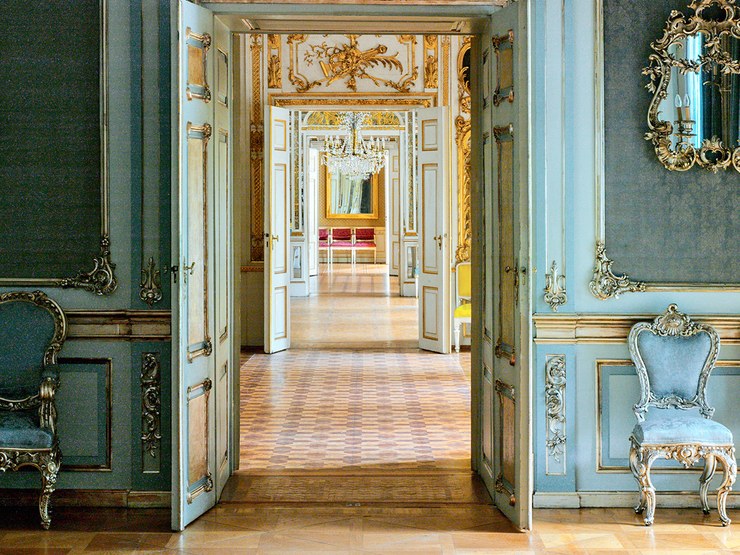
Today Princess Gloria spends two months each year at her loft apartment in Chelsea (NYC), enjoys her beach compound in Kenya, keeps an apartment in Rome and has a sprawling lake house in Bavaria. Prince Albert today makes his home at the ancestral Schloss St. Emmeram (below) in Regenburg. At 500 rooms and 210,000 sq. ft., give or take, it is the largest home in Europe still maintained by a princely family. It even contains a throne room and a riding hall for the practice and performance of extreme dressage.
19-century palace addition: bowling lane
Prince Albert von Thurn und Taxis, full inheritor,
photographed in his throne room.
Sources: Gloria, die Fürstin (Peter Seewald, 2004), Wikipedia & Tim Allis for People Magazine (1991)
At the time he sang second tenor in the Glee Club at Yale, Cole Porter (1891-1964) also appeared in stage roles and performed cabaret sets at private parties. It became his habit to step out of the chorus just before the choir’s last number to sit at the piano to accompany himself in a solo performance of songs and patter, much of the clever and cheeky material his own. Although he was listed just once in the program, the audience usually kept him there until he had gone through 10-12 encores. Reviewers called him the “highlight” of the concerts, “a clever imitator, strong singer and comedian”. Then, as later in life, Porter wrote both the words and music to his songs.
After one year he dropped out of Harvard Law School, where he had resided with Dean Acheson, the future Secretary of State. His unwavering D-grades in all his law courses resulted in a transfer to the School of Music in 1914 for his second year at Harvard. For a time he studied music with Pietro Yon, who went on to become famous as organist at NYC’s St. Patrick’s Cathedral.
Porter, who was exclusively homosexual, met his future wife Linda at a 1918 wedding reception in Paris, where he had lingered after serving in France in a volunteer ambulance unit during the final year of WW I. At least that's what he told Linda. Although Cole appeared on the streets of Paris in various military uniforms, later biographers revealed that Porter never served in the military of any country. Porter maintained a luxury apartment in Paris, where he entertained lavishly. His parties were extravagant and scandalous, with a little of everything sprinkled in for good measure – much gay and bisexual activity, cross-dressing, international musicians, Italian nobility, and a large surplus of recreational drugs. For a twenty-something boy born on a farm in Peru, Indiana, things were moving fast.
Linda Lee Thomas (at right), a fabulously wealthy socialite divorcée, was descended from the Paca family (one of whom was a signer of the Declaration of Independence) as well as from the Lees of Virginia. Linda was well aware of Porter’s homosexuality, but they nevertheless married on December 12, 1919, and remained based in Paris as bon vivants of hedonistic high style until 1937, when war clouds forced their return to the U.S. Many of their circle suspected that Linda might be lesbian or bisexual, while others thought of her as asexual. Whichever was true, their marriage was without sex, but certainly not without love. They adored each other. Years later Linda miscarried, but it is not certain whether Cole was the would-be father. Linda was known to have affairs of her own, but it cannot be determined if they were sexual. It’s all a cloud of ambiguity.
After their honeymoon in southern France and Italy, Cole sought further formal musical training, enrolling at the Schola Cantorum in the Latin Quarter of Paris. He soon abandoned his notion of writing serious orchestral music, however, and did not complete the curriculum.
Linda, thirteen years older than Cole, provided him with a passport to social landscapes he could never have traversed on his own. Their world was a fusion of outrageous Bohemianism and mad-cap Roaring Twenties liberation, tossed together with moneyed misfits, exiled royalty, show business personalities and assorted impoverished creative geniuses. Included in their social circles were Coco Chanel, Lauritz Melchior and Arthur Rubenstein, who loved to sit down at the piano to play Cole Porter songs. In short, they knew anyone worth knowing.
Soon after their marriage, Linda bought a much larger Parisian residence in 1920 at 13, rue Monsieur, a street just one block long, not far from Les Invalides and the Rodin Museum (and purchased for more than $10 million in today’s money). The rear garden backed up to the house of Nancy Mitford, the British novelist, biographer and socialite, who was involved in a romance with the homosexual Scottish aristocrat Hamish St. Clair-Erskine. But I digress.
Linda’s house in Paris was so large that they rented a suite of rooms to Howard Sturges, a close friend of Linda’s who became Cole’s dearest life-long friend. Sturges lent Linda a beautiful painting by Christian Bérard, which hung for years in their Parisian drawing room. Sturges, a witty, old-money Boston socialite, was a trained violinist who kept a pet bear and walked a pig on a leash through the streets of Paris. I’m not making this up.
Hostess Elsa Maxwell (a closeted lesbian) leans over a smiling Cole Porter. The legendary society maven was a huge fan and patron.
Sturges often traveled with Cole and Linda, wherever their journeys took them, and Cole and Howard made this three-way friendship more complicated when the two men entered into an affair. The Porters were peripatetic to the extreme. They always traveled with an entourage of servants and friends, usually picking up the tab for their guests, and quickly became acquainted with Egypt, Monte Carlo, Italy, London, Biarritz, Spain and New York. To say that the Porters lived large is understatement.
Cole and Linda befriended wealthy American ex-pats Gerald and Sarah Murphy, and together they made the South of France a fashionable year-round resort destination. There were striking parallels in the lives of the Murphys and Porters, not the least of which was the fact that both Gerald and Cole were married homosexual men.
In 1923 Cole’s wealthy grandfather died. Long disapproving of Cole’s choice of a career, he made no mention of Cole in his will. Of the four million dollars left to Cole’s mother, however, she gave half to her son, then 32 years old, who later said the inheritance didn’t spoil or ruin his life – it just made it wonderful. Well, not everything was wonderful. It was about this time that Porter tested positive for syphilis.
Soon Cole and Linda became part of the social set of Prince and Princesse Edmond de Polignac. The princess, based in Paris, was heir to the singer sewing machine fortune. She was a captivating lesbian married to a homosexual (and financially destitute) prince, who was himself a talented amateur composer. They hosted private musical salons that drew on the talents of Stravinsky, Fauré, Satie, Ravel and Milhaud. The Polignac’s musical afternoons were for decades the most important and influential venue for new French music.
For five summers during the 1920s, the Porters descended upon Venice, renting the fabulous Palazzo Rezzonico. During the summer of 1925 Cole became completely smitten with Boris Kochno, a Russian poet, librettist and Ballet Russes dancer who was Diaghilev's collaborator. Their correspondence survives, and Porter comes across as a love-sick puppy. Soon thereafter, Porter returned to the U.S. to write shows for Broadway and Hollywood. While living in New York, Porter found that paying for sex was less complicated emotionally, and it allowed him to indulge his taste in sailors, marines and assorted prostitutes.
Until recently Porter's piano (right) stood on the cocktail terrace of the lobby of the Waldorf Astoria hotel in NYC, where Cole and Linda Porter kept an apartment* in the Waldorf Towers, the residential wing of the hotel. The 1907 Steinway grand, with a hand decorated walnut case, was a gift from the hotel in 1945. Upon Porter's death in 1964, the piano went downstairs to the lobby.
Monty Woolley, who often joined Cole to cruise New York City's waterfront bars and bordellos, recounted that one night, a young sailor they approached by car asked outright, "Are you two cocksuckers?" Woolley responded with, "Now that the preliminaries are over, why don't you get in and we can discuss the details?"
Cole’s numerous male lovers included Nelson Barfeld (a dancer/choreographer who was a former U.S. Marine), Robert Bray (a married Californian) and Jack Cassidy (a character actor). Not to mention architect Ed Tauch, director John Wilson and longtime friend Ray Kelly, whose children still receive half of Porter's copyright royalties. After relocating to Hollywood, he was a regular guest at George Cukor's Sunday all-male pool parties, but soon the two became rivals. While renting a beautiful Hollywood home owned by renowned homosexual actor-decorator Billy Haines, Porter held competing all-male parties, and Cole’s became the more valued invitation. Porter was not discrete. A recent biography recounts that in his later years, Cole kept "breaking appliances so he could lure cute repairmen into his lair". As well, Scotty Bowers's recent Hollywood tell-all recounts that Porter had a decided taste for giving oral sex to Marines while suffering verbal abuse and humiliation. The homosexual relations were not casual. All of Porter's sexual activity was homosexual, and he became more brazen in the more open and permissive atmosphere of Hollywood. Linda reacted by staying away from California, sailing back and forth between her residences in Paris and New York. She was quietly making plans to divorce Cole.
Then in 1937, Cole was involved in a tragic horse riding accident and fractured both his legs. This was especially debilitating and humiliating to the ego of a vain man who placed enormous value on looks and a dashing appearance for both social and sexual reasons. He was in the hospital for months as his mental and physical health waned. He was in constant pain from his leg injuries and underwent 34 operations, all ultimately unsuccessful. Linda changed her plans and returned to Cole's side; they shared quarters at the Waldorf Towers in NYC, and before long he returned to writing songs.
Porter hired a driver and a personal assistant, who tended to details such as getting Cole into and out of wheelchairs, elevators and buildings. Soon enough Porter was reviving his lusty male/male activity. Once he graduated from a wheelchair to a cane, he maintained a small house overlooking the ocean at Lido Beach on Long Island, which he used for male/male trysts. Frank Walsh, a soldier stationed at Governors Island, recalled attending a party at Porter's Lido Beach residence, describing it as "a drinking and sex party, nearly orgiastic, with fifty or more soldiers kissing, drinking and engaging in lots of very graphic sex." At about this time Cole tripped on a stair and broke his left leg again, causing a major setback to his recovery.
Cole Porter portrait by Richard Avedon, 1950.
In 1945, he lent his permission to the movie project Night and Day, allegedly about the life of Cole Porter. Although a great boost to his ego, the plot was a wildly fictionalized biography. His friends thought it hysterically funny, knowing the divide between fact and fiction. The movie overlooked Porter’s overly pampered and controlled youth, his notorious gay life and his sexless marriage of social convenience; instead it lent credence to the tall tales Cole spread about himself, such as his (fake) war record and injuries. According to friends, Cole enjoyed the movie's wildly fictional account, and he especially savored having closeted movie star Cary Grant play a heroic, straight version of himself. Fortunately Porter did not live to see the 2004 film De-Lovely, a wretched misstatement of facts and an utter bore. I do not know how it was possible to make the extravagant, over-the-top lives of Cole and Linda Porter, portrayed by Kevin Kline and Ashley Judd, appear so dull.
Porter's greatest hit musical came late in his career. Kiss Me Kate (1948) is a play within a play about a troupe putting on Shakespeare's The Taming of the Shrew. W. H. Auden even called it a much better piece of theater than The Taming of the Shrew (!). A film version hit movie theaters in 1953, also to great acclaim, but Porter's risqué lyrics had to be sanitized to avoid the Hollywood code censors, thus robbing the musical of much of its comedy. The film was originally released in 3-D.
A major blow came with Linda’s death in 1954. She died after a long illness from chronic respiratory problems at their apartment in the Waldorf Towers in NYC. Although they had separated only to reunite several times, they remained devoted to each other. She left an estate of over $1.5 million, in which Cole had a lifetime interest (Cole had also inherited the bulk of his mother's half million dollar estate, but needlessly worried about money constantly). He was given Linda's Williamsport, Massachusetts, estate outright (description below), as well as all of Linda's personal belongings.
Unfortunately, Porter descended into further creative silence and social isolation in 1958, when his right leg was finally amputated. Porter was embarrassed and incapacitated by the surgery. Linda Porter had acquired a 40-acre estate in Williamsport, MA in 1940, and after her death, Cole became a virtual recluse at Buxton Hill**, as the property was named (current photo below). In a bizarre act Porter ordered the Tudor-style main house razed after Linda's death and moved a caretaker’s cottage to the location of the original house. According to one of his biographers, visitors to Buxton Hill became fewer and fewer, because most weekends Porter was wicked drunk and ignored his invited guests, some of whom dubbed the farm, “the torture chamber.” At Cole’s death from kidney failure in 1964 (at a nursing home in Santa Monica), the Buxton Hill estate went to Williams College, but returned to private hands a few years later. It recently served as a luxury inn, with tennis courts and a 30' X 50' swimming pool. And the whole shebang (structures and 40 acres of land) subsequently hit the market for $4.5 million. 1425 Main St., Williamstown, MA. It has since gone off the market.
**When Cole Porter formed his own publishing company, he named it Buxton Hill.
* Porter’s 5-bedroom apartment in the Waldorf Astoria was available for rent last year at the rate of $150,000 a month. No lie. The Porters had lived in several apartments at the Waldorf Towers from 1939 to 1954, but Cole moved into this much larger unit just after the death of Linda. When Porter moved to apartment 33-A (1955-1964), he hired Billy Baldwin to do the interior design work. Baldwin was so well-known for his love of slipcovers that Cole Porter joked that he didn’t want to come back to find his piano slip covered! After Cole Porter died, Frank Sinatra moved in. Quite a pedigree for Waldorf Towers apartment 33-A (floor-plan porn below).
Of note: Porter’s wildly successful 1934 musical Anything Goes was revived on Broadway in 2011, and a touring company took the show to audiences all across the country.
His body of work includes some 1,400 songs. Some are one-offs which continue to astonish listeners today. For example, in Miss Otis Regrets (1934) we are told by a servant of a polite society lady how her employer was seduced and abandoned. In just a few lines of lyrics, we learn that Miss Otis hunted down and shot her seducer, was arrested, taken from the jail by a mob, and lynched. The servant conveys Miss Otis's final, polite, apologetic words to her friends: "Miss Otis regrets she's unable to lunch today." There is not another song like it.
Carmen McRae's impassioned reading of "Miss Otis Regrets..."
Among Cole Porter’s classic American standards are:
Ev'ry Time We Say Goodbye (1944) Ray Charles and Betty Carter’s classic reading of Porter’s extraordinary tune and lyric:
When you're near there's such an air of spring about it. I can hear a lark somewhere begin to sing about it. There's no love song finer, but how strange the change from major to minor Everytime we say goodbye.
Begin the Beguine (1935)
Don’t Fence Me In (1934)
From This Moment On (1950)
I Love Paris (1952)
I Get a Kick Out of You (1934)
I’ve Got You Under My Skin (1936)
In the Still of the Night (1937)
Let's Do It, Let's Fall In Love (1928)
Night and Day (1932 - one of ASCAP's top 10 all time money makers)
You’re the Top (1934)
True Love (1956) Bing Crosby and Grace Kelly sing a duet aboard the yacht True Love in High Society, the musical remake of Philip Barry’s 1939 stage play, The Philadelphia Story (made into an acclaimed film in 1941).
Some songs have remained inexplicably obscure. After You, Who? was a great favorite of Mabel Mercer, but I had not heard anyone else sing it in years. Imagine my surprise when John Barrowman included it on a recent album.
After You, Who? - The Gay Divorce* (1932)
Though with joy I should be reeling that at last you came my way,
There's no further use concealing that I'm feeling far from gay,
For the rare allure about you makes me all the plainer see
How inane, how vain, how empty life without you would be.
After you, who could supply my sky of blue?
After you, who could I love?
After you, why should I take the time to try,
For who else could qualify - after you, who?
Hold my hand and swear you'll never cease to care,
For without you there what could I do?
I could search years but who else could change my tears
Into laughter after you?
* Hollywood codes forced the 1934 film version to be called The Gay Divorcée. Censors would not concede that a divorce could be something joyous. I kid you not.
Trivia: Cole Porter was left handed and found it awkward to write down music on staff paper. He worked out a solution by turning the paper at a right angle, so that the staff lines were vertical. True.
Cary Grant & Randolph Scot share an intimate moment outside their Santa Monica beach house (1930s).
Though he married women five times, movie star Cary Grant (1904-1986) enjoyed many gay relationships during his early career in New York and Hollywood. His most famous same-sex romance was with fellow actor Randolph Scott (1898-1987), the rugged star of numerous westerns.
Grant and Scott met at Paramount Studios in 1932 and were immediately attracted to each other. Soon after, they moved in together, sharing a house at 2177 W. Live Oak Drive near Griffith Park in Hollywood. The arrangement was explained away by studio public relations agents as a way for two young actors to “cut costs and share expenses,” even though both men could easily afford their own homes. Even after Grant’s studio-arranged marriage to Virginia Cherrill, the two men continued to bear a torch for each other; just a few months into Grant's marriage, he attempted suicide. After a 13-month marriage, in a 1935 divorce settlement, Cherrill received $50,000, which was equivalent to 50% of their community property at the time. Grant moved back in with Scott.
Randolph Scott
Randolph Scott (above), beyond handsome.
Between liaisons with other men and women, Grant and Scott’s relationship endured, well known to their colleagues in the industry. In the late 1930s, Grant and Scott occupied a Santa Monica beach house at 1019 Ocean Front (since renumbered – now 1039). In fan magazines, they were photographed together in domestic bliss, wearing aprons and cavorting pool side or on the patio. According to Grant’s biographer, they believed their public openness and flamboyance would raise them above suspicion of homosexuality. The public bought it, and Grant enjoyed a screen career as a suave ladies’ man for the next three decades, while Randolph Scott made popular westerns, always playing rugged, masculine characters.
Don’t miss My Favorite Wife (1940 - available from NetFlix), a film featuring Grant and Scott as co-stars in a screwball comedy. In this trailer for the movie, Scott appears with Cary Grant at the 1:45 mark.