Role models of greatness.

Here you will discover the back stories of kings, titans of industry, stellar athletes, giants of the entertainment field, scientists, politicians, artists and heroes – all of them gay or bisexual men. If their lives can serve as role models to young men who have been bullied or taught to think less of themselves for their sexual orientation, all the better. The sexual orientation of those featured here did not stand in the way of their achievements.
Showing posts with label Green-Wood Cemetery. Show all posts

Monday, January 8, 2024

Leonard Bernstein

*UPDATED January 7, 2024 to include mention of the 2023 bio-film MAESTRO.


a gay man who dabbled in the straight world


Bernstein photographed in 1988 at home in Connecticut.


Leonard Bernstein* (1918-1990) was a celebrity American conductor and composer. As principal conductor and music director of the New York Philharmonic, he was without peer, so much so that the orchestra had a difficult time recovering when he departed the podium. He composed music for the concert hall, cinema and the theater, making him the most celebrated American composer since George Gershwin.

*He pronounced his surname BURN-stine, not BURN-steen.

Photo:
In the green room at Carnegie Hall 1951, with sister Shirley.

His personal life, however, was one of deception. Bernstein’s homosexual proclivities were undisputed and well documented. Because he married and had children, many people assume he was bisexual. But Arthur Laurents, who collaborated with Bernstein on West Side Story, related that Bernstein was simply "a gay man who got married. He wasn't conflicted about his sexual orientation at all. He was just gay." Leonard Bernstein, Jerome Robbins, Arthur Laurents and Stephen Sondheim were the four gay Jewish men, all working at the very top of their craft, who created West Side Story, one of the most enduring musicals of the 20th century. Like many gay men of his generation, Bernstein appeared to be a devoted husband and father in public while carrying on a promiscuous homosexual life behind the scenes.

While still a student at Harvard, Bernstein had an affair with his mentor, famed conductor Dimitri Mitropoulos, and after a sexual dalliance he became close to gay composer Aaron Copland. Many say that Bernstein chose to marry to dispel rumors about his homosexual activity, which would have made it difficult to secure a major conducting appointment, given the conservative nature of orchestra boards. Bernstein had an on-again, off-again relationship with his future wife Felicia, a Chilean actress, but Bernstein broke off their engagement, telling Felicia that he was homosexual. In spite of this, she continued to pursue him. Their arrangement was such that, so long as he did not embarrass her publicly, he was free to pursue his homosexual affairs.

Photo:
With wife Felicia and children 1956.

A major event in Bernstein's personal life was his decision that he could no longer repress his homosexuality; he left his wife in 1976 to live with  Tom Cothran, his male lover at the time. Bernstein was going to Paris to spend half a year with Cothran, whom Felicia detested. At the Carnegie Hall holiday concert of Peter and the Wolf that year, Lenny conducted and Felicia narrated. The two had been booked long in advance of their personal turmoil, but there was no question of the Bernsteins not fulfilling their obligation. When Bernstein took the podium, the audience went wild. At the end of the concert, an assistant brought a hundred red roses to him. Lenny walked across the stage to hand the roses to Felicia,  but as he did so, she pivoted on her heel and stormed offstage. The giant bouquet fell to the floor with a thwump, and the audience gasped. Afterward, Bernstein was disconsolate, but went through with his plan to join Cothran in Paris. The next year Felicia was diagnosed with lung cancer, and Bernstein moved back in to care for her until she died in 1978 (Bernstein himself was to die of progressive lung failure). Most biographies of Bernstein relate that his lifestyle became more excessive and his homosexual activities cruder and less discrete after her death. Cothran died of AIDS in 1981.

Just three years before his marriage, Bernstein visited Israel (1948) and had an affair with Azariah Rapoport, a stunning young Israeli soldier who was his guide. Bernstein was madly in love: "I can't quite believe that I should have found all the things I've wanted rolled into one. It's a hell of an experience – nerve-racking and guts-tearing and wonderful. It's changed everything."

*In late 2023 Netflix released MAESTRO, a biographical film starring Bradley Cooper (with a prosthetic nose) as Bernstein. The screenplay focused on Bernstein's relationship with his wife Felicia and the impact his dalliances with men (often his younger students), alcohol and drug abuse had on their marriage. Cooper directed the film and co-wrote the screenplay.

Professionally, however, Bernstein felt that his homosexuality was a curse. He underwent psycho-analysis with Hungarian-born Dr. Sandor Rado, whose specialty was "curing" homosexual men of their "inversion". Bernstein felt marriage could “save” him from a homosexual life style. (A personal comment here: homosexuality is not a life style. “Preppy” is a life style; homosexuality is a sexual orientation)

A friend of the Bernsteins who was visiting their home recalled finding Bernstein in a hallway making out with a beautiful twenty-year old boy while his wife was sitting by herself in the living room. His wife also suffered the humiliation of receiving phone calls and discovering love letters from her husband's many boyfriends. Shortly after 1973, when Bernstein met the young Tom Cothran (musical director of Radio KKHI-FM in Denver), he became so infatuated with the boy that he allowed his wife to catch them in bed together.
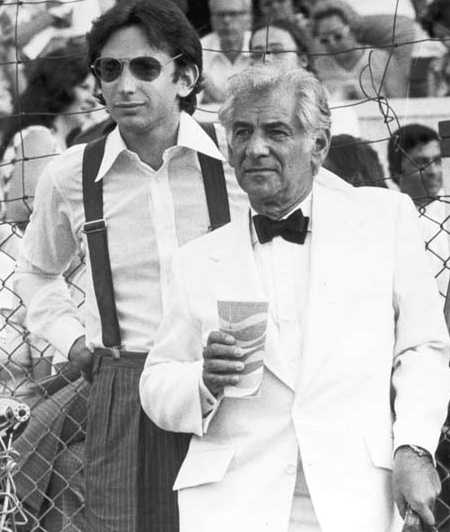
Photo:
With young gay conductor 
Michael Tilson Thomas 1974

After his wife died Bernstein abandoned all caution. By this time addicted to alcohol and drugs, he became open and crude about his homosexual activity. Pianist William Huckaby, after performing at a White House recital, was talking with President Carter when he "felt these hands clamped on my shoulders.” He was whirled around and forced into a deep French kiss right in front of the President, who walked away in astonishment and embarrassment. During his sixties and seventies, Bernstein surrounded himself with an entourage of beautiful boys, each one as intoxicated and obnoxious as his patron.

Many who knew him suggest that Bernstein became frustrated and cantankerous in his later years because he had never able to match the brilliance and popularity of West Side Story (1957), composed when he was in his late thirties. He was forever chasing and trying (unsuccessfully) to live up to his own fame. He also became increasingly intolerant of being called "Lenny" by those outside his inner circle and forever corrected those who pronounced his last name Burn-steen; he pronounced his name closer to the German way, BURN-stine. Bernstein means "amber" in German. In truth, Bernstein had changed his first name to Leonard when he was fifteen years old; he had been born Louis Bernstein.

After Felicia's death, Bernstein dealt with much guilt over how his homosexual activity adversely affected her. Some of this guilt and conflict was expressed in his 1983 opera, A Quiet Place, which tackled issues close to Bernstein’s life. Its story is one of suffering the loss of a loved one and a father’s acceptance of a gay son.

Bernstein's obituary in the New York Times (1990) made clear mention of his homosexuality. Since then many fans still visit his grave at Green-Wood Cemetery in Brooklyn, New York.

Photo: Bernstein at the piano in 1944 at age 26.


Most of the information in this post comes from Meryle Secrest’s “Leonard Bernstein: A Life” and Charles Kaiser's “The Gay Metropolis.”

Note: Bisexuality is a thorny label. Do we call Bernstein bisexual because he married and fathered three children? The recently deceased Arthur Laurents did not think we should. He said Bernstein was a "gay man who married." I go about it this way. If a person has sexual relations regularly with both men and women, then I call that person bisexual. Bernstein's sexual relations before, during and after his marriage were overwhelmingly homosexual, so I agree with Laurents' assessment. The same with actor Anthony Perkins, who did not have a sexual experience with a female until he was 39 years old (he was so closeted and paranoid prior to that time that he insisted on parking blocks away from the homes of his male lovers and arrived at events and restaurants well before or after his boyfriends). Those who knew Perkins said that he'd let nothing stand in the way of his career, and getting married served his career goals. Once he sampled married life, he was so relieved that the gay rumors and suspicions no longer haunted him that he at last settled into a zone comfortable for him. If the gay rumors about George Gershwin proved true, I'd label him bisexual, because he was known to have regular sexual relations with women. Pete Townshend? I call him bisexual, too. Bernstein? Not so much.

And to those many responses in the comments section (below) who tell me that it is not my business to mention Bernstein's sexuality, I draw your attention to the first paragraph at the top of this blog, which I created to give encouragement to young men who were bullied, discriminated against, and/or shunned by their teachers or parents. You can succeed in realizing your life goals -- and it really does get better with age. May you be inspired by the life stories of the men feature here.


Saturday, March 14, 2020

Dr. Richard Isay


Psychiatrist Richard Isay Fought
Mental Illness Label for Gays


Dr. Richard A. Isay (1934-2012) was a psychiatrist and gay-rights advocate who badgered the professional psychiatric community to declassify homosexuality as an illness. Dr. Isay (pronounced EYE-say) was a married father of two sons who did not accept that he was gay until he was forty years old. At the time of his death from cancer, he was married to Gordon Harrell, an artist twenty years his junior.

Isay, who was a professor at Weill Cornell Medical College and faculty member at Columbia University, also authored several books, among them “Commitment and Healing: Gay Men and the Need for Romantic Love” (2006), “Becoming Gay” (1997), and “Being Homosexual” (1989).

Along his path to changing the way the psychoanalytic profession viewed homosexuality, Isay was attacked by his peers. Troubled by his own sexuality, Isay underwent ten years of therapy, after which he accepted that he was homosexual. Although he remained closeted for a time, he assisted gay patients in accepting their sexual orientation, instead of promoting a “cure” by way of therapy. He published articles promoting homosexuality as normal, not an illness or defect of development.

When Isay acknowledged his homosexuality at professional gatherings, he was attacked by his colleagues, who stopped referring patients and suggested the he needed more therapy himself. Nevertheless, over the course of fifteen years Dr. Isay championed the premise that the medical field based its views on ideology, not evidence.

Even though the American Psychiatric Association stopped classifying homosexuality as a disease in 1973, many members of the American Psychoanalytic Association (the oldest professional group for analysts in the United States and one of the most influential) continued to regard it as an illness. In 1992 Isay threatened to sue that association, ultimately forcing them not to discriminate in training, hiring or promoting gay psychoanalysts. Isay’s stubbornness paid off. By 1997, in a major turnaround, the American Psychoanalytic Association became the first national mental health organization to support gay marriage.

During the course of his illustrious career Isay also served as vice president of the National Lesbian and Gay Health Association and as a member of the board of the Hetrick-Martin Institute for LGBT youth in Manhattan.


Steven Sampson, a patient who became a friend, wrote after Isay’s death, “I think Richard was sort of a ‘bridge’ person, providing a bridge between different worlds that don’t always communicate. He was married with children, yet he was gay and had a long-term committed relationship with a man, in an environment in which long-term relationships were rare.”

From Andy Humm for Gay City News: Tobias Picker, the composer and a patient of Isay’s, wrote in an e-mail, “Richard said that fear of death came from feeling unloved. He knew he was completely loved by his husband, Gordon, and his family, and it was easy to see that he felt that love utterly and completely. He knew he was much beloved by his patients too. Not long ago, he told me...that he had no fear of death –– that he never gave it a thought.” Picker added, “For those who didn’t know him, his writings leave behind a lasting legacy of love.” Both his sons said that Isay’s favorite literary figure was Ferdinand the Bull from the Munro Leaf children’s book, the gentle beast who preferred flowers to bullfights. Richard Isay, famous for the fights he took on and won, was himself a "gentle beast".

In addition to his sons and husband, at the time of his death Isay was survived by his former wife,  a brother, and four grandchildren, one of whom served as best man when Isay and Gordon Harrell were married in the living room of Isay’s son Josh. Dr. Isay is buried in Brooklyn’s Green-Wood Cemetery (below), along with other gay luminaries Leonard Bernstein, Fred Ebb (of Kander and Ebb) and Louis Moreau Gottschalk (see individual blog posts in sidebar).


Sources:
New York Times (Denise Grady)
Gay City News (Andy Humm)
Headline photograph: Ozier Muhammad (NYT)

Friday, July 28, 2017

Jean-Michel Basquiat


New York City graffiti prodigy Jean-Michel Basquiat (1960-1988) had honed his signature painting style of obsessive scribbling, elusive symbols and diagrams alongside mask-and-skull imagery by the time he was 20. He sold his first painting in 1981. Although he received extraordinary exposure and acclaim as a painter, the Brooklyn-born artist was also an accomplished poet and musician. But his meteoric rise as a multi-genre artist was cut short when he died from a heroin overdose at age 27*.

In the early 1980s he fell under the spell of Andy Warhol, with whom he collaborated on a series of paintings. Some say he entered into an intimate relationship with Warhol, his idol and mentor,  but Basquiat’s sexual relationship with fellow East Village artist David Bowes is better documented. However, no matter how fluid his sexual orientation has been described by art historians, most of his sexual relations were with women.

Although Basquiat’s Caribbean heritage provided ample subject matter (his father was Haitian and his mother of Puerto Rican descent), his art incorporated influences from African-American, Aztec and African cultures. Contemporary heroes such as musicians and athletes factored into his paintings, as well. Basquiat was often associated with Neo-Expressionism, and his works were shown at NYC’s most prestigious galleries and events. Tragically, a rapid descent into drug culture eventually stunted his creativity and artistic output. 


Untitled (1982): $10.5 million at auction
 

At a Sotheby’s art auction two months ago (May 18, 2017) Basquiat's “Untitled 1982" painting depicting a face in the shape of a skull, created with oil stick and spray paint, set a new record high for any U.S. artist at auction, selling for $110,500,000. Not a typo. The pre-sale estimate had been $60 million, aligned with the previous Basquiat record that had been set last year at $57.3 million, also for a skull painting. Japanese billionaire Yusaku Maesawa now owns both.

A 2009 documentary film, “Jean-Michel Basquiat: The Radiant Child” was shown at the 2010 Sundance Film Festival and on PBS television in 2011.

*Basquiat is buried at Brooklyn’s historic Green-Wood Cemetery, alongside other gay and bisexual luminaries Leonard Bernstein, Dr. Richard Isay, Jean Moreau Gottschalk, Fred Ebb (of the Kander & Ebb song-writing team) and Paul Jabara. See their individual posts in the sidebar.

Saturday, July 22, 2017

Paul Jabara


 Paul Jabara and Donna Summer


You might not know the name, but you know the music. Songwriter, producer, singer and actor Paul Jabara (1948-1992), of Lebanese ancestry, won an Academy Award in 1979 for writing the Donna Summer disco hit "Last Dance" (Oscar for best original song for 1978's “Thank God It’s Friday”). A native of Brooklyn, NY, he made his Broadway debut in the original cast of “Hair,” going on to create the role of King Herod in the original London production of “Jesus Christ Superstar.”

Although he wrote songs for Barbra Streisand (“The Main Event”), Bette Midler (“Jinxed”) and a duet for Streisand and Summer (“Enough Is Enough”), he is perhaps better known as the author of “It’s Raining Men” (The Weather Girls). Jabara also produced Streisand’s Grammy Award-winning “Broadway Album.” As a singer himself, he released seven albums. “Paul Jabara and Friends” (1983) featured a 19-year-old Whitney Houston.


The incomparable WEATHER GIRLS:


Paul’s movie career included roles in "Midnight Cowboy," "The Lords of Flatbush," "The Day of the Locust," "Honky-Tonk Freeway," "Star 80," "Legal Eagles" and "Light Sleeper." He also appeared on television in "Starsky and Hutch," "Mary Hartman, Mary Hartman," "The Equalizer" and the made-for-television movies "The Last Angry Man" and "Out of the Darkness."

Jabara died from AIDS at just 44 years old. He is buried at the historic Green-Wood Cemetery in Brooklyn, alongside such gay luminaries as Leonard Bernstein, Fred Ebb (of Kander & Ebb), Louis Moreau Gottschalk and Dr. Richard Isay (see individual posts in sidebar).


LAST DANCE video -- Donna Summer


Sources:
Wikipedia
New York Times obituary (1992)

Thursday, June 1, 2017

Kander and Ebb

After studying music composition at Oberlin and Columbia, John Kander (b. 1927), at left in photo, settled in New York City, where he worked as an arranger, accompanist, and conductor. He met lyricist Fred Ebb (1928-2004), at right, in 1963, and they formed a four-decade-long song writing team that produced such stage hits as Cabaret (1966) and Chicago (1975), both of which were made into award-winning films.

In 1965 Kander and Ebb joined forces with Harold Prince and George Abbott on a show called Flora, The Red Menace, which made a star out of nineteen-year-old Liza Minnelli, who won a Tony Award for her performance. In fact, Miss Minnelli and Chita Rivera went on to debut much of their material. The rest is Broadway history: The Happy Time/1968, Zorba/1968, 70, Girls, 70/1971, The Act/1977, Woman of the Year/1981, The Rink/1984, And the World Goes 'Round/1991, Kiss of the Spider Woman/1993, Steel Pier/1997 and The Visit/2001. Most of their collaborations were shows that explored the dark side of relationships, and few resulted in a happy ending.

Their contribution to the film score of Martin Scorsese's New York, New York/1977 yielded one of their most celebrated songs, sung by Liza Minelli in the film; however, it is Frank Sinatra’s cover that has become the most enduring interpretation.

Kander and Ebb – their two surnames were indivisible – it was impossible to say one without the other. Both were openly gay, and it was wrongly assumed by many that they were long-term lovers. In 2003, Kander, who has lived for nearly thirty years with Albert Stephenson (a choreographer and teacher) addressed those rumors in an interview in which he described the nature of his non-professional relations with Ebb as "his 40-year partner in creativity but never in domesticity, much less romance."

Marvin Hamlisch said of Kander and Ebb, "All I can remember is that working with Fred Ebb was a lot of fun. You know, John Kander and Fred Ebb wrote as a team. So, most of the songs that were written when we usually worked with Liza (Minnelli) were written by them. However, when it came to doing arrangements and working on Liza with a Z and putting things together, I loved working with Fred Ebb. We had the best time. He and I were really good friends. It was just delightful. He was a very, very smart man. And he was very funny. And he was very caustic. I think he probably wrote for her better than anyone in the world could have written for her. He just understood her so well."

After Ebb succumbed to a heart attack* in 2004, Kander continued working on the unfinished collaboration Curtains/2007, a murder mystery musical for which David Hyde Pierce won a Tony Award for best actor in a musical. Rupert Holmes supplied additional lyrics to complete the work. Alas, Curtains was not A-list Kander and Ebb. On a happy note, in 2010 John Kander wed his long-time partner, dancer and choreographer Albert Stephenson. Kander, who turns ninety this year, continues to work at his life-long profession. His most recent musical is The Landing/2013, with book and lyrics by Greg Pierce.

*Frank Ebb is buried at Green-Wood Cemetery in Brooklyn, New York, also the final resting place of Leonard Bernstein.

Update: July 28, 2014

John Kander was present at the White House to receive a prestigious award presented by President Obama, who spoke these words:


The 2013 National Medal of Arts (is given) to John Kander for his contributions as a composer. For more than half a century, Mr. Kander has enlivened Broadway, television and film through songs that evoke romanticism and wonder and capture moral dilemmas that persist across generations.

Friday, December 7, 2012

Louis Moreau Gottschalk

Louis Moreau Gottschalk (1829-1869 was an American composer and pianist, best known as a virtuoso performer of his own piano compositions. He spent most of his career outside of the United States.

His father was an English Jew working in New Orleans as a real estate speculator, and his mother was of French descent. She had grown up in Haiti and fled to Louisiana after a slave uprising threatened the ruling class. By the age of thirteen, Gottschalk’s talent had become so prodigious that he was sent to Paris to study at the Conservatoire. Denied entrance to that august institution*, he studied piano and composition privately, culminating in his public debut in Paris at the famed Salle Pleyel in 1845. The precocious sixteen-year-old’s performance won the admiration of Chopin.

* The Conservatoire rejected Gottschalk’s application without hearing him on the grounds of his nationality. Pierre Zimmermann, the head of the piano faculty, derisively commented that "America is a country of steam engines".

During the summer of 1848 Gottschalk wrote two piano pieces based on Louisiana Créole tunes, La Savane and Bamboula. He introduced them into the salons of Paris in early 1849, and the strongly syncopated Bamboula (the title refers to Afro-Caribbean drums) quickly became an underground sensation. In April of that year he performed it at a public concert, where it was received with wild enthusiasm. Dedicated to Isabella II of Spain, Bamboula became one of his signature pieces. Gottschalk disliked performing the standard repertoire (Bach, Mozart and the like), but very much liked performing his own compositions, which were entertaining works of a unique voice that, unfortunately, were subsequently relegated to the category of “novelties.”  Some of his pieces found popular use in silent movie houses, and the public eventually identified his music as clichéd, and within a few decades, Gottschalk was condemned as hopelessly old-fashioned.

Gottschalk's first piano works appeared in print in the late 1840s. These syncopated pieces based on Creole melodies gained international popularity. Gottschalk left Paris in 1852 to settle in New York City, where in 1855 he signed a contract with a publisher to issue several piano pieces, including The Banjo and The Last Hope. The latter is a mawkishly melancholy piece that nevertheless achieved great popularity. Gottschalk found himself obligated to repeat it at every piano concert, writing, "even my paternal love for The Last Hope has succumbed under the terrible necessity of meeting it at every step."

Pianist Cyprien Katsaris performs his embellished version of “The Banjo.” Gottschalk’s music lends itself perfectly to this sort of treatment.


Gottschalk’s primary physical and emotional relationships were with men, and he had a particular fondness for young boys. On a concert tour of Spain he “adopted” a very young boy who accompanied him thereafter. Unlike many nineteenth century high profile homosexual or bisexual performers, Gottschalk never married. His extensive tours abroad protected him from the condemnation of America’s puritanical standards and judgment. 

At the age of twenty six at a concert in Dodsworth Hall, on Broadway at 11th Street, an area which was then the nerve center of New York City’s musical life, Gottschalk at last found his niche with an audience. Even with his new-found success and popularity, Gottschalk was a nervous nail-biter who bloodied his fingers before recitals, gnawing away at them anxiously. After his mother’s death in 1857 he left for a concert tour of the Caribbean that stretched out to five years. Upon his return, his country was in the midst of the Civil War, and Gottschalk became a Union sympathizer, in spite of his southern roots. He was a superlative showman, presenting flamboyant musical spectaculars. He once placed on a single stage forty pianos played by eighty pianists. All in a day’s work for Gottschalk.

After a tour of California in 1865, he once more left the U.S., this time for Panama City. Once there, Gottschalk decided not to return to NYC, instead pressing on to Peru, Chile, Uruguay, and Argentina, staying just one step ahead of revolutions, rioting, and cholera epidemics. He was greatly influenced by the melodies and rhythms of these countries, and they were echoed in his compositions. At the height of his success and popularity, Gottschalk contracted malaria in Brazil in 1869. During a concert in Rio de Janeiro later that year, Gottschalk collapsed at the keyboard, and on December 18, 1869, Gottschalk died at the tender age of 40. His body was returned to the United States for interment at Green-Wood Cemetery in Brooklyn, New York.

American pianist Eugene List (1918-1985) and Irishman Philip Martin (b. 1949) both championed the works of Gottschalk and performed and recorded most of the extant piano solo repertoire of 200 pieces. A 1995 biography by A. Frederick Star, Bamboula! The life and times of Louis Moreau Gottschalk, brought Gottchalk’s sexuality to the forefront.

"Fiesta criolla" from Gottschalk's Symphony no. 1, "La nuit des tropiques" (Symphonie romantique). The Basel Festival Orchestra conducted by Thomas Herzog in 2008.