Role models of greatness.

Here you will discover the back stories of kings, titans of industry, stellar athletes, giants of the entertainment field, scientists, politicians, artists and heroes – all of them gay or bisexual men. If their lives can serve as role models to young men who have been bullied or taught to think less of themselves for their sexual orientation, all the better. The sexual orientation of those featured here did not stand in the way of their achievements.
Showing posts with label Opera. Show all posts

Friday, August 5, 2022

Sal Mineo


Bisexual actor Sal Mineo (1939-1976) was defined by two things: his unforgettable Academy Award–nominated role opposite James Dean in the film Rebel Without a Cause (at age 15), and his murder in Hollywood at the age of 37.

Nevertheless, the Bronx-born actor of Italian heritage appeared in 22 films, directed stage plays and operas and made many television appearances. While still a youth he was mentored by Yul Brynner in the stage musical The King and I,  Mineo had taken over the role of the young Prince Chulalongkorn three months into the show's initial run.

Sal Mineo was so convincing as Plato in Rebel Without a Cause* that he was nominated for an Academy Award as Best Supporting Actor, leading to his being forever typecast as a troubled youth. It was difficult for him to sustain an acting career when he became too old for such parts. A welcome exception came with the role of a Jewish emigrant in Otto Preminger’s film Exodus (1960), for which he won a Golden Globe Award and received a second Academy Award Nomination for Best Supporting Actor. Another escape from typecasting was his star turn as drummer Gene Krupa in The Gene Krupa Story (1959).


*Rebel Without a Cause also starred Natalie Wood. All three of the leads – James Dean, Sal Mineo (photo still from the film at left) and Natalie Wood – met with tragic, untimely deaths.

His mother, a quintessential stage mother, acted as his manager and spent his fortune faster than he could make it, leading to a series of financial crises, especially as his career tapered off.

In 1976 Mineo was stabbed to death in an alley next to his apartment building in West Hollywood by an unknown assailant. A year later actress Christa Helm was killed in the same neighborhood and in a similar fashion, and a pizza deliveryman by the name of Lionel Ray Williams was charged and convicted of that crime. Police had overheard him admitting to the murder of Sal Mineo, stating that at the time of the stabbing he did not know that his victim was Sal Mineo.

In “Sal Mineo: A Biography” (2010) by author Michael Gregg Michaud*, several rumors and speculations about Mineo’s private life are cleared up. British actress Jill Haworth, to whom Mineo was once engaged to be married, was not just a “beard” to mask a homosexual orientation. Although Sal Mineo idolized his bisexual film star James Dean, the two did not engage in sexual relations. The same with actor Don Johnson, who co-starred with Mineo in a stage production of Fortune and Men’s Eyes (1969), a play with a homosexual theme; Johnson and Mineo had once been roommates. At the time Mineo was murdered, he had been in a six-year relationship with male actor Courtney Burr III.


*From a book review by Gerry Burnie:
This exhaustive biography is not only a tribute to Sal Mineo, a talented and misunderstood individual who lived life to the fullest – no matter what he did – it is also a tribute to the author’s unrelenting dedication. For example, the writing of “Sal Mineo: A Biography” took Michaud ten years and three years of research to complete. Moreover, numerous interviews were conducted, most particularly with Jill Haworth and Courtney Burr (both were Sal Mineo’s lovers), to give it a personal insight beyond the written record...Full of details and previously undisclosed anecdotes, the biography captures a career of ups and downs and a private life of sexual impulses.


It's a little-known fact that Sal Mineo was the model for The New Adam, a colossal 8-foot-tall by 39-foot-long male nude painting (1962), precisely and sensually rendered in full frontal anatomical detail over nine linen panels by artist Harold Stevenson (1929-2018).


   Since 2005 the painting (panels separated, above) has been  part of the permanent collection of the New York City Guggenheim Museum, as shown in the image below. Note: currently not on display.



Tuesday, July 13, 2021

Allen Klein & Bliss Hebert

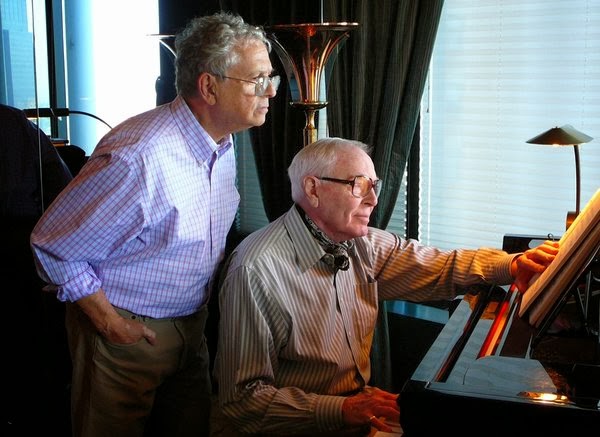
Long-time partners Allen Klein (left) and Bliss Hebert were married on October 15, 2013, at the ages of 73 and 82, respectively. The couple resides in Miami.

Opera scenery/costume designer Klein and opera stage director Hebert have worked together since 1962. They have collaborated on more than 100 productions since they met while working at the Washington Opera in DC, where Hebert was General Manager from 1960-1964.

Allen Klein created productions for the Vienna State Opera, Deutsche Oper Berlin, La Fenice in Venice, the Scottish Opera, the Edinburgh Festival and the Glyndebourne Festival. Bliss Hebert, who earned a master’s degree in piano performance from Syracuse University, worked with Igor Stravinsky on three of his operas, including five productions of “The Rake’s Progress.” According to Rosalie Radomsky of the New York Times, Klein and Hebert encountered Stravinsky and his wife Vera, along with conductor Robert Craft, in front of Carnegie Hall after a screening of Disney’s film “Fantasia,” which included an excerpt from Stravinsky’s “Rite of Spring.”

“They greeted Bliss with great happiness and many kisses,” Allen Klein said, adding that, “Stravinsky was tiny and glowing with electricity.” Bliss then introduced Allen to Stravinsky. While Bliss was speaking with Robert Craft, Allen remained alone with Stravinsky. At one point, Stravinsky took Allen by the arm and asked, “Tell me, my dear, do you love our Bliss very much?”

“I recall being rather shocked by such a question,” Allen said. “Remember, this was 1964. I stuttered out, ‘Yes, I do,’ to which the composer responded, ‘Well then, my dear, you must take very good care of our Bliss.’ ”

Allen added, “ I’ve tried to do that ever since.”


Source:

Rosalie R. Radomsky, The New York Times

Thursday, February 18, 2016

Pierre Boulez

Mr. Boulez in 1971.
Photo by Larry Morris


When the great French composer, conductor and pianist Pierre Boulez (1925-2016) died at the age of 90 at his home in Baden Baden last month, there was much Internet chatter about his sexual orientation. Obituaries in major newspapers and journals mentioned that Boulez was “tightly guarded” about his personal life, but music critic Norman Lebrecht, who knew him for decades, stated that Mr. Boulez was gay. Boulez was extremely closeted, often introducing Hans Messner, his German lover of more than fifty years, as his “valet.” That Boulez (the “z” is not silent) was homosexual was one of the music world’s worst kept secrets.

Mr. Boulez enjoyed a first tier international career, holding conducting positions in France, Germany, Austria, Switzerland, England and the United States, and his numerous recordings earned him twenty-six Grammy Awards. Boulez did not use a baton, using only his hands to conduct, in the fashion of Dimitri Mitropoulos, Leopold Stokowski and fellow Frenchman  Georges Prêtre.

As an opera conductor, Pierre Boulez was most famously associated with Bayreuth, conducting Parsifal and the Ring Cycle. In Paris he founded the Institut de Recherche et Coordination Acoustique/Musique (IRCAM) at the Centre Pompidou and the Ensemble Intercontemporain (EIC). In the United States he was conductor of the Cleveland Orchestra, Chicago Symphony and the New York Philharmonic and was composer-in-residence at Carnegie Hall (1999-2003).

As a composer, he was a champion of the avant-garde, writing atonal, electronic and serial music, although in later years composition took a back seat to conducting. He championed twentieth century composers, programming major works by Berg, Mahler, Debussy, Schoenberg, Stravinsky, Bartok, Webern and Varèse.

After a 2012 eye operation left him with impaired vision, he cancelled conducting engagements, and a shoulder injury from a fall kept him from attending the many 90th birthday celebrations held throughout the world in 2015. Both Columbia Records and Deutsche Grammophon issued limited edition box sets (67 CDs and 44 CDs, respectively) of his recordings in honor of his 90th birthday. Last month BBC Four broadcast an hour-long documentary, “Pierre Boulez at the BBC: Master and Maverick.”

Friday, January 17, 2014

Charles Wuorinen

Annie Proulx, the author of the short story “Brokeback Mountain,” wrote the libretto for the opera of the same title that has been set to music by Pulitzer Prize winning American serialist composer Charles Wuorinen (photo at right). Wuorinen is a New York City based gay classical composer who is married to his manager, Howard Stokar.

The opera version of "Brokeback Mountain," completed in 2012, was originally commissioned by the New York City Opera and Gerard Mortier, but the project was postponed when General Manager Mortier resigned. When he became head of the Teatro Real (Madrid, Spain), Mortier decided to take up the work again and present it there.  

Canadian bass/baritone Daniel Okulitch has the role of Ennis del Mar, and American tenor Tom Randle is cast as Jack Twist. The opera premieres at the Teatro Real (Madrid) on January 28 and runs through February 11.

Proulx’s short story “Brokeback Mountain" was originally published in The New Yorker on October 13, 1997, and was made into an Academy Award winning film in 2005 with Jake Gyllenhaal as Jack and Heath Ledger as Ennis in the lead roles. The story, set in Wyoming, reveals a complex romantic/sexual relationship between two cowboys, in which homophobia stands in the way of their being able to be partners. Ennis is a confused ranch hand who finds himself in a homosexual situation he did not foresee, nor can understand. He is reluctant to show affection towards Jack, and when Jack brings up suggestions about their living together, Ennis declines in a harsh way. Both men marry, but their heterosexual relationships falter. The men meet for infrequent fishing trips, which rekindle their frustrating sexual desires. Both the story and the film have become gay classics.

Baritone Daniel Okulitch, in The Fly (2008):


Tattooed tenor Tom Randle in Wozzeck:


To your blogger's way of thinking, choosing serialist composer Charles Wuorinen to write the score for this opera is appropriate, because the short story's style was powerfully emotional without being overly romanticized. I think that a 19th-century tonal musical setting would not do this story justice.

Wuorinen's catalog of more than 260 compositions emphasizes chamber music and solo instrumental and vocal works, but his most recent commissions tend toward large scale symphonic, operatic and choral compositions.

At age 16 Wuorinen was awarded the New York Philharmonic's Young Composer’s Award, and early in his career he was active as a singer, pianist and organist. In 1962 Wuorinen and fellow composer-performer Harvey Sollberger formed The Group for Contemporary Music, an ensemble that raised the standard of new music performance in New York City. He has taught at Columbia University and the Manhattan School of Music. The premiere of his opera "Brokeback Mountain" will likely garner world-wide attention.

Wednesday, November 6, 2013

Lee Hoiby

Composer Lee Hoiby (1926-2011) was best known for his operas and songs, although he originally sought a career as a concert pianist. After studying composition with Gian Carlo Menotti he made a career change, going on to make a significant contribution to American music. His vocal repertoire is favored by singers everywhere, especially his art songs, which are championed by such luminaries as Leontyne Price and Frederica von Stade. Many of the texts were selected by his partner, Mark Shulgasser.

Hoiby’s musical style and language were old fashioned. Critics wrote that much of his music could have been written a hundred years previously. When he encountered atonal music for the first time, Hoiby reacted with revulsion. “If music doesn’t have melody and harmony and rhythm as I understand it,” he said, “I’m not interested. A lot of that stuff sounds like wallpaper to me.”

For the most part Hoiby eschewed dissonance and rejected compositional “fads” such a serialism, minimalism and eclecticism. Over a span of sixty plus years of composing music, his style remained consistent and has now come full circle, in that today’s young composers are writing music that is in step with Hoiby’s lifetime output. 

Hoiby wrote only to please himself. He was not part of the musical establishment, instead keeping his distance. In a 2010 profile by Zachary Woolfe, Hoiby stated, “All I did was compose. I never went anywhere, I didn’t know anybody. I never went to any parties. I never met anybody. I’m basically not interested in social life, I guess.”

While composing his best known opera Summer and Smoke (1971), a musical setting of the play by Tennessee Williams, Hoiby had a breakdown that led him to a search for spiritual fulfillment. He joined a New Age group that was also attended by his future partner Mark Shulgasser, a writer and astrologist. “He’s the Jewish intellectual I’ve always wanted,” Mr. Hoiby said.

To mark its tenth anniversary in 2006, Minnesota-based male chorus Cantus commissioned Hoiby to set to music a letter written by Pfc. Jesse Givens, who was killed in Iraq in 2003. Addressed to his pregnant wife, unborn son and six-year-old stepson, it was to be opened only in the event of his death. The closing lines are "Go outside and look at the stars and count them. Don't forget to smile."

Last Letter Home performed by the Cornell University Glee Club:


Hoiby photographed with CANTUS male chorus performers at the premiere of Last Letter Home.


Hoiby died on April 8, 2011, at the age of eighty-five, and he was actively composing at the time of his death. He was survived by Mr. Shulgasser, who shared a home with Hoiby in a remote location in the Catskills.

Monday, July 15, 2013

Ed Lyon

English tenor Ed Lyon is an out gay man who, at the drop of a hat, poses without his shirt on, much to his fans’ delight. The 34-year-old singer, one of Britain’s leading young tenors, is extremely easy on the eyes, and his body shows evidence of all the time he spends in the gym while following a strict, healthy diet. Lucky us.

He is also outspoken about where he thinks opera needs to go. He recently told Time Out magazine, "Telly and cinema have made a big impact on the way we view other forms. The idea that opera is just fat people getting up to sing is a complete fallacy. The days of ‘park and bark’ are over – we don't just waddle up and sing from where we're standing, we also have to act convincingly."

Lyon did not at first pursue a career in opera. “I did a lot of acting at school, and I found out that I could sing. I was in choirs. I was an alto until I was 18, then I started singing tenor. Opera was an obvious solution to wanting to be an actor but also having a singing voice.”

He has always been completely open about his homosexuality. “Let's be honest,” he said. “Opera isn't known as the most homophobic of industries.”

Lyon got his first big break when baroque specialist William Christie cast him in Handel's opera “Hercules”, and he has had an extraordinary career so far. Among the many highlights, he cites “Pygmalion” with The Trisha Brown Dance Company, Freddy in “My Fair Lady” and singing at La Scala in Milan.


His piercing blue eyes and stubbly beard push all the right buttons. Click the “photos” link on his official web site, and you’ll see that he’s partial to bare skin.
Go on. You know you want to:
http://www.edlyon.info/Tenor_Ed_Lyons_Website/Welcome.html

Now have a look at our tenor in action. Here he sings an early opera (Monteverdi) clad in only a sleeveless tunic. Note that the audio and video are slightly out of sync. For you impatient types, Mr. Lyon starts singing at the 2:05 timing mark.


His Twitter page identifies himself as:
“Tenor, undercover Yorkshireman, architecture and gym bore. Proud to be in #teamgay - bf of the wonderful Harry McIver.”
https://twitter.com/ed_lyon

Saturday, June 15, 2013

Emile Griffith

Champion” is a jazz opera about bisexual boxer Emile Griffith, an immigrant from St. Thomas (Virgin Islands), who landed 17 punches in seven seconds on Cuban boxer Benny "The Kid" Paret in 1962, resulting in not only a knockout, but also a coma from which Paret never recovered. He died ten days later. The match, held at NYC’s Madison Square Garden, was televised nationally by the ABC network. Before the fight Paret had taunted Griffith with gay slurs, calling him a “maricón” (faggot) at the weigh-in.

The world premiere of this opera takes place tonight at the Opera Theatre of Saint Louis, and five more performances will be offered through Sunday, June 30. Arthur Woodley plays the older Emile Griffith, while Aubrey Allicock (photo at top of this post and below) will portray the younger Griffith. Famed mezzo-soprano Denyce Graves is cast as Emelda Griffith, Emile’s mother. Direction is by James Robinson. The opera presents different episodes of Griffith’s life, each separated by the bell sounding a new round.

Baritone Aubrey Allicock (b. 1983), portrays Emile Griffith.

With music by jazz trumpeter, bandleader and composer Terence Blanchard (b. 1962, the very year of this fateful boxing match) and libretto by Pulitzer Prize-winning playwright Michael Cristofer, “Champion” is inspired by the true event of Griffith’s meeting with the son of Benny Paret forty years later. Paret’s son was two years old at the time of his father’s death. Flooded by memories of his career, his checkered personal life, and a later attack that exposed his homosexual activity*, the character of Emile explores his finding himself in the face of his greatest tragedy. Paret’s son is expected to attend the premiere performance, but Griffith himself, now 75 years old, is not well enough to attend.

*In 1992 Griffith was viciously beaten by a gang upon exiting a gay bar in NYC’s Port Authority Bus Terminal vicinity. He was hospitalized for four months as a result of his massive injuries. In a 2005 interview with Sports Illustrated magazine, Griffith discussed his struggle with his sexual attraction to both men and women. Ring of Fire: The Emile Griffith Story, a documentary about the life of Emile Griffith, was released in 2005.

"I kill a man," Griffith said, "and most people understand and forgive me. I love a man, and to so many people this is an unforgivable sin." Later in his life, Griffith began to suffer from dementia, and today he lives in a New York nursing home, requiring full-time medical attention.

"My father loved opera," says jazz composer Terence Blanchard, a five-time Grammy winner. "He was a baritone who studied opera, so it was impossible not to feel an emotional connection to him in writing Champion. I was drawn to tell Emile's story through music from the moment I first heard of his incredible journey. I knew there was no other way to tell this story but through the unique power of opera." Blanchard took on the project to honor his father, who was unable to realize his dream of becoming an opera singer in an era when opera companies did not hire black male singers.

Said librettist Cristofer, "Champion is the story of a man struggling to make peace with himself and to find his place in the world as a fighter and a gay man. It's the story of courage in the face of sexual oppression, of love in the face of hate, of grace in the face of physical and mental decline. For me, Emile's story not only asks the question of what it means to be a man. It asks what it means to be a human being."

Victor Ryan Robertson as Benny “The Kid” Paret (boxing gloves, left background), Aubrey Allicock as boxer Emile Griffith (center) and Denyce Graves as his mother Emelda (right).


Wednesday, February 29, 2012

Paulo Szot


Opera singer Paulo Szot (b. 1969) made his Broadway debut as Emile de Becque in the recent Lincoln Center Theatre revival of the Rodgers and Hammerstein classic musical South Pacific (see photo below). He earned a Tony award for Best Actor in a Musical for his performance, and his name came to the forefront of operatic and Broadway baritones as a result of that career-changing role, which he played from April 2008 through August, 2010. Since that time he made his debut at the Metropolitan Opera and returns there next month to perform in Massenet’s Manon.

The baritone’s background is Polish-Brazilian. Both his parents were born in Poland, and that’s how he landed a last name beginning with “SZ” (by the way his name is pronounced "shawt") They emigrating to Brazil during WW II, so Portuguese was his first language. He lived in Poland for many years after he turned 18, so he considers himself both Polish and Brazilian. Szot studied voice at the Jagiellonian University in Kraków, Poland, and began a singing career in 1990.

Szot originally trained to be a ballet dancer, but was never on stage professionally, because he injured his knee while training and had to quit, thus opening the door to a career in music. In his early years he had learned to play piano and violin. Fast forward to 2010, and the world was delivered of an opera-turned-Broadway singer who seems the physical reincarnation of Errol Flynn, down to the pencil moustache.

Szot is openly gay, but came out in a quiet fashion. His sexual orientation was simply added to his Internet biography after an inquiry was made of his management. Szot has been in a long-term relationship, but does not mention his partner’s name. He simply states that his lover is “in the business,” and that he is not from the United States. Szot shares a house he built on the edge of the Brazilian rainforest with his partner and 4 Weimaraners. When he's on the road (which is most of the time), he talks with his dogs via Skype.


This Nearly Was Mine (South Pacific)

Of his performance in South Pacific, Ben Brantley of the New York Times said the following: "When he delivers 'Some Enchanted Evening' or 'This Nearly Was Mine,' it's not as a swoon-making blockbuster (though of course it is!), but as a measured and honest consideration of love."


The Nose (Shostakovich)

Paulo Szot made his Metropolitan Opera debut in the 2010 production of The Nose, the first ever staging of this opera by the Met. The unlikely crowd-pleaser, based on a story by Nikolai Gogol, is a fantasy about a Russian bureaucrat who wakes up to find his nose missing. When he finally tracks down the runaway facial feature, it's become a high-ranking official and celebrity. I’m not making this up.

Dmitri Shostakovich was only 22 when he wrote the angular, dissonant, percussion heavy score, but when the opera was first produced in Leningrad in 1930, the satiric tone ran afoul of Stalin's repressive government, and it was banned in the Soviet Union until 1974.

In an interview Szot related, “I was extremely nervous my first time on the stage, because it’s the Metropolitan Opera. As a first-time ever Brazilian male singer there, I had my whole country on my back, representing a new generation, so it was a heavy thing for me.”


In 2011 Szot returned to the Met to sing Escamillo (Carmen), and next month (March 26) he returns to the Metropolitan Opera in the role of Lescaut in Jules Massenet's Manon. It is interesting that David Pittsinger, who alternated the role of Emile de Becque with Szot in Lincoln Center’s South Pacific (so that Szot could fulfill previously secured opera commitments), will also be in the cast of Manon at the Met. I was fortunate to see South Pacific with both Szot in New York and Pittsinger (a gracious, talented straight man) at the Kennedy Center in Washington, DC, in the national touring company of the musical.

When the show’s run was extended on Broadway, Szot had to cancel performances in three opera productions in Brazil. He was amazed that he was cast in South Pacific in the first place, which came about when he answered a casting call from Lincoln Center. They were looking for an opera singer, and Szot was in the U.S. performing a Mozart opera in Boston at the time.

“First of all, I didn't think they would give me the role. I was just doing one of the many auditions I do whenever I am in town. I didn't think it would be very probable to hire a Brazilian man to do a French role in the United States on Broadway, you know?”

Szot photographed holding his Tony award next to presenter Liza Minelli (at left).

There are parallels to Ezio Pinza’s creating the role of Emile de Becque in 1949, when South Pacific first opened on Broadway. Pinza was also an opera star who crossed over to Broadway, but Pinza had retired from the Metropolitan Opera a year earlier. Szot has done the reverse – retiring from a Broadway production to make his debut at the Met. We can hope that Szot continues simultaneous careers on Broadway and in the world’s great opera houses.

Sunday, January 22, 2012

Heldentenor Lauritz Melchior

Lauritz Melchior (1890-1973) was born in Denmark, where he studied voice at the Copenhagen Royal Opera School. His professional singing career began as a baritone in 1913, but by 1918 he had become a Heldentenor (heroic tenor) – a penetrating, powerful type of tenor voice ideally suited to the operas of Richard Wagner, which require stamina and the ability to soar above a large orchestra for hours and hours (and hours). His “second” debut was in 1918 in the title tenor role of Tannhäuser, also at the Royal Opera in Copenhagen. However, Melchior’s career was cemented by his hundreds of Wagner performances at the Metropolitan Opera (NYC) between 1926 and 1950.

On a trip to England in 1920 he met wealthy author Hugh Walpole, who became his patron. Walpole, whose pet name for Lauritz was "David," was a popular novelist and enthusiastic Wagnerite. He provided Melchior with financial aid, enabling him to audition successfully in 1923 for Siegfried Wagner (Richard Wagner’s son and Franz Liszt’s grandson) and his mother Cosima, Richard Wagner’s widow. They were planning the reopening of the Wagner Festival in Bayreuth, which had been silenced for ten years by World War I. Cosima herself coached Melchior in staging and acting, providing Lauritz with a direct link to the composer’s intentions. He made his Bayreuth début in 1924 as Parsifal and continued to take leading roles at Bayreuth. The legendary 1930 Tristan und Isolde performances at Bayreuth under Arturo Toscanini led to Toscanini’s high praise, dubbing him "Tristanissimo."

Melchior and Walpole became involved in a six year relationship that lasted until Walpole met Harold Cheevers, a married former policeman, in 1926 (Cheevers and Walpole remained partners until Walpole’s death in 1941). Walpole's diary entries spell out jealousy over those who vied for Melchior's attentions. When the relationship with Walpole waned, Melchior took up with a merchant seaman, Emil Opffer, a man he shared with his friend, the American poet Hart Crane. Melchoir married twice, but his homosexual liaisons were well documented.

Although Melchior began singing Wagnerian roles at the Metropolitan opera in 1926, his breakthrough came when he performed there in Tristan und Isolde in 1929. Over a 24-year period Melchior sang 519 performances of Wagnerian roles at the Met, and most critics still regard him as the quintessence of the Heldentenor voice. At six-feet four-inches and 225 pounds (on a lean day), he earned the sobriquet, “Mammoth Melchior, the Great Dane of the Met.”

Melchior performed frequently at other venues, including Covent Garden (London), the Teatro Colón (Buenos Aires), and with the Chicago and San Francisco opera companies. His voice was enduring, showing little evidence of deterioration when he sang the first act of Die Walküre on Danish radio on the occasion of his 70th birthday. One critic, Washington DC based Paul Hume, wrote of Melchior, "not the world's greatest Wagner tenor – the only one!"

While on a world tour in the late 1940s, Melchior visited his native Denmark as a guest of King Frederic, who was an amateur conductor with his own personal concert hall in his palace.

Shortly before World War II, he immigrated to the United States with his German-born wife, settling in California, where he appeared in five movie musicals between 1944 and 1952, mostly in somewhat cheesy roles. He was a frequent performer on radio and television, even singing the national anthem at the opening of ball games. In 1947 his hand and footprints were immortalized in cement in front of Grauman's Chinese Theater in Hollywood.

Although not well remembered by young audiences today, he was the most famous Wagnerian tenor of his era. Historic recordings testify to his greatness as a Heldentenor.

Melchior died in Santa Monica, California, in 1973. Although he had been an American citizen since 1947, his body was returned to Copenhagen to be buried in the city of his birth.

Those who are fans of Wagner’s operas need no introduction to Melchior’s voice, but this film clip is from the film Luxury Liner (1948), in which he sings “Come Back to Sorrento” to Jane Powell. Xavier Cugat (!) is conducting.


Dispute of operatic proportions:
Melchior’s son, Ib Jørgen Melchior (b. 1917), a decorated WW II hero, author and film producer, screenwriter and director, wrote Lauritz Melchior: The Golden Years of Bayreuth, a biography of his father. Ib Melchior, living today in Los Angeles at age 94, has also worked tirelessly to broker the return of his father’s hunting estate in Chossewitz, Germany (five miles from the border with Poland), which was confiscated in 1943 by East Germany and as yet never returned.


Lauritz, who willed Seeschloss Chossewitz solely to his son Ib, had spent idyllic summers there beginning in 1932. The family had rented the property from 1932, eventually purchasing the house and 300 acres in 1938. The lakefront estate was recently offered for sale for €800,000, with no mention of its previous owner. The East German government had used the estate as a convalescent home (Erholungsheim) for national railroad workers, and it later served as an inn run by Norbert Krause, who leased the dilapidated property from the German government. He displayed Lauritz Melchior memorabilia and hung photos and paintings of the tenor in theatrical costumes, promoting the inn as a place where guests could spend a night in the great performer's old bedroom. The manor house was subsequently renovated in 2007 (shown below), prior to being offered for sale. Unfortunately, I have been unable to learn of its recent fate. I can't get the notion out of my mind that it would make a wonderful museum to Melchior, if the right organization/people would step forward. No law against wishful thinking.