Role models of greatness.

Here you will discover the back stories of kings, titans of industry, stellar athletes, giants of the entertainment field, scientists, politicians, artists and heroes – all of them gay or bisexual men. If their lives can serve as role models to young men who have been bullied or taught to think less of themselves for their sexual orientation, all the better. The sexual orientation of those featured here did not stand in the way of their achievements.
Showing posts with label Conductor. Show all posts

Thursday, March 21, 2024

Yannick Nézet-Séguin

(Updated since the original 2021 post) 

A native of Montreal, Canada, Yannick Nézet-Séguin (Yah-NEEK neh-ZAY Say-GAN, b. 1975, 48 years old) was the conducting coach for Bradley Cooper, who portrayed Leonard Bernstein in the 2023 movie MAESTRO. Yannick also recorded the movie's soundtrack. Your blogger is stunned that he could find the time, since he teaches conducting at the Curtis Institute and leads three orchestras and a world-famous opera company. His is a superstar conductor on the level of Gustavo Dudamel (also in his forties).

Here's a rundown. He was first named Music Director of The Philadelphia Orchestra in 2012, and subsequent contract extensions assure this position through the 2029-30 season. This makes him the first openly gay conductor of one of the "big five" orchestras in the United States, and on very sure footing indeed. 

In 2016 the Metropolitan Opera (NYC) announced that Nézet-Séguin would assume the title of Music Director beginning with the 2020-21 season, but following the termination of James Levine for sexual misconduct, he took the title two years early, beginning with the 2018-19 season.

Since 2000 Mr. Nézet-Séguin has also been Artistic Director and Principal Conductor of the Orchestre Métropolitain (Montreal), with whom he holds a lifetime contract.

He is a regular guest conductor of the Chamber Orchestra of Europe. He will appear this July with the COE as pianist and conductor in Baden-Baden, Germany. As well, he was  Music Director of the Rotterdam Philharmonic Orchestra from 2008-2018; today he holds the title of Ehredirigent (honorary conductor) of that organization (RPO).

 
Mr. Nézet-Séguin’s partner of two decades, Pierre Tourville (shown in sunglasses behind Yannick), is the assistant principal violist of the Orchestre Métropolitain (Montreal), and they appear everywhere together. When the conductor was fêted by the city of Philadelphia some years ago, Pierre Tourville was also introduced at every stop – amazing, considering the tortured history of gay conductors. After all, Leonard Bernstein (gay) had married a woman at the advice of famed conductor Dmitri Mitropoulos, and both those men led closeted lives.

In a New York Times profile by Daniel Wakin, it was reported that “Nézet-Séguin is what the orchestra world is desperate for: a young, charismatic maestro who can win the respect, even affection, of grizzled orchestra veterans, the enthusiasm of audiences and the praise of critics, which has for him been pretty exalted.”

The 48-year-old conductor’s relative youth is reflected in his flouting of certain traditions – he frequently leads from the podium in a business suit and tie (Carnegie Hall), and he’s partial to tight V-neck sweaters and skinny jeans. Many times he conducts without a baton, in the style of Mitropoulos. While on vacation in Tahiti he acquired a turtle tattoo on his right shoulder, and his compact five-foot-five frame bursts with energy.


Again from Mr. Wakin’s NYT profile: “He seemed stunned by the ovation” (conducting the Philadelphia Orchestra in Verdi’s Requiem at Carnegie Hall). “Applause from his inner circle greeted him in the crowded dressing room. Attendants broke open bottles of sparkling wine. Mr. Nézet-Séguin embraced his companion, Mr. Tourville, looked him in the eyes and said, ‘Oui?’

‘Oui,’ Mr. Tourville answered. With an air of coronation, orchestra and Carnegie Hall executives toasted Mr. Nézet-Séguin. “

The conductor’s honors include a prestigious Royal Philharmonic Society Award, Canada’s highly coveted National Arts Centre Award and the Prix Denise-Pelletier, the highest distinction for the arts in Quebec, awarded by the Quebec government.  In 2011, he received an honorary doctorate from the University of Quebec in Montreal and was appointed a Companion of the Order of Canada in 2012.

Even as he ages, Mr. Nézet-Séguin has not outgrown his overtly gay traits. He bleaches his hair blond, paints his nails, wears necklaces and bracelets and has pierced ears. Not to mention his shoulder tattoo. He listens to the music of Bad Bunny (an ally and of self-professed "fluid" sexuality) when he works out, and enjoys a penchant for jazz. Your blogger was pleased to learn that his favorite singer of all time was Sarah Vaughan, as is mine (when she died in 1990, my answering machine was full of condolences from sympathetic friends and colleagues).

Oh. Need I mention that orchestras and critics wax rhapsodic?

Official web site: https://yannicknezetseguin.com/en/

A recent photo by Mark Sommerfeld:


Monday, January 8, 2024

Leonard Bernstein

*UPDATED January 7, 2024 to include mention of the 2023 bio-film MAESTRO.


a gay man who dabbled in the straight world


Bernstein photographed in 1988 at home in Connecticut.


Leonard Bernstein* (1918-1990) was a celebrity American conductor and composer. As principal conductor and music director of the New York Philharmonic, he was without peer, so much so that the orchestra had a difficult time recovering when he departed the podium. He composed music for the concert hall, cinema and the theater, making him the most celebrated American composer since George Gershwin.

*He pronounced his surname BURN-stine, not BURN-steen.

Photo:
In the green room at Carnegie Hall 1951, with sister Shirley.

His personal life, however, was one of deception. Bernstein’s homosexual proclivities were undisputed and well documented. Because he married and had children, many people assume he was bisexual. But Arthur Laurents, who collaborated with Bernstein on West Side Story, related that Bernstein was simply "a gay man who got married. He wasn't conflicted about his sexual orientation at all. He was just gay." Leonard Bernstein, Jerome Robbins, Arthur Laurents and Stephen Sondheim were the four gay Jewish men, all working at the very top of their craft, who created West Side Story, one of the most enduring musicals of the 20th century. Like many gay men of his generation, Bernstein appeared to be a devoted husband and father in public while carrying on a promiscuous homosexual life behind the scenes.

While still a student at Harvard, Bernstein had an affair with his mentor, famed conductor Dimitri Mitropoulos, and after a sexual dalliance he became close to gay composer Aaron Copland. Many say that Bernstein chose to marry to dispel rumors about his homosexual activity, which would have made it difficult to secure a major conducting appointment, given the conservative nature of orchestra boards. Bernstein had an on-again, off-again relationship with his future wife Felicia, a Chilean actress, but Bernstein broke off their engagement, telling Felicia that he was homosexual. In spite of this, she continued to pursue him. Their arrangement was such that, so long as he did not embarrass her publicly, he was free to pursue his homosexual affairs.

Photo:
With wife Felicia and children 1956.

A major event in Bernstein's personal life was his decision that he could no longer repress his homosexuality; he left his wife in 1976 to live with  Tom Cothran, his male lover at the time. Bernstein was going to Paris to spend half a year with Cothran, whom Felicia detested. At the Carnegie Hall holiday concert of Peter and the Wolf that year, Lenny conducted and Felicia narrated. The two had been booked long in advance of their personal turmoil, but there was no question of the Bernsteins not fulfilling their obligation. When Bernstein took the podium, the audience went wild. At the end of the concert, an assistant brought a hundred red roses to him. Lenny walked across the stage to hand the roses to Felicia,  but as he did so, she pivoted on her heel and stormed offstage. The giant bouquet fell to the floor with a thwump, and the audience gasped. Afterward, Bernstein was disconsolate, but went through with his plan to join Cothran in Paris. The next year Felicia was diagnosed with lung cancer, and Bernstein moved back in to care for her until she died in 1978 (Bernstein himself was to die of progressive lung failure). Most biographies of Bernstein relate that his lifestyle became more excessive and his homosexual activities cruder and less discrete after her death. Cothran died of AIDS in 1981.

Just three years before his marriage, Bernstein visited Israel (1948) and had an affair with Azariah Rapoport, a stunning young Israeli soldier who was his guide. Bernstein was madly in love: "I can't quite believe that I should have found all the things I've wanted rolled into one. It's a hell of an experience – nerve-racking and guts-tearing and wonderful. It's changed everything."

*In late 2023 Netflix released MAESTRO, a biographical film starring Bradley Cooper (with a prosthetic nose) as Bernstein. The screenplay focused on Bernstein's relationship with his wife Felicia and the impact his dalliances with men (often his younger students), alcohol and drug abuse had on their marriage. Cooper directed the film and co-wrote the screenplay.

Professionally, however, Bernstein felt that his homosexuality was a curse. He underwent psycho-analysis with Hungarian-born Dr. Sandor Rado, whose specialty was "curing" homosexual men of their "inversion". Bernstein felt marriage could “save” him from a homosexual life style. (A personal comment here: homosexuality is not a life style. “Preppy” is a life style; homosexuality is a sexual orientation)

A friend of the Bernsteins who was visiting their home recalled finding Bernstein in a hallway making out with a beautiful twenty-year old boy while his wife was sitting by herself in the living room. His wife also suffered the humiliation of receiving phone calls and discovering love letters from her husband's many boyfriends. Shortly after 1973, when Bernstein met the young Tom Cothran (musical director of Radio KKHI-FM in Denver), he became so infatuated with the boy that he allowed his wife to catch them in bed together.

Photo:
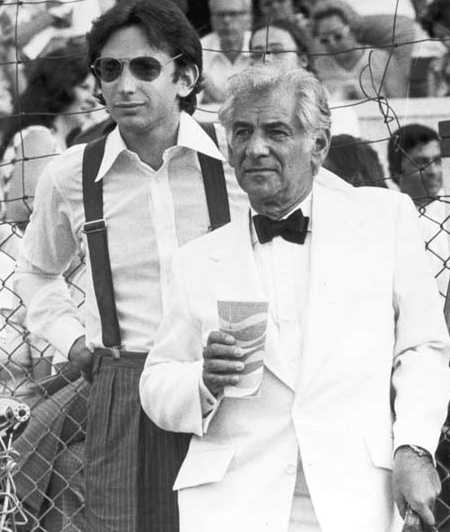
With young gay conductor 
Michael Tilson Thomas 1974

After his wife died Bernstein abandoned all caution. By this time addicted to alcohol and drugs, he became open and crude about his homosexual activity. Pianist William Huckaby, after performing at a White House recital, was talking with President Carter when he "felt these hands clamped on my shoulders.” He was whirled around and forced into a deep French kiss right in front of the President, who walked away in astonishment and embarrassment. During his sixties and seventies, Bernstein surrounded himself with an entourage of beautiful boys, each one as intoxicated and obnoxious as his patron.

Many who knew him suggest that Bernstein became frustrated and cantankerous in his later years because he had never able to match the brilliance and popularity of West Side Story (1957), composed when he was in his late thirties. He was forever chasing and trying (unsuccessfully) to live up to his own fame. He also became increasingly intolerant of being called "Lenny" by those outside his inner circle and forever corrected those who pronounced his last name Burn-steen; he pronounced his name closer to the German way, BURN-stine. Bernstein means "amber" in German. In truth, Bernstein had changed his first name to Leonard when he was fifteen years old; he had been born Louis Bernstein.

After Felicia's death, Bernstein dealt with much guilt over how his homosexual activity adversely affected her. Some of this guilt and conflict was expressed in his 1983 opera, A Quiet Place, which tackled issues close to Bernstein’s life. Its story is one of suffering the loss of a loved one and a father’s acceptance of a gay son.

Bernstein's obituary in the New York Times (1990) made clear mention of his homosexuality. Since then many fans still visit his grave at Green-Wood Cemetery in Brooklyn, New York.

Photo: Bernstein at the piano in 1944 at age 26.


Most of the information in this post comes from Meryle Secrest’s “Leonard Bernstein: A Life” and Charles Kaiser's “The Gay Metropolis.”

Note: Bisexuality is a thorny label. Do we call Bernstein bisexual because he married and fathered three children? The recently deceased Arthur Laurents did not think we should. He said Bernstein was a "gay man who married." I go about it this way. If a person has sexual relations regularly with both men and women, then I call that person bisexual. Bernstein's sexual relations before, during and after his marriage were overwhelmingly homosexual, so I agree with Laurents' assessment. The same with actor Anthony Perkins, who did not have a sexual experience with a female until he was 39 years old (he was so closeted and paranoid prior to that time that he insisted on parking blocks away from the homes of his male lovers and arrived at events and restaurants well before or after his boyfriends). Those who knew Perkins said that he'd let nothing stand in the way of his career, and getting married served his career goals. Once he sampled married life, he was so relieved that the gay rumors and suspicions no longer haunted him that he at last settled into a zone comfortable for him. If the gay rumors about George Gershwin proved true, I'd label him bisexual, because he was known to have regular sexual relations with women. Pete Townshend? I call him bisexual, too. Bernstein? Not so much.

And to those many responses in the comments section (below) who tell me that it is not my business to mention Bernstein's sexuality, I draw your attention to the first paragraph at the top of this blog, which I created to give encouragement to young men who were bullied, discriminated against, and/or shunned by their teachers or parents. You can succeed in realizing your life goals -- and it really does get better with age. May you be inspired by the life stories of the men feature here.


Monday, November 21, 2022

Charles-Camille Saint-Saëns: 1835-1921

NOTE: Your blogger recently performed an organ work by Saint-Saëns, so this post has been expanded and updated.

When his father died when he was only three months old, Charles-Camille Saint-Saëns was raised by his mother in Paris and continued to live with her until her death. He became one of the world’s most famous composers in his day, and he was a homosexual possessed of a complicated private life, which often revealed his dark side.

Saint-Saëns was a child prodigy (on the level of Mozart), and made his debut as a concert pianist in 1846, before his eleventh birthday. As an encore, Saint-Saëns offered to play any of Beethoven's 32 piano sonatas from memory. Word of this incredible experience spread across Europe and as far as the United States, where it was mentioned in an article in a Boston newspaper. Having all 32 of Beethoven’s sonatas in ones fingers, ready for concert performance, was an unheard-of feat (then as now), all the more astonishing when offered by a ten year old.

By the age of 13, Saint-Saëns was attending the Paris Conservatory. He soon gained recognition among his peers as an organ virtuoso, eventually attaining the highly coveted position of chief organist at the Madeleine Church in Paris, a post he held from 1858, at the age of 23, until he was 42 years old. His weekly organ improvisations captured the attention of all Paris. As a composer, he was highly versatile, writing operas, symphonies, concertos, much chamber music, masses and other choral works, songs and solo literature for organ and piano. His opera Samson et Dalila still ranks among the standard repertoire of opera houses all over the world. His music was wildly popular during his lifetime, and he was well-connected with other composers, particularly Hector Berlioz and Franz Liszt. Gabriel Fauré, who was Saint-Saëns's favorite pupil, soon became his closest friend.


His now popular Le Carnaval des animaux (The Carnival of the Animals, 1886), for two pianos and orchestra, was intended as a private entertainment for friends, and Saint-Saëns forbade its public performance during his lifetime. The part of the narrator, now frequently included during performance, was added by others after his death. It is a little-known fact that Saint-Saëns had the distinction of being the first noted composer to write a musical score for a motion picture, The Assassination of the Duke of Guise (L'assassinat du duc de Guise, 1908), featuring actors of the Comédie Française in Paris.

Once called a second Mozart, Saint-Saëns soon made many enemies, who were envious of his stellar success and disdainful of his biting sarcasm. Later in life he was declared to be a “composer of bad music well written.” In old age he came to be mocked for his rabid conservatism, his dislike of modern music, the campaigns he mounted against French composers Claude Debussy and Cesar Franck, his shocked disapproval of Stravinsky's Rite of Spring (allegedly infuriated over what he considered the misuse of the bassoon in the ballet's opening bars) and his insistence, during World War I, that all German music be suppressed. He was never shy with opinion.

Saint-Saëns was a true polymath. In addition to conquering the world of music as composer, conductor, critic, teacher and concert organist and pianist, he excelled in the fields of geology, archaeology, botany, mathematics and lepidoptery. He held discussions with Europe's finest scientists and wrote scholarly articles on acoustics, occult sciences, ancient theatre decoration, and early musical instruments.  Saint-Saëns wrote a philosophical work that spoke of science and art replacing religion, and his pessimistic and atheistic ideas foreshadowed Existentialism. Other literary achievements included poetry and a successful farcical play. He was also a member of the Astronomical Society of France, giving lectures on mirages; he had a telescope made to his own specifications and planned concerts to correspond to astronomical events, such as solar eclipses.


The private life of Camille Saint-Saëns was filled with turmoil. He was homosexual but realized how much marrying would bolster his reputation. Understandably, he showed little outward sign of wanting to marry. However in 1875, at the age of almost 40, he began an affair with nineteen year old Marie-Laure Truffot, which led to marriage. Immediately after their wedding, Saint-Saëns declared that he was too busy for a honeymoon and took Marie straight home to live with his mother. Thereafter the composer treated his wife with deep disdain, until the arrival of children brought out a more sympathetic side. But tragedy intervened when both children died within six weeks of each other in 1878. André, aged two, fell from a fourth floor window, and soon afterward his baby brother Jean became ill and died. Saint-Saëns blamed Marie for the children's deaths, and a short time later he walked out on her in the middle of a holiday trip. Though there was no divorce, Marie never saw him again.

Saint-Saëns was solitary and secretive, prone to disappearing for weeks at a time. He could also be a remarkable host, often entertaining friends lavishly at his Paris home, where his performances in drag were well-known among his circle, particularly his impersonation of Marguerite, the female soprano lead in Charles Gounod's opera Faust. He is reputed to have danced in ballerina tutus for the entertainment of fellow gay composer, Tchaikovsky.

After abandoning his wife, Saint-Saëns traveled extensively. He began spending winters in French-speaking Algeria, which became a favored holiday spot for European homosexuals who enjoyed the adolescent male companionship easily available there. He was quoted as saying, "I am not a homosexual, I am a pederast." Saint-Saëns died of pneumonia in Algiers, at the age of 86, on December 16, 1921.

Have a listen to his hugely popular orchestral work, Danse Macabre. I’m sure you’ll recognize it.


Trivia: Pianist Franz Liszt made an astonishing piano solo transcription of this piece.


Saturday, August 20, 2022

Siegfried Wagner's Homosexual Circle

Siegfried Wagner (1869-1930), son of the great German opera composer Richard Wagner (father and son in photo at right), displayed a feminine demeanor while growing up and was greatly attached to his mother. During his student days he often dressed up as a ballerina, and he had affairs with several of his fellow male students.

Siegfried, who was also the grandson of pianist/composer Franz Liszt, became part of a circle of high-profile closeted homosexual men, including English composer Clement Harris, tenor Max Lorenz, writer Oscar Wilde, illustrator Franz Stassen and Prince Philipp of Eulenburg. In 1892 Clement Harris and 23-year-old Siegfried set off on an around-the-world tour together, and the two fell deeply in love. Wagner kept a portrait of Harris on his desk for the rest of his life.

When journalist Maximilian Harden later accused Prince Philipp of Eulenburg and others close to Kaiser Wilhelm II of homosexuality (Harden-Eulenburg Affair), Siegfried either had to get married or be exposed for what he was. So it was that in 1915 at the age of 46, after strong prodding from his mother, Siegfried Wagner married an 18-year-old Englishwoman named Winifred Klindworth, with whom he had four children, thus providing heirs for the continuation of the Wagner dynasty. His sexual orientation, however, became the source of both scandal and concerted attempts to erase it from the history of the Wagner family.

Siegfried Wagner in his twenties (left).


When the Wagner dynasty’s papers were bequeathed to Bayreuth’s Richard Wagner Foundation in 1973, Winifred Wagner included Siegfried’s musical scores but withheld her husband's correspondence. This was consistent with the family’s notorious stalling and purging of any revelations that would taint the legacy of Richard Wagner.


In response to Harden’s insinuations about his sexual nature, Siegfried replied, “There was ugly gossip about Frederick the Great, too, the greatest king of all time – and he made Prussia great and strong! So don't worry. I won't defile the House of the Festival.” The irony in that statement is that all the rumors and gossip about Frederick the Great were true.


Siegfried did not give up social and sexual relations with homosexuals, however, and he and Franz Stassen (1869-1949), a gay artist who had served as the best man at Siegfried’s wedding, continued a social and artistic relationship that lasted for decades. Stassen (at left) was a noted Art Nouveau painter and illustrator who also married. Siegfried introduced Stassen to Wagnerian tenor Max Lorenz (1901-1975), much admired by Hitler, even though Lorenz was a gay man married to a Jewish woman. For a time Stassen and Lorenz were involved in an affair. When Hitler, who was a financial supporter of the Bayreuth Festival, could no longer publicly endorse Lorenz, it was Siegfried’s wife Winifred who used her influence to rescue Bayreuth’s star heldentenor from public disgrace, exile and possible imprisonment over a charge of homosexuality.

Most historians concede that Hitler and Winnifred (below) carried on an affair after Siegfried’s death in 1930; there were even rumors of a possible marriage. Although Winifred was proud of her association with Hitler, when he visited her at Bayreuth, she took pains to conceal the connection. Hitler would register at the Hotel Bube in nearby Bad Berneck, and Winnifred would send her own car to pick him up, so that Hitler's ostentatious Mercedes would not be seen pulling into the driveway at Wahnfried, the Wagner family's villa built for Richard Wagner by King Ludwig II of Bavaria.


Following in his father’s footsteps, Siegfried Wagner was also a composer, but his operas, although popular during his lifetime, never entered the standard repertoire. In 1896 Siegfried began conducting at the Bayreuth Festival and from 1906-1930 was the festival’s sole artistic director. In Siegfried’s controversial 1930 staging of his father’s opera Tannhäuser, he boldly embellished several scenes with scantily clad male teenagers. In the opening Venusberg bacchanal scene their costume consisted of ballet slippers and loincloths -- nothing else. Don't believe me? There is archival video on YouTube.

Siegfried dedicated one of his eighteen operas to Franz Stassen, who designed stunning illustrations for the programs for Wagnerian opera productions at Bayreuth (example at right). Franz also published homoerotic drawings and paintings and went on to become a major player in the Teutonic Art Nouveau style. During the last decade of his life Stassen wrote recollections about his male "soul mate", thus publicly hinting at his own homosexuality. An aside -- Stassen was adept at illustrating male posteriors, most often naked, in a fashion we would describe these days as "perfect bubble butts".


In the previous decade Stassen had also become associated with the Nazi Party. He created four important tapestries for Hitler's Reich Chancellery in Berlin that illustrated motifs of the Germanic Edda sagas. In gratitude, Hitler awarded him the title of professor in 1939.

After 1941 Franz lived openly with his male partner and professed his homosexual orientation, but the Third Reich generously overlooked and ignored this declaration. In the final phase of World War II, Hitler included Stassen in the Gottbegnadeten (Gifted by God) list of important artists most crucial to Nazi culture.


Wagnerian tenor Max Lorenz (right) was homosexual as well, but in 1932 he married Lotte Appel, a Jewish singer who was aware of his sexual orientation going into the marriage. Max’s homosexuality was tolerated by the Nazis as a well-known secret, because Lorenz was a favorite of Hitler. When Lorenz was dragged into court because of an affair with a young man, Hitler advised Winifred Wagner, the director of the Bayreuth Festival after Siegfried’s death in 1930, that Lorenz would not be suitable for the Festival. She replied that in that case she would have to close the Festival, because, “...without Lorenz, there can be no Bayreuth.” Lorenz was thus retained.

As for his Jewish wife Lotte, Max insisted on being open about his marriage of convenience, which was taken as a provocation by the Nazis. Once when Lorenz was away from his house, the SS burst in and tried to take Lotte and her mother away. At the last moment Lotte Lorenz was able to make a phone call to Hermann Göring’s sister, and the SS was ordered to leave their residence and not bother the women. Göring stated in a letter dated March 21, 1943, that Lorenz was under his personal protection, and that no action should be taken against him, his wife, or her mother.


Siegfried Wagner -- Violin Concerto in One Movement (1915):


Second Movement (1927) of Siegfried Wagner’s Symphony in C (in the earlier 1925 first version of the symphony, the slow movement was recycled from the prelude to Der Friedensengel, an opera written in 1914):

Saturday, December 7, 2019

Michael Tilson Thomas, American Conductor

UPDATE to the original post (9/7/2011):

MTT will be one of five recipients of a Kennedy Center Honors Award to be broadcast December 15, 2019 at 8pm on CBS.

Michael Tilson Thomas (b. 1944) is an American conductor, composer, and pianist – and a gay man. A California native, he has been music director of the San Francisco Symphony Orchestra since 1995, and beginning this evening he will lead the orchestra in the opening performances of the orchestra's 100th anniversary season.

Tilson Thomas is the first conductor to achieve prominence without concealing his homosexuality. For more than thirty years he has been partnered with Joshua Robison, who shares Tilson Thomas's  Edwardian house in San Francisco and a 1925 pink stucco palace in Miami. He has pushed audiences to rethink the relationship between classical music and homosexuality by celebrating gay composers and commissioning works that explore the experiences of gay men and lesbians.

After winning the 1968 Koussevitzky Prize at Tanglewood, Tilson Thomas became the youngest assistant conductor in the history of the Boston Symphony Orchestra, when he garnered great critical praise by conducting the second half of the symphony’s 1969 New York concert after its musical director became ill.

From that point on, Tilson Thomas steadily rose in the world of classical music, serving as conductor of a number of prestigious orchestras. In 1987 he founded the New World Symphony, an orchestra academy in Miami Beach, which moved into its permanent new home designed by Frank Gehry for an inaugural concert on January 26, 2011. The academy prepares gifted graduates of distinguished music programs for leadership positions in orchestras and ensembles around the world (www.nws.edu). Notably, four of them have been hired by the San Francisco Symphony. 

In 1988, Tilson Thomas became principal conductor of the London Symphony Orchestra, and in 1995 the music director of the San Francisco Symphony Orchestra. In June, 2000, he organized the American Mavericks music festival in San Francisco, highlighting the works of such gay composers as Lou Harrison, David Del Tredici and Meredith Monk.


In May 2001, Tilson Thomas conducted the premiere of Del Tredici’s “Gay Life,” a series of pieces he commissioned that explore the experiences of gay men in America, including the challenges that gay men have faced in their struggle to survive the AIDS epidemic. In addition, two of Tilson Thomas’ own compositions have added to the small but growing classical music repertoire focused on gay subjects. “Three Poems by Walt Whitman,” for baritone and orchestra, and “We Two Boys Together Clinging,” for baritone and piano, which use Whitman’s poetry to explore intimacy between men.

In February 25, 2010, President Obama presented Tilson Thomas with the National Medal of Arts, the nation’s highest award for artistic achievement.


Maestro Tilson Thomas narrates a history of the San Francisco Symphony. His commentary begins at the 1:36 mark in this video. Until I viewed this fascinating chronicle, I was unaware that the San Francisco Symphony was our nation's first professional orchestra to hire women to play instruments other than the harp.


Tilson Thomas embraced the YouTube genre in 2009 to help create the “YouTube Symphony Orchestra,” whose 96 members were selected from 30 countries based on more than 3,000 video auditions on YouTube. Here Tilson Thomas conducts gay composer Piotr Ilyich Tchaikovsky’s Finale from Symphony No. 4, leading the YouTube Symphony Orchestra on April 15, 2009 at Carnegie Hall.

Saturday, August 19, 2017

Dimitri Mitropoulos

Greek-born orchestra conductor Dimitri Mitropoulos (1896-1960) had a distinct style while on the podium – he didn’t use a baton, he conducted without a printed musical score in front of him, and he displayed an intense, vigorous physicality (later mimicked by Leonard Bernstein and Gustavo Dudamel – all three of them criticized for it).

Born into a deeply religious family, he trained to be a monk, but abandoned that plan when he learned that the church would not allow him to keep a musical instrument in his cell. His musical career rose to the very heights of his profession, most notably as principal conductor of the Minneapolis Symphony Orchestra for twelve years, followed by his appointment to the New York Philharmonic in 1950, a position regarded as the most prestigious in classical music in the United States. A talented pianist and composer in his youth, Mitropoulos championed difficult, complex newly-composed music, but it was during the time of his studies in Berlin that he redirected his focus from performing and composing to conducting.

But for all his international success and acclaim, he was victimized for his homosexuality.  During the time that Mitropoulos and Bernstein were having an affair in NYC, Mitropoulos advised the much-younger Bernstein to get married if he wanted to better his chances at leading a major symphony orchestra. Bernstein, a gay man, took his advice and married an actress – and went on to succeed Mitropoulos as conductor of the New York Philharmonic.

Photo below: Mitropoulos as both soloist and conductor with the Minneapolis Symphony.


At the height of his success as conductor of the New York Philharmonic, Mitropoulos became the subject of rumor and innuendo spawned by the open secret of his homosexuality, and he became a victim of McCarthy-era homophobia. He invariably dodged questions about his bachelor status by claiming "I married my art." Fear of being outed publicly forced Mitropoulos to sublimate his sexual desires, and he claimed that music making was a substitute for his “unlived sex life.”

Mitropoulos always lived modestly, even while being one of the highest paid conductors in the country; he gave away most of his money to assist struggling musicians and orchestras. He was sweet natured and kind, showing great professional respect for his orchestra members, but he was criticized for that, as well.

As support for Mitropoulos waned in NYC, the NY Philharmonic board looked for a replacement that would epitomize the masculine, heterosexual ideal. Ironically, they settled on Leonard Bernstein and named him co-conductor with Mitropoulos for the 1957-58 NY Philharmonic season. Bernstein took over as sole musical director in the fall of 1958. Although Mitropoulos bowed out gracefully, championing Bernstein’s talent, the loss of that job created a wound from which he never fully recovered. During the last years of his life Mitropoulos toured the world as guest conductor of major orchestras, but he succumbed to a third and fatal heart attack in late 1960 while rehearsing Mahler's Third Symphony with the La Scala Opera Orchestra in Milan. He was sixty-four years old.

Note: principal sources for this post are Linda Rapp and Geoffrey Bateman.

This video gives an up-close view of his “baton-less” conducting style – excerpts from a rehearsal and performance with the New York Philharmonic.

Third movement (Mephistopheles) of Franz Liszt’s A Faust Symphony:

Thursday, February 18, 2016

Pierre Boulez

Mr. Boulez in 1971.
Photo by Larry Morris


When the great French composer, conductor and pianist Pierre Boulez (1925-2016) died at the age of 90 at his home in Baden Baden last month, there was much Internet chatter about his sexual orientation. Obituaries in major newspapers and journals mentioned that Boulez was “tightly guarded” about his personal life, but music critic Norman Lebrecht, who knew him for decades, stated that Mr. Boulez was gay. Boulez was extremely closeted, often introducing Hans Messner, his German lover of more than fifty years, as his “valet.” That Boulez (the “z” is not silent) was homosexual was one of the music world’s worst kept secrets.

Mr. Boulez enjoyed a first tier international career, holding conducting positions in France, Germany, Austria, Switzerland, England and the United States, and his numerous recordings earned him twenty-six Grammy Awards. Boulez did not use a baton, using only his hands to conduct, in the fashion of Dimitri Mitropoulos, Leopold Stokowski and fellow Frenchman  Georges Prêtre.

As an opera conductor, Pierre Boulez was most famously associated with Bayreuth, conducting Parsifal and the Ring Cycle. In Paris he founded the Institut de Recherche et Coordination Acoustique/Musique (IRCAM) at the Centre Pompidou and the Ensemble Intercontemporain (EIC). In the United States he was conductor of the Cleveland Orchestra, Chicago Symphony and the New York Philharmonic and was composer-in-residence at Carnegie Hall (1999-2003).

As a composer, he was a champion of the avant-garde, writing atonal, electronic and serial music, although in later years composition took a back seat to conducting. He championed twentieth century composers, programming major works by Berg, Mahler, Debussy, Schoenberg, Stravinsky, Bartok, Webern and Varèse.

After a 2012 eye operation left him with impaired vision, he cancelled conducting engagements, and a shoulder injury from a fall kept him from attending the many 90th birthday celebrations held throughout the world in 2015. Both Columbia Records and Deutsche Grammophon issued limited edition box sets (67 CDs and 44 CDs, respectively) of his recordings in honor of his 90th birthday. Last month BBC Four broadcast an hour-long documentary, “Pierre Boulez at the BBC: Master and Maverick.”

Saturday, May 3, 2014

Thomas Adès

London-born composer, conductor and pianist Thomas Adès (b. 1971) is one of the “hot” classical musicians on the current international scene.  He is also an out and proud gay man who, in 2006, entered into a civil partnership with Tal Rosner, an Israeli filmmaker and video artist. The two have worked on many projects together, and their apartment in Covent Garden serves as their center of creativity.

Your blogger was lucky enough to attend the world premiere of Polaris, a multi-media work for orchestra and five video screens (music composed by Adès, moving images by Rosner), written for the opening of Miami’s New World Arts Center in January, 2011. The center, designed by superstar architect Frank Gehry, is home to the New World Symphony Orchestra, led by gay conductor Michael Tilson Thomas.

London-born Adès graduated in 1992 from King's College, Cambridge, where his degree was classified as 'double starred first', indicating outstanding academic distinction. Success piled upon success. He was made Britten Professor of Composition at the Royal Academy of Music and in 2004 was awarded an honorary doctorate from the University of Essex. By the age of 36
a retrospective of his work was presented in London, and he was the focus of festivals in France Finland.

Asyla, a work for orchestra, was premiered in 1997 by Simon Rattle and the City of Birmingham Symphony Orchestra and received the Grawemeyer Award for Music Composition. Adès was the youngest ever recipient of this award. Asyla has since been performed across the world, including a tour of the Far East by Rattle and the Berlin Philharmonic.

Adès composed a chamber opera, Powder Her Face (1995), which gained immediate notoriety for its musical depiction of fellatio. The Duchess character in the opera was based on the notorious Margaret Campbell, Duchess of Argyll, whose scandalous behavior in the 1960s was revealed during her divorce trial when photographs of her various sex acts were introduction into evidence.

This video clip is an excerpt from In Seven Days (2008), a creative collaboration between Adès and Rosner. The work depicts the biblical creation story via piano, video-installation and orchestra.