Role models of greatness.
Here you will discover the back stories of kings, titans of industry, stellar athletes, giants of the entertainment field, scientists, politicians, artists and heroes – all of them gay or bisexual men. If their lives can serve as role models to young men who have been bullied or taught to think less of themselves for their sexual orientation, all the better. The sexual orientation of those featured here did not stand in the way of their achievements.
Showing posts with label Paul Cadmus. Show all posts
Monday, April 16, 2012
George Tooker
The Waiting Room* (1959) – egg tempera on wood; 30" wide x 24" tall
Smithsonian Museum of American Art (4th Floor, Luce Foundation Ctr.)
8th and F Streets, N.W.
Washington, DC 202.633.7970
AmericanArtInfo@si.edu
This painting as described by the artist:
“The Waiting Room is a kind of purgatory – people just waiting – waiting to wait. It is not living. It is a matter of waiting – not being one’s self. Not enjoying life, not being happy, waiting, always waiting for something that might be better, which never comes. Why can’t they just enjoy the moment?”
Gay artist George Tooker (1920-2011) grew frustrated with bureaucracy while trying to obtain building permits to renovate a house in New York. In reaction, he painted several works that show “faceless” government workers and worn-down people getting nowhere. The clinical interior of The Waiting Room evokes the conformity of the 1950s and emphasizes the pale, drawn expressions on the figures. The people stand in numbered boxes, evoking ideas of standardization that force people into predefined categories. The sinister man on the left appears to be in charge of the “human sorting,” a mindless agent of bureaucratic scrutiny.
Your blogger lives in the Washington, DC, metropolitan area, so I have been able to view this painting numerous times. Although not a large piece, it always catches my eye, and I cannot pass by without stopping to admire its powerful message; it seems the very definition of purgatory.
*The Waiting Room was a 1968 gift from the S.C. Johnson & Son company. In every year since 2003, S.C. Johnson & Son (makers of cleaning products) has received a perfect 100% rating on the Human Rights Campaign's annual Corporate Equality Index report.
George Tooker was one of the America’s preeminent painters. A leading artist in the American Magic Realism movement, he regarded himself as a reporter of society, rather than an interpreter. Born in Brooklyn, NY, his family relocated to Belleport, Long Island. George took art classes from Malcolm Frazier, a Barbizon Style painter. Tooker attended the elite Philips Academy, a private boarding school in Andover, Massachusetts. In contrast to the school’s upper class environment, he observed the lower classes during trips to the working class textile towns of Lowell and Lawrence, experiences that would influence his political sensibilities, as well as his art.
Self Portrait (at right):
After graduating from Philips Academy, to please his parents Tooker went to Harvard to study English literature, where he became active in socialist causes on campus. In 1942, he received his undergraduate degree and entered the Marine Corps, only to be discharged on medical grounds (the psychological stress of bayonet drill had reactivated an old intestinal condition). From 1943 he studied under Reginald Marsh and Kenneth Hayes Miller at the Art Students League in New York.
His lover (and fellow artist) Paul Cadmus encouraged Tooker to try the egg tempera medium, an Italian Renaissance technique that is difficult to apply and especially hard to change once on the gesso panels or masonite panels he used. He adopted the technique and made paintings that depict scenes of everyday American life that he transformed into iconic images – haunting scenes reflecting numbing isolation, anonymity, and mindless repetition.
His human figures were often androgynous and of indeterminate race, isolated in their bulky clothes, trapped in their own worlds. He worked at an exceptionally slow pace, generally producing only two or three paintings a year. Fastidiously planned and laboriously executed, each painting took months to complete.
Tooker is often compared to Edward Hopper, Andrew Wyeth, and Samuel Beckett in terms of his themes and visual style. His works are in the permanent collections of the Whitney Museum of American Art (NYC), the Metropolitan Museum of Art (NYC), the Columbus Museum of Art (OH), and the Smithsonian American Art Museum (DC), among others.
In 1968, Tooker (in his studio, above; photo by Tim Lowly 2001) was elected to the National Academy of Design and was also a member of the American Academy of Arts and Letters. The 2007 National Medal of Arts was awarded to Tooker and presented by President Bush in a White House East Room ceremony. Mr. Tooker received the award for “his paintings that combine realism and symbolism, transforming scenes of American life into iconic images. His metaphysical works reveal man’s journey from despair to triumph.” The National Medal of Arts is a presidential initiative managed by the National Endowment for the Arts.
Mr. Tooker’s work was included in the “Fourteen Americans” show at the Museum of Modern Art in 1946, and his paintings also appeared in exhibitions at the Whitney Museum of American Art and other major museums.
Tooker with Paul Cadmus (right):
His personal life was complicated. Although Tooker was in a relationship with Paul Cadmus, Paul was also the painter Jared French's lover. Not only that, but French was married at the time. When Tooker met the painter William Christopher and began a relationship with him, Cadmus gave it his blessing. With his new partner, William Christopher, they entered into a committed relationship and moved into a loft on West 18th Street in Manhattan, making custom furniture to supplement their art income. Tooker sometimes addressed homosexuality in his paintings, such as the terrifying “Children and Spastics (1946)”, in which a group of leering sadists torment three frail, effeminate men.
By the late 1940s he had developed his mature style and settled on the themes that would engage him for the rest of his life: love, death, sex, grief, aging, alienation and religious faith. After 1960 he worked in isolation in rural Vermont. In 1967 he moved to Malaga, Spain, with William, who died there in 1973. This plunged Tooker into a spiritual crisis that led to his embracing Roman Catholicism. He even produced an altarpiece (1980) for the church of St. Francis of Assisi in Windsor, VT.
Tooker died of natural causes at the age of 90 on March 27, 2011, at his home in Hartland, Vermont, a cramped little cottage in which he lived a life of Franciscan simplicity.
The Fountain (1950):
Window XI (1999):
Window VII (1966)
Sunday, September 11, 2011
Paul Cadmus, controversial artist
Cadmus was born in 1904 New York City into a family of commercial artists. At 15, before he finished high school, he was enrolled in art classes at the National Academy of Design, where he won numerous prizes and scholarships. Cadmus worked at advertising jobs until 1931 and studied at the Art Students League, where he met the painter Jared French, who became his lover and urged him to quit commercial art. In 1931, Cadmus made one of his first paintings depicting French. The painting, Jerry (illustrated above), remained in the French family until recently, when it was acquired by the Toledo Museum of Art. The painting is strikingly intimate; French holds a copy of James Joyce's Ulysses, then banned in the United States for being obscene.
After hopping an oil tanker to Europe and cycling through France and Spain, Cadmus and French settled on the island of Majorca (1931-1933), where Cadmus painted two of his best-known early works, YMCA Locker Room and the Bicyclists (later bought by Cole Porter). After his return to New York in 1933, Cadmus became the center of a circle of gay artists including his brother-in-law, Lincoln Kirstein (who helped found the American School of Ballet), Pavel Tchelitchew, and photographer George Platt Lynes (for whom Cadmus frequently modeled). At the time, he worked for the Public Works of Art Project, which was later incorporated into the WPA. This experience was to help shape his style for the rest of his long career. Nearly illustrative, his paintings remained linked to a realist style found in many WPA works of the 1930s.
In 1934, Cadmus' painting, The Fleet's In, depicted the pleasures of uniformed sailors; it was removed from an exhibition at the Corcoran Gallery in Washington because of complaints by Navy officials (the Corcoran also infamously removed Robert Mapplethorpe's pictures in the 1980s). This "disreputable drunken brawl" came from "the sordid, depraved imagination of someone who has no conception of actual conditions in our service", fumed Secretary of Navy Claude Swanson. Like a stealth cruiser, The Fleet was kept from public view until 1981 and is now temporarily displayed at the Navy Art Gallery in Washington, DC. The tight, butt and crotch clinging clothing on the soldiers leaves little to the imagination (click to enlarge).
In 1937 Cadmus’s lover Jared left him to marry a mutual friend, Margaret Hoening. The three of them remained close friends, however, and worked together on a number of photography projects. Throughout the late 1930s Cadmus continued to shock. Murals commissioned for a post office were rejected as "unsuitable for a public building", and in 1939 he once again depicted drunken sailors, causing “Sailors and Floozies” to be removed from the Golden Gate International Exhibition in San Francisco. A mural hung in 1939 in a Richmond, VA, post office depicted an event important in the state's history, The Rescue of Capt. John Smith by Pocahontas; while it contains an image of Pocahontas with a bared breast, and the bare buttocks of a male Indian, Cadmus was ordered to retouch the prominent and suggestive crotch area of another male Indian figure (figure below; click to enlarge).
Despite the stream of rejections and controversies, the 1930s and 1940s were Cadmus' most successful years. Professionally, he was at his peak, and his social life was an endless whirl of glamorous Manhattan parties with friends, including W.H. Auden, Christopher Isherwood, Edith Sitwell, George Platt Lynes, and E.M. Forster. In the post-war 1940s he had been involved with artist George Tooker but the relationship was over by 1949. Cadmus once again found love in 1964 when he met Jon Andersson, a singer and actor who became his partner for the next 35 years.
Manikins (1951)
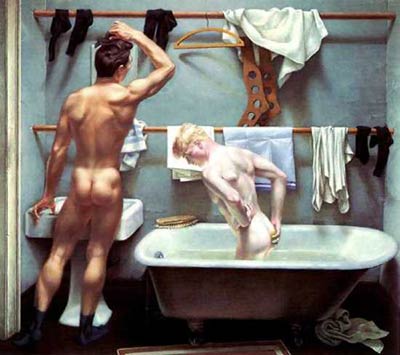
The Bath (center)
Stone Blossom: A Conversation Piece (1939)
Cadmus was a slow, meticulous worker who favored the complicated, time-consuming medium of egg tempera. He finished an average of only two paintings a year. He was more prolific in other media, including drawing, printmaking and photography. Although Cadmus stopped painting toward the end of his life, he continued to draw at his home in Weston, Connecticut, particularly portraits and figure studies of his partner Jon Andersson. Paul Cadmus died in his home in Weston in 1999, just five days short of his 95th birthday.
After hopping an oil tanker to Europe and cycling through France and Spain, Cadmus and French settled on the island of Majorca (1931-1933), where Cadmus painted two of his best-known early works, YMCA Locker Room and the Bicyclists (later bought by Cole Porter). After his return to New York in 1933, Cadmus became the center of a circle of gay artists including his brother-in-law, Lincoln Kirstein (who helped found the American School of Ballet), Pavel Tchelitchew, and photographer George Platt Lynes (for whom Cadmus frequently modeled). At the time, he worked for the Public Works of Art Project, which was later incorporated into the WPA. This experience was to help shape his style for the rest of his long career. Nearly illustrative, his paintings remained linked to a realist style found in many WPA works of the 1930s.
In 1934, Cadmus' painting, The Fleet's In, depicted the pleasures of uniformed sailors; it was removed from an exhibition at the Corcoran Gallery in Washington because of complaints by Navy officials (the Corcoran also infamously removed Robert Mapplethorpe's pictures in the 1980s). This "disreputable drunken brawl" came from "the sordid, depraved imagination of someone who has no conception of actual conditions in our service", fumed Secretary of Navy Claude Swanson. Like a stealth cruiser, The Fleet was kept from public view until 1981 and is now temporarily displayed at the Navy Art Gallery in Washington, DC. The tight, butt and crotch clinging clothing on the soldiers leaves little to the imagination (click to enlarge).
In 1937 Cadmus’s lover Jared left him to marry a mutual friend, Margaret Hoening. The three of them remained close friends, however, and worked together on a number of photography projects. Throughout the late 1930s Cadmus continued to shock. Murals commissioned for a post office were rejected as "unsuitable for a public building", and in 1939 he once again depicted drunken sailors, causing “Sailors and Floozies” to be removed from the Golden Gate International Exhibition in San Francisco. A mural hung in 1939 in a Richmond, VA, post office depicted an event important in the state's history, The Rescue of Capt. John Smith by Pocahontas; while it contains an image of Pocahontas with a bared breast, and the bare buttocks of a male Indian, Cadmus was ordered to retouch the prominent and suggestive crotch area of another male Indian figure (figure below; click to enlarge).
Despite the stream of rejections and controversies, the 1930s and 1940s were Cadmus' most successful years. Professionally, he was at his peak, and his social life was an endless whirl of glamorous Manhattan parties with friends, including W.H. Auden, Christopher Isherwood, Edith Sitwell, George Platt Lynes, and E.M. Forster. In the post-war 1940s he had been involved with artist George Tooker but the relationship was over by 1949. Cadmus once again found love in 1964 when he met Jon Andersson, a singer and actor who became his partner for the next 35 years.
Manikins (1951)
The Bath (center)
Stone Blossom: A Conversation Piece (1939)
Cadmus was a slow, meticulous worker who favored the complicated, time-consuming medium of egg tempera. He finished an average of only two paintings a year. He was more prolific in other media, including drawing, printmaking and photography. Although Cadmus stopped painting toward the end of his life, he continued to draw at his home in Weston, Connecticut, particularly portraits and figure studies of his partner Jon Andersson. Paul Cadmus died in his home in Weston in 1999, just five days short of his 95th birthday.
Subscribe to:
Posts (Atom)