Role models of greatness.

Here you will discover the back stories of kings, titans of industry, stellar athletes, giants of the entertainment field, scientists, politicians, artists and heroes – all of them gay or bisexual men. If their lives can serve as role models to young men who have been bullied or taught to think less of themselves for their sexual orientation, all the better. The sexual orientation of those featured here did not stand in the way of their achievements.
Showing posts with label Director. Show all posts

Thursday, October 13, 2022

Jack Cole

Jack Cole (1911-1974) was the most influential choreographer you’ve never heard of. As a dancer, choreographer and director, Cole’s relative obscurity today belies the major influence he had on stage and cinema musicals of the 1940s-50s and -60s. Considered the father of modern jazz dance, his many disciples became much more famous than their muse – Gwen Verdon, Bob Fosse, Jerome Robbins, Tommy Tune, Matt Mattox, and Alvin Ailey, among others. According to Agnes de Mille, “They all stole from Cole,” a sentiment shared by his greatest interpreter, the sassy redhead Gwen Verdon – Cole’s protégée.

A New Jersey native, Cole ventured far beyond his modern-dance roots. Entranced by the Asian influences of the Denishawn Dance Company, he studied bharata nātyam with master instructor Uday Shankar (Ravi's uncle). As a dynamic, powerhouse solo dancer, Cole projected tough masculine energy. Photos show the elegant, muscular young Cole striking sphinx-like poses dressed in harem pants and jewels, captivating audiences at NYC’s Rainbow Room with exotic, weird, entrancing movements. In many ways, he was America’s Nijinsky. He was also homosexual, but he remained closeted during his entire career. Even though the field of choreography is not exactly overly populated by heterosexuals, such were the times.


Entering the Manhattan nightclub scene, he infused Afro-Caribbean, Spanish and Asian dance motifs into floor shows. During the late 1930s the Jack Cole Dancers headlined at leading nightclubs, including regular stints at NYC’s Rainbow Room and Ciro's on the Sunset Strip in L.A. He then became a master choreographer for Broadway. stage. Among his many hits were Kismet (1953), A Funny Thing Happened on the Way to the Forum (1962), and Man of La Mancha (1965).

His greatest fame came from his work in nearly 30 films. Miraculously, he was able to coach stellar performances from untrained dance novices: Betty Grable, Rita Hayworth and, most notably, Marilyn Monroe. He made Rita Hayworth sizzle in “Put the Blame on Mame” in Gilda (1946). Cole was responsible for Grable’s astonishing “No Talent Joe” number in Meet Me After the Show (1951). Perhaps his greatest triumph was “Diamonds Are a Girl’s Best Friend,” a show-stopping performance by Marilyn Monroe in Gentlemen Prefer Blondes (1953). That was the role that made her a famous sex symbol, and Cole was responsible for every shimmy, strut, arm gesture, shoulder shrug and hip bump. Monroe, a complete dance novice at the time, was so impressed by his coaching that she insisted he work with her on five more of her film projects.


Diamonds Are a Girl's Best Friend
(YouTube)


This production number made Marilyn Monroe a star. Her every gesture is Cole’s creation; he was even responsible for her breathy singing delivery. Knowing her limitations, he made a showcase number out of her available talents.

Ain’t There Anyone Here for Love

(Jane Russell – Gentlemen Prefer Blondes)
Can there be any question that it was a gay man who choreographed this number?

20th-Century Fox does not allow embedding, so you’ll have to click the link below to see this production number.


"Marilyn and I had never danced before; we were a pair of klutzes," Russell told Cole biographer Glenn Meredith Loney of Dance magazine. "Jack was horrible to his own dancers, but with us, the two broads, he had the patience of Job. He would show us and show us and then turn us over to Gwen Verdon." Russell said she fled several sessions in exhaustion, while Monroe begged Cole and Verdon to continue into the night. Cole not only choreographed the Gentlemen Prefer Blondes dance numbers, he directed them, as well. Russell revealed that “Gentlemen” director Howard Hawks was not even on the set when the dance sequences were being shot.

Much of Cole's choreography reflected the hip, cool-Daddy flavor of the Beat generation. His infamous knee glides were a trademark, but famously hard on the knees of the dancers. Cole was a slave driver, notoriously demanding of his dancers. He was a known terror in the dance studio, a force to be respected and feared. He cussed a blue steak, sparing no one, and his technique classes were brutal. When a female dancer fainted in rehearsal, others were afraid to stop, hopping awkwardly over her body. He harangued bandleaders who didn't swing and scolded chatting customers during his nightclub performances. Wearing harem pants and sporting a bare chest, he once chased a belligerent client down Wilshire Boulevard wielding a kitchen knife.

In his 1984 Cole biography, "Unsung Genius," Dance magazine writer Glenn Meredith Loney relates that, although Cole purported to loathe Los Angeles (keeping a Manhattan pied-a-terre for Broadway work), his primary residence was in an isolated location in the Hollywood Hills, way up on Kew Drive on a precipice reachable only by a dangerous, narrow twisting road, barely wide enough for one car. This was the perfect place for a closeted gay man to hang out, and Cole lived here from 1943 until his death from cancer at 62 in 1974. In his last two years of life, he was a treasured UCLA dance instructor and a scholar with an impressive private dance library.


Jack Cole: Jazz Dancing


Wednesday, October 30, 2013

Colin Higgins

Openly gay film director, actor, producer and screenwriter Colin Higgins (1941-1988) was born in New Caledonia, a French island nation east of Australia, although most of his formative years were spent in Australia and California. His father was an American, and his mother Australian. After earning a bachelor's degree in English from Stanford University, he went to UCLA, where he received an M.F.A. in screenwriting.

Although he had solid hits with Silver Streak (screenwriter, 1976), Foul Play (director and screenwriter, 1978), Nine to Five (director and screenwriter, 1980), and The Best Little Whorehouse in Texas (director and screenwriter, 1982 – the film adaptation of the stage musical), he is best remembered for an earlier film for which he wrote the screenplay – Harold and Maude (producer and screenwriter, 1971), which has become a cult classic. It tells the tale of a suicidal young man (Bud Cort) who falls in love with a 79-year-old woman (Ruth Gordon). Higgins wrote the screenplay, which formed the basis for his thesis while he was still a student at UCLA.

After graduating Higgins went to work for a rich man and his wife in Los Angeles as a part-time chauffeur and pool cleaner in exchange for free accommodation. The man was film producer Ed Lewis, and Higgins showed him a draft of Harold and Maude. Lewis took it to Robert Evans at Paramount, where the film project got the green light. Higgins wanted to direct the script himself, but Hal Ashby was hired as director. Ashby and Higgins were highly compatible, and both were pleased with the result of their collaboration, although it was not a great box office success upon its initial release.


Later Higgins (above left) received an offer from Jean-Louis Barrault (right) in Paris to turn Harold and Maude into a play for French actor Madeleine Renaud. Higgins took on the project, working on the French translation with Jean-Claude Carriere, and the play ran for seven years. The film of Harold and Maude continued to run in cinemas around the world, with some fans having seen it over a hundred times. By 1983 the film had turned a profit, twelve years after its original release.

In this clip from the beginning of the film, Harold meets Maude:


Higgins’ last film project was a 1986 television miniseries based on Shirley MacLaine's book, Out on a Limb. Sadly, Higgins died of AIDS-related illness in Beverly Hills, CA, in 1988, at the tender age of forty-seven.

Trivia: When Colin Higgins was having a hot tub and deck built for his backyard, he hired a young carpenter to do it. That carpenter was Harrison Ford. 
   
Sources:

Queers in History (2009) – Keith Stern

Wikipedia

Aggie Song: Best Little Whorehouse in Texas

Friday, September 6, 2013

Moss Hart

American playwright and theatre director/producer Moss Hart (1904-1961) considered George S. Kaufman his greatest collaborator. Among the hit comedies they wrote together were You Can’t Take It With You (1936 – Pulitzer Prize for Drama and Oscar for Best Picture) and The Man Who Came To Dinner (1939). Hart also wrote a best-selling autobiography called Act One (1959), about which George S. Kaufman said, “I’m very pleased for Moss that Act One is on the best seller list. I simply feel that it should be under fiction instead of non-fiction.” Kaufman knew what he was talking about.

Hart’s wife Kitty Carlisle (1910-2007) was committed to protecting her husband’s secrets. A socialite, opera singer, stage and film actress and cabaret performer, she was married to Hart for the last fifteen years of his life, and their union produced two children. Although Hart died in 1961 of a heart attack at age 57, she lived for another 46 years, never remarrying. In Steven Bach’s biography of Hart, Dazzler: The Life and Times of Moss Hart (2001), the author revealed that throughout his marriage Hart was a closeted bisexual. Miss Carlisle made no public comment about the contents of the book, but until her death she continued Hart’s own attempt to heterosexualize his life story, despite his physical relationships with literary agent Lester Sweyd. MGM screenwriter Charles Lederer and many of the homosexuals mentioned in Hart’s autobiography. In a 1939 letter written by Hart to Dore Schary (later president of MGM Studios), he wrote the damning words, “We shall once again lay in each other’s arms and taste the sweetness of sin – I love you very much.”

After his death Carlisle sealed Hart’s diaries and prevented access to materials that contained evidence of his sexuality. Nevertheless, Hart’s name cropped up on lists of bisexuals by Yamaguchi Fletcher, Adrien Saks and others.

Suffering from writer’s block, manic depression and numerous nervous breakdowns, Hart developed an addiction to psychoanalysis. His therapist, Lawrence Kubie, strongly disapproved of Hart’s gay alliances and pushed him into eventually adopting an entirely heterosexual lifestyle. Kubie was known for “conversion therapy” that resulted in redirecting gay or bisexual patients to heterosexual lives. Kubie saw Hart twice a day and conducted shock therapy once a week. As a result, at age 42, Hart married Kitty Carlisle, an act that greatly surprised most of his friends and associates. After getting married, Hart ended his friendships with many "out" gay men, but Arthur Laurents reported his embarrassment at the wedding reception at Hart’s house in Bucks County, PA, when Hart suggested that the men take all their clothes off when there were no women around. Following a performance by Kitty Carlisle at Bucks County Playhouse in 1948, Hart proudly presented his infant son to the audience, declaring, "Now they won't be able to say I'm gay anymore."

Although a tortured man psychologically, Hart enjoyed tremendous professional success. He directed huge Broadway hits such as My Fair Lady (1956 – Tony Award for Best Director) and Camelot (1960). During the latter production, actor Robert Goulet maintained that Hart behaved in a “notably flirtatious manner” toward him; others involved in Camelot confirmed this. Hart’s screenplays included major successes such as A Star Is Born (1954) and Gentlemen’s Agreement (1947).

Personal note from your blogger: One of the first professional stage productions I ever saw was a revival of Hart's Light Up the Sky.

Tuesday, June 4, 2013

James Bridges

Arkansas native James Bridges (1936-1993) was an Oscar-nominated screenwriter and film director who got his start as a writer for the television series Alfred Hitchcock Presents. One episode, An Unlocked Window (1966), won an Edgar Award from the Mystery Writers of America.

Bridges went on to write and direct a number of feature films, including The Baby Maker (1970), The Paper Chase (1973), September 30, 1955 (1977), The China Syndrome (1979), Urban Cowboy (1980), Mike’s Murder (1984), Perfect (1985), and Bright Lights, Big City (1988).

For a number of years he was a mentor to actress Debra Winger. In fact, Bridges nearly quit the production of Urban Cowboy, because Paramount didn't want Debra Winger to play the role of John Travolta's love interest, the independent cowgirl Sissy.

From 1958 until his death in 1993, he was life partner to actor Jack Larson (b. 1928, photo at right), best known for his portrayal of Jimmy Olsen in the TV series Adventures of Superman. Prior to his commitment to Bridges, Larson had been in a relationship with actor Montgomery Clift.

Bridges and Larson shared the historical Frank Lloyd Wright-designed “George Sturges” house (1939) in Brentwood Heights, CA, where Larson still resides. It is the only southern California example of the modest modern style house called "Usonian" by Wright (photo below). This example boasts extreme cantilevers to deal with the steeply  sloped lot, and it has been impeccably maintained by Larson.


In a feature article published in the Los Angeles Times, Larson revealed that Bridges made only eight feature films because he wouldn't compromise. "There were many films that he didn't do if the situation was going to be bad, because he didn't want to go through that. He would not argue with people. He was Southern and polite, but he was very tough..."

Larson (top) with Bridges (right) and their dog Max.

Actor Larson, forever typecast as Jimmy Olson, found later success as a playwright and opera librettist (Larson wrote the libretto to the opera Lord Byron, with music by Virgil Thomson). After Bridges' career took off, they formed a production company, with Larson producing several of his partner’s films. Said Olson, "It was obvious to anyone that since we lived together we were partners. We always went places together. We never pretended (otherwise).”

Bridges died of cancer in Los Angeles, California, at age 57. The James Bridges Theater at  UCLA was named in his honor in November, 1999. Bridges had once been a faculty member there. Every year the Bridges/Larson Foundation issues the James Bridges Award in Film Directing at UCLA, USC, Columbia University and the American Film Institute.

Peter Tonguette's book, The Films of James Bridges (2011) is the first substantive volume on Bridges, and Jack Larson gives the publication his whole-hearted approval.

In  this filmed interview, Jack Larson reminisces about his life partnership with James Bridges:


Saturday, March 30, 2013

Ben Piazza

The film The Hanging Tree (1959) is a Western character study of a doctor (Joseph Frail) who saves a local criminal (Rune) from a mob that is trying to hang him. The doctor, played by Gary Cooper, then tries to control the life of the young man, promising to keep his criminal past secret in exchange for his labor. Bisexual actor Ben Piazza (1933-1991) played Rune in his Hollywood debut, and although Piazza was being groomed for movie stardom, he never attained true leading man status. Instead, he ended up with a steady, if unsensational, career of supporting roles and TV guest shots. Although Piazza was married to actress Dolores Dorn from 1967 to 1979 (no children), he became the longtime companion of Wayne Tripp, who was mentioned as his partner in Piazza’s 1991 Los Angeles Times obituary. Piazza and Tripp lived together for eighteen years.

Compared to the young Marlon Brando, Piazza began acting in 1952 during his college days at Princeton University. He was accepted as a member of New York’s famed Actors Studio and made his professional debut off-Broadway in 1956. Ben made his Broadway debut in 1958 in Winesburg, Ohio, a play penned by Sherwood Anderson.

Piazza had some notable success on Broadway, where he replaced fellow gay actor George Grizzard in the role of Nick in the original production of Who’s Afraid of Virginia Woolf? (1962). Ben appeared in two other Edward Albee plays, The Death of Bessie Smith and The Zoo Story.

On television, he had recurring roles in two prime-time soaps, Dallas and Dynasty; as well, he played a supportive doctor in the coming-out TV movie Consenting Adult.

His big-screen credits included The Bad News Bears (1976), The Blues Brothers (1980), and Mask (1985), and his final feature film was the blacklist drama Guilty by Suspicion (1991), portraying Hollywood mogul Darryl F. Zanuck.

Piazza also wrote plays and a novel, The Exact and Very Strange Truth (1964), a coming-of-age story about an Italian-American boy in Little Rock, Arkansas, which was Piazza’s hometown. However, Ben wrote in the book’s introduction that any resemblance between the characters and real people was “irrelevant,” although the parallels to his own life were unmistakable. Piazza dedicated the book to openly gay playwright Edward Albee, who was a close friend.

Ben Piazza died of AIDS-related cancer at the age of 57 in Sherman Oaks, California, and is buried at Forest Lawn Cemetery.


In this film clip Piazza plays Mr. Simms, the high school principal in Mask, starring Cher and Eric Stoltz:

Thursday, March 28, 2013

Ron Nyswaner

American screenwriter, producer and film director Ron Nyswaner (b. 1956 in Pennsylvania) has often worked on film projects having to do with homosexuality, homophobia and AIDS. Openly gay himself, Nyswaner has long been an activist for gay rights. His first produced screenplay dates to 1982, but he scored a mega-hit ten years later with his screenplay for Philadelphia (1993).

Philadelphia was Hollywood’s first big-budget film on the subject of AIDS, and mainstream big-name cast members included Tom Hanks and Denzel Washington. Nyswaner was nominated for an Academy Award for Best Writing, Screenplay Written Directly for the Screen, and Hanks won the Academy Award for Best Actor in a Leading Role for this film. Bruce Springsteen also won an Academy Award for Best Original Song (Streets of Philadelphia). Antonio Banderas was cast in the role of Miguel, the live-in lover of lawyer Andrew (Tom Hanks). Says Nyswaner, “The part of Miguel was written as a Hispanic for one reason – that’s my sexual fantasy.”

Well, there you have it.

Nyswaner also wrote the script for the television movie A Soldier's Girl (2003 Peabody Award winner), based on the true story of U. S. Army Pfc. Barry Winchell, who was beaten to death in 1999 after his fellow soldiers learned of his involvement with a transgendered nightclub performer.

Three years later Nyswaner wrote the screenplay for the much-lauded period film The Painted Veil (2006), based on the 1925 novel by Somerset Maugham. The film, which tells the story of a dysfunctional marriage,  starred Edward Norton, Naomi Watts and Liev Schreiber. Ron’s screenplay was the third film adaptation of Maugham’s book.

At present Nyswaner is working on a screenplay for Freeheld, a movie that will tell the true story of Stacie Andree, an auto mechanic living with her female partner of five years, Laurel. A crisis ensues when the medical benefits provided to her as a police office are blocked by a state law against same-sex couples. With the help of Laurel’s fellow officer, she begins a crusade for protection that soon garners national attention. Ellen Page will star in the leading role as Stacie, and Peter Sollett will direct. The short documentary film on which Freeheld is based won the Oscar for Best Short Documentary in 2009.       

Blue Days, Black Nights is the title of Nyswaner’s memoir, published in 2004 (called "hilarious and uncompromising" by The New York Times). He has written extensively for television and stage and has also directed two films, The Prince of Pennsylvania (1988) and Why Stop Now (2012). Nyswaner also wrote the screenplays for both films.

Monday, November 5, 2012

Nicholas Ray

Bisexual American film director Nicholas Ray, best known for Rebel without a Cause (1955) and Johnny Guitar (1954), was a talented, undisciplined renegade whose Hollywood career lasted a mere sixteen years. Wisconsin-born Ray directed many films that explored the lives of lonely outsiders who refused to conform to the rigors of mainstream society.

Actor Farley Granger and writer Gore Vidal, Ray’s gay neighbors at the Chateau Marmont in Hollywood during the mid-1950s, both reported that Ray was simultaneously involved in affairs with lead actors Sal Mineo, James Dean, and Natalie Wood during the filming of Rebel without a Cause. Although he identified as heterosexual, Ray could be seen dancing with other men at the Chateau Marmont. Ray said he wasn’t gay because he had more affairs with women than men. Ray was also in denial about his crippling alcohol and drug abuse.

British-born screenwriter Gavin Lambert (1924-2005) met Nicholas in England while publicizing Rebel without a Cause. Seduced by Ray the night they met, Lambert was swept off his feet and accepted Ray’s invitation to follow him back to the United States, where he moved in with Ray at the Chateau Marmont. Nicholas found a job for Gavin as a screenwriter at Twentieth-Century Fox, and Ray and Lambert lived together for eight months. Lambert, who characterized Ray as a possessive and erratic lover, broke off the affair because of Ray’s alcohol abuse and infidelity with both men and women.

After dropping out of college, in 1933 Ray joined the first fellowship of participants at Frank Lloyd Wright’s Taliesin (Wisconsin). After eight months, the intensely moralistic Wright expelled Ray for homosexual activity. Ray relocated to NYC and met writer Jean Evans, with whom he had a son, Anthony (Tony), in 1937. By 1941 the FBI had opened a file on Ray, because of his socialist leanings and association with African Americans. In 1944 Ray was forced to resign his position with Voice of America on the basis of further damning FBI reports of leftist political sympathies and homosexual activity.


In 1946 Ray got a huge break when RKO assigned him to direct the filming of They Live by Night, a film-noir project for which Ray had written a screenplay based on Edward Anderson’s novel Thieves Like Us. Ray cast the film from a group of unknown contract players, chief among them Farley Granger (in photo above). Although previews of the completed film garnered positive reviews in 1947, distribution was delayed until 1949, due to marketing dilemmas. During this gap RKO’s new chief, bisexual Howard Hughes, protected Ray from appearing before the House Committee on Un-American Activities, which would have damaged his personal reputation as well as the reputation of the studio.

In 1948 Ray married actress Gloria Grahame, even though Nicholas had gambled away everything in the days leading up to their wedding in Las Vegas. In 1950 Ray directed In a Lonely Place, starring his wife Gloria and Humphrey Bogart. During filming of In a Lonely Place, Ray found his wife in bed with his teenaged son (Tony) by his previous marriage. Gloria and Nicholas divorced in 1952, and Gloria Grahame eventually married Tony Ray in 1960, an act that incited a public scandal that ended her movie career. Gloria had children by both father and son. I’m not making this up.

In 1953 Ray bought out his contract at RKO, but went to work for MCA when he was unable to establish his own production company. It was there that Ray made a success of Johnny Guitar (1954), in spite of Joan Crawford’s attempts to thwart the production. Intensely jealous of supporting actress Mercedes McCambridge, Crawford insisted that McCambridge’s scenes be reduced in favor of an expanded part for herself. Crawford destroyed McCambridge's costumes and threatened to leave Sedona, Arizona, where the film was shot. Although Crawford prevailed, and Ray was forced to make the adjustments, he delivered a brilliant film with strong gender-bending leanings. Its critical and commercial success was exceeded by Rebel without a Cause, released the following year.

Homosexual actor Sal Mineo portrayed Plato, a character that was perhaps the first gay teenager shown on the screen. Ray had wanted to include a scene showing James Dean and Mineo kissing each other, but cautious Warner Bros. executives nixed that idea.  Released shortly after the tragic death of James Dean, Rebel without a Cause was one of the highest grossing films of the decade, and by far the most commercially successful film of Ray's career.

Ray seemed on track to become one of Hollywood’s greatest directors, but his personal demons of gambling and drug and alcohol abuse thwarted his career. Astonishingly, by 1958 his Hollywood career was over, and Ray moved to Europe, where he experienced both success and failure for eleven years. Ray suffered a heart attack in 1962 while working on 55 Days at Peking (1963), his last studio project.

Settling in Chicago in 1969, Ray met Susan Schwartz, a student who eventually became his unofficial fourth wife. During the 1970s Ray settled down and taught film in New York. Unfortunately, he was diagnosed with cancer in 1977, which took his life two years later. During the summer of 2010, the Harvard Film Archive presented a month-long film series featuring the work of Nicholas Ray. Hosted by Susan Ray, Nicholas Ray’s “fourth wife”, with whom he shared the last ten years of his life, the festival showcased all of Ray’s twenty-odd pictures. The following link includes an excellent bio, commentary and descriptions of all the films:

http://hcl.harvard.edu/hfa/films/2010julsep/ray.html

Martin Scorsese introduces Nicholas Ray and his film, Johnny Guitar:

Wednesday, July 18, 2012

Jerome Robbins

Jerome Robbins (1918-1998) was an American theater producer, dancer, director, and choreographer. Known primarily for his work in Broadway theater and ballet, he also directed Hollywood and television films. Of all his contributions over a career that lasted many decades, he is perhaps best known for the stage and film versions of West Side Story, which he choreographed and directed. Robbins was one of four gay male Jewish creators of this landmark show, collaborating with Leonard Bernstein, Arthur Laurents and Stephen Sondheim. Robbins won the Academy Award for Best Director with Robert Wise for the film West Side Story.

Born Jerome Wilson Rabinowitz in NYC, one month before the end of WW I, Robbins changed his last name to Robbins to disguise his ethnicity. He accompanied his sister to dance classes, and by the age of 19 had made his professional debut in a Yiddish Art Theater production. Robbins choreographed and performed at Lake Tamiment resort in the Poconos for five seasons, all the while dancing in Broadway musicals. In 1940 he joined Ballet Theatre (later known as American Ballet Theatre) and was soloist with that company from 1941 through 1944.

Robbins choreographed and danced in Fancy Free, a ballet about sailors on liberty that was staged at the Metropolitan Opera as part of the Ballet Theatre season in 1944. Oliver Smith, set designer and collaborator on Fancy Free, knew Leonard Bernstein, and eventually Robbins and Bernstein, both just 25 years old,  met to work on the music, resulting in a work of phenomenal success. Later that year, Robbins conceived and choreographed On the Town, a musical inspired by Fancy Free, thus launching his Broadway career. Again, Bernstein wrote the music. In 1947 he was praised for his comic Keystone Kops ballet in High Button Shoes, earning his first Tony Award for choreography.

During the 1950s barely a year went by without both a new Robbins ballet and a Broadway musical, and in this dual career he reached stratospheric heights in both fields. He directed and choreographed Irving Berlin's Call Me Madam, starring Ethel Merman. Robbins created celebrated dance sequences for Rodgers and Hammerstein's The King and I (1951), including the March of the Siamese Children, the ballet The Small House of Uncle Thomas and the Shall We Dance? polka between the two leads. He became associated with the New York City Ballet and was called in to perform uncredited assistance on troubled stage musicals, including Wonderful Town (1953). He worked on The Pajama Game (1954), which launched the career of Shirley MacLaine, and the Mary Martin vehicle Peter Pan (1955). As well, Robbins directed and co-choreographed Bells Are Ringing (1956), starring Judy Holliday. Other famed Broadway productions involving Mr. Robbins were Gypsy (1959) and Fiddler on the Roof (1964). But the magic year was 1957, when he conceived, choreographed, and directed a show that most feel is his crowning achievement, West Side Story. He won the Academy Award for Best Director with Robert Wise for the film version of that show, and the movie still holds the record as the film musical with the most Academy Award wins (10).

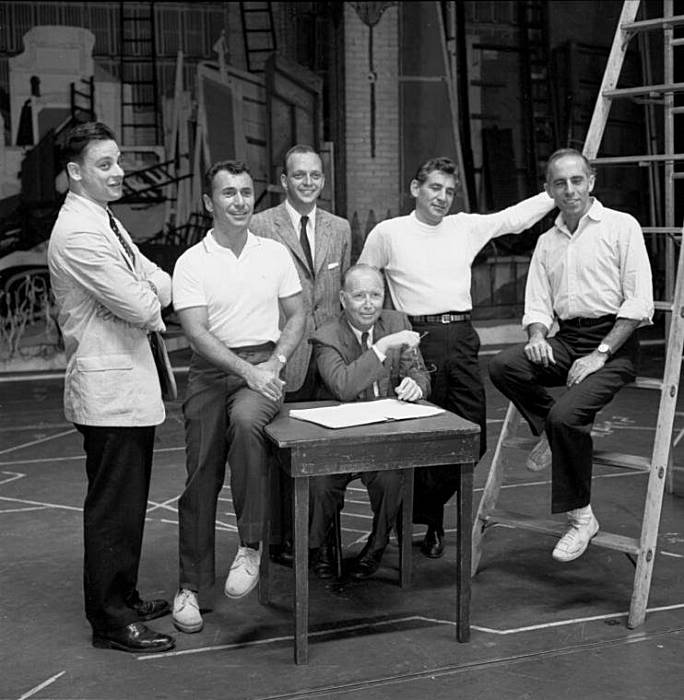
Robbins dominated the production of West Side Story, coming up with the original idea of a modern, urban Romeo and Juliet. Bernstein and Laurents added the idea of warring street gangs in place of Shakespeare's feuding families. The street warfare was between Puerto Ricans and U.S. born Americans, and at its most basic level the story is about how love can survive in a violent world of prejudice. The creators, all four of them homosexual and Jewish, knew a thing or two about prejudice. Other homosexuals involved in the project were set designer Oliver Smith, lighting designer Jean Rosenthal, costume designer Irene Sharaff as well as the first actor to play Tony, Larry Kert.


The West Side Story Broadway production team (1957), left to right: lyricist Stephen Sondheim, scriptwriter Arthur Laurents, producers Hal Prince and Robert Griffith (seated), composer Leonard Bernstein and choreographer Jerome Robbins (on ladder).

Complicating their bond, however, was the fact that Leonard Bernstein and Arthur Laurents, both of them blacklisted, were working with Jerome Robbins, who only a few years earlier, during the McCarthy era, had cooperated with those responsible for the blacklist by naming names. This was a stain on the record of Jerome Robbins and alienated him from many people. Robbins, a closeted homosexual, cooperated with the House Un-American Activities Committee under threat of exposure as a homosexual. Nevertheless, Broadway dancer Buzz Miller and Robbins carried on a five year live-in relationship (1950-1955), and Robbins later had affairs with actor Montgomery Clift, photographer Jesse Gerstein and film maker Warren Sonbert.

Bernstein recalled that the give and take and flexibility among the four young West Side Story creators was extraordinary. Each inspired the other to greater heights of creativity and genius. Robbins insisted that the entire ensemble of actors also sing and dance, which was an innovation and challenge in casting the landmark musical.

Laurents said, "I think the difficulty was having death, attempted rape and murder in a musical.  The subject matter – bigotry, violence and prejudice – might have precluded people from paying money to see that sort of thing – with dancing and an orchestra."

Carol Lawrence, who created the role of Maria, said, "The opening night in 1957 in Washington, DC, when the curtain went up for our curtain calls (after Tony's lifeless body had been taken away and the strains of 'Somewhere' played under the tolling of a single bell – it still breaks me up) we ran to our places and faced the audience holding hands. As the curtain went up, and we looked at the audience, they just looked at us, and we at them, and I thought, 'Oh, dear Lord, it's a bomb!' "

"We thought the thing was going down the drain," Laurents added. "Oh, it was awful."

"And then, as if Robbins had choreographed it," Carol Lawrence said, "they all jumped to their feet. I never saw people stamping and yelling, and by that time, Bernstein had worked his way backstage, and he came at the final curtain and walked to me, put his arms around me, and we wept."

Walter Kerr of the Herald Tribune opened his review with the classic and much-repeated line, "The radioactive fallout from West Side Story must still be descending on Broadway this morning."

The rest is American musical theater history.

Here’s a video of the 9-minute prologue from the movie version of West Side Story (1961). In spite of the Broadway production's critical success, the show seldom sold out, and it didn't make money until the movie version came along, introducing the show to millions. The choreography of Jerome Robbins is beyond brilliant, from the opening finger snaps to classical ballet moves incorporated into the movements of street gangs, to a choreographed rumble with rock throwing.

Friday, May 4, 2012

James Ivory & Ismael Merchant

California-born film director James Ivory (b. 1928, shown at left) and Indian-born producer Ismail Merchant’s collaboration with Merchant-Ivory Productions resulted in films that won six Academy Awards. Merchant (1936-2005) and Ivory were long-term life partners, and their professional and romantic relationship lasted for more than forty years – from the early 1960s until Merchant’s death. They enjoyed a lavish lifestyle together on their 40-acre country estate in the Hudson River Valley north of NYC. They also maintained apartments in London and New York City.

Ismail Merchant (below), born and educated in Bombay, went to the U.S. to earn an MBA from New York University. He met James Ivory in 1961 at a New York City screening of Ivory’s film about Indian art miniatures, and the two became instant friends. Merchant recalled, “Some people meet and part ways, others bond together on a lifelong stream. I guess you could call our relationship destiny.”

Ivory was born in California and educated at the University of Oregon before attending the University of Southern California Film School. He wrote, photographed, and produced “Venice: Theme and Variations”, as a thesis film for his degree in cinema. This film was named by The New York Times as one of the ten best documentaries of 1957.

In 1961, Ivory created Merchant Ivory Productions with Ismail Merchant (right) and Ruth Prawer Jhabvala, who served as the screenwriter for many of their films. Jhabvala, who was married to an Indian man, lived in the New York City apartment above the one occupied by Merchant and Ivory. Of his partnership with Ivory and Jhabvala, Merchant once commented, “It is a strange marriage we have at Merchant Ivory...I am an Indian Muslim, Ruth is a German Jew, and Jim is a Protestant American. Someone once described us as a three-headed god. Maybe they should have called us a three-headed monster!” Merchant raised the money, squeezed the budgets (no Merchant-Ivory film has ever cost more than $3.2 million) and cajoled top talent to work for a pittance. He also sheltered Ivory from the exigencies of the marketplace, leaving the director free to work with the actors, including high-profile stars such as Vanessa Redgrave, Maggie Smith, James Mason and Julie Christie. “We offered them quality,’ says Ivory. The camaraderie on the sets was enhanced by Merchant’s skilled cooking, usually preparing huge Indian meals for the cast and crew. Merchant has published several cookbooks, each covering an aspect of Indian cuisine.

There is no arguing with success. While their first film premiered in 1963, their first real commercial winner was The Europeans, adapted from the Henry James novel. A Room with a View (1985), based on the book by E. M. Forster, was nominated for eight Academy Awards and won three; it won many other awards at home and in the U.K. and Italy.


Maurice (1987) – pronounced Morris – received a Silver Lion Award for Best Director at the Venice Film Festival, Best Film Score for Richard Robbins and Best Actor Awards for co-stars James Wilby and Hugh Grant (seen in photo above). 

Mr. and Mrs. Bridge (1990) was adapted from novels by Evan S. Connell; it received an Oscar nomination and awards from the New York Film Critics Circle.

Ivory directed another Forster-adapted film, Howards End (1992), and it was nominated for nine Academy awards, including Best Picture and Best Director, and won three; the film also won Best Picture at the British Academy of Film and Television Arts (BAFTA) Awards, as well as awards for Best Picture, Best Actress for Emma Thompson and Best Director for Ivory from the National Board of Review; the Directors Guild of America gave its D.W. Griffith award, its highest honor, to Ivory for this film.

The Remains of the Day (1993), was in turn was nominated for eight Academy Awards, including Best Picture and Best Director. Emma Thompson and Anthony Hopkins, who co-starred in Howard’s End, were reunited in working in this film.

Taking a break from filming historical novels, Merchant Ivory Productions had a success with Le Divorce (2003), which Jhabvala adapted from the 1997 novel by Diane Hohnson; despite tepid reviews, the film grossed $13 million on a budget of $3 million. The final Merchant-Ivory film was The White Countess (2005).

MAURICE (1987) deals with the subject of coming of age as a homosexual in a restrictive society; the novel by E. M. Forster was so scandalous that it was not published until after Forster’s death. This clip features scenes of Rupert Graves as Alec Scudder, a gameskeeper, who climbs a ladder into the bedroom (and bed) of Maurice, portrayed by James Wilby. Their sex scene begins at the 7:15 timing mark. Both actors are straight men, so don’t get your hopes up.

Sunday, March 11, 2012

Gus Van Sant

Gus Van Sant (b. 1952) is an Academy Award-nominated film director, photographer, musician, and author who is pointedly based in Portland, Oregon, instead of L.A. or NYC. It is Van Sant's view that living in the city where he attended high school and learned his craft is a way to keep his head and art clear of a sort of alien residue that it might take on if he worked somewhere else.

Openly gay, he has dealt unflinchingly with homosexual themes in which his characters are more often misfits than role models. As a writer and director, he created My Own Private Idaho (1991) and an adaptation of Tom Robbins' novel Even Cowgirls Get the Blues (1993). His mainstream triumph, as director of Good Will Hunting (1997, photo with Matt Damon, below), led to an unusually faithful remake of the Alfred Hitchcock classic Psycho, a disappointment that met with equal parts curiosity, skepticism, and derision from industry insiders and the public alike.

Van Sant seems equally at home with major studio projects and low-budget independent films, and he is known for being a low-key writer/director who tailors his characters to the cast. The Columbine-themed Elephant (2003) unexpectedly won the Palme d'Or and a Best Director award at Cannes. With the period film Milk (2008) Van Sant returned to mainstream film making; its budget of $20 million was more than his four previous films combined. Milk was a biopic of openly gay San Francisco supervisor Harvey Milk (portrayed by Sean Penn, photo at end of post)), who was assassinated in 1978. The film was released to much acclaim and earned accolades from film critics and guilds and was a major hit with the public. Ultimately, it received eight Oscar nominations, including Best Director for Van Sant. It won two Academy Awards, Best Actor in a Leading Role for Penn and Best Original Screenplay for writer Dustin Lance Black.

His next project will star Taylor Lautner (who has had to remind us for the thousandth time that he’s “straight” – funny how that concept just doesn’t stick in our heads) in a movie about illegal underground boxing matches in NYC’s Chinatown in which the participants are buffed male models. Based on a non-fiction  article that appeared in New York magazine on February 13, 2011 (Fight Like a Pretty Boy by Alex Morris), it will give Mr. Lautner (abs-featured photo below) an excuse to take off his clothes for “his art” (not his fan base) and Van Sant an excuse to inject heaps of homoerotic subtext in a film for a mainstream audience.

Ms. Morris wrote, “They come for the sheer violence – the wormhole back to a long-lost New York. But they’ve also come for the spectacle of beautiful boys stripping to the waist and submitting their features to a thorough pummeling.”

Alrighty then. I give the project my vote, as it seems a perfect match for Van Sant and Lautner, and I hereby cease my bitchy comments about the über-straight Mr. Lautner. Filming is to commence any day now.

I should also note that Gus Van Sant has written one novel, Pink, and published a book of his photography, called 108 Portraits. He has also exhibited original art works (watercolors), made music videos and has released two CD albums on which he sings and plays all instruments.


Below: Van Sant with Sean Penn, star of Milk.


My Own Private Idaho stars Keanu Reeves (Scott) and River Phoenix (Mike) as street hustlers. In this scene drug-addicted Mike, who suffers from narcolepsy, professes his unrequited love to Scott; Phoenix himself expanded Van Sant’s original 3-page scene into an 8-page confessional that clears up the ambiguity of his character's sexual orientation. The film, whose title is derived from the song "Private Idaho" by the B-52s, is a retelling of Shakespeare’s Henry IV plays, with the character of Scott (Keanu Reeves) based on Prince Hal. The plot, which centers on death and betrayal, provides roles of great density, rare offerings for such young actors. River Phoenix received enormous praise for his performance. Tragically, two years after the release of this film, Phoenix collapsed and died of drug-induced heart failure on the sidewalk outside West Hollywood’s Viper Room nightclub, at the age of 23.

"Campfire Confessional" scene from My Own Private Idaho:

Tuesday, February 7, 2012

Tate Taylor

42-year-old Tate Taylor is the openly gay director/writer of the Academy Award nominated film, The Help, based on Kathryn Stockett's civil rights-era novel of the same name. Stockett, who has known Taylor since they were in a Presbyterian Church preschool together in Jackson, Mississippi, gave him rights to make the film adaptation in 2008, before the book was published. Actually, Taylor started writing the screenplay before a publisher was found, deciding he’d make an independent film based on an unpublishable manuscript.

Last month the film received four Academy Awards nominations, including Best Picture and acting noms for Viola Davis, Jessica Chastain and Octavia Spencer. The film won the Screen Actors Guild Award for Outstanding Performance by a Cast in a Motion Picture. Made on a $25 million budget, The Help has grossed more than $200 million so far.

On February 19 Taylor is set to receive the Writers Guild of America West's Paul Selvin Award for his adapted screenplay. The Selvin Award recognizes written work which embodies the spirit of constitutional rights and civil liberties.

“The studios, other than Dreamworks, didn’t want to produce it, because I insisted on directing it,” Taylor said. “… I can’t say that I blame them. You know, on paper, you just don’t let someone with limited experience go down there with a pile of money and start making a complicated ensemble piece. I’m not a sure-fire hit in the Hollywood economics and business model, but it happened because I was being stubborn and Dreamworks studios was being really cool by saying, ‘You know what? Let’s give it a shot’.”

Stockett and Taylor once shared a rent-controlled apartment in New York’s East Village. Stockett recounts that 60 literary agents turned her down. However, once The Help became a best seller, Stockett promoted Taylor as the person to write and direct the movie version. “I really wanted a Mississippian to tell the story, to translate it to the screen,” she says. Taylor commented, “We didn’t think there was any way a studio would do an all-female bi-racial drama set in the sixties. They just don’t make these movies anymore.”

Octavia Spencer, who plays Minny, was Taylor’s roommate while he was working on the screenplay in L.A. Filmed in Greenwood, Mississippi, the crew was greeted rapturously by the locals, nearly 1,000 of whom wound up as extras. Viola Davis, who many consider a shoo-in for a best actress Oscar win (tune in on February 26), arrived a month early. She had already started her research, watching civil rights documentaries like “Eyes on the Prize” and reading books about that era. “I read anything I could possibly get my hands on just to recreate what it was like to live in that time period,” she said.

Taylor summed up the pride he takes in this project: “What’s meant the most to me in this whole process is that people I don’t know sending me letters and emails saying ‘I was about to quit the business. It’s changed so much. It’s so jaded. It’s so economically driven. The art has been lost. And I heard what happened with you and and Kathryn and DreamWorks…and I am refueled.’ That makes me feel really good.”

In an interview with The Advocate, Taylor said, “I didn’t live through the ’60s, so one of the ways I was able to really understand that civil-rights struggle was by looking at what’s happening in America now with the gay community. Gays understand what it’s like to be discriminated against.”


After fifteen years of work in New York City and Los Angeles, Taylor recently moved into Wyolah, a 70-acre antebellum plantation in Church Hill, north of Natchez. He hopes to hold workshops and host industry hopefuls on the c. 1836 estate, poignantly built by slave labor. Taylor plans on restoring the plantation, turning the third floor of the main house into a space to hold such events. Many of the original Mississippi plantation outbuildings survive, including a great house with double porches, doctor’s office, brick kitchen (photo below), commissary, carriage house and barn. Wyolah plantation and its nine buildings are listed on the National Register of Historic Places.


An interview with Tate Taylor at the U.K. premiere of The Help:

Saturday, December 24, 2011

Cyril Collard, French Polymath


The “Découverte d’une oeuvre” series was launched by the Musée d’Orsay in Paris in the late 1980s in an effort to make its holdings known to those who would otherwise not likely visit the museum. They chose the medium of television and proposed 5-minute audiovisual interpretations of several of its paintings, each produced by a team made up of a choreographer, a composer and a director. Among the first works was Les raboteurs (The Floor Scrapers, 1988; 7 minutes, clip at end of post) directed by Cyril Collard (1957-1993), from the painting of the same title by Gustave Caillebotte (1875, shown above). The film was a choreography about the floor scrapers, their movements and sounds amid an all-pervasive emptiness. The idea was fully rooted in what was known as video dance: the dancers danced and the camera with them, while at different moments details of the painting appeared.

Openly bisexual Collard abandoned his studies in mathematics and physics and moved to Puerto Rico, where he began to write and develop other interests such as film and video production. He was a singer, actor, director, author, composer and film maker. He formed CYR, a music group that produced a few albums, and worked as an assistant director on several of Maurice Pialat's films. Collard shot documentaries for television and produced video clips.

His second novel, the powerful “Les nuits fauves(Savage Nights, 1989), thoroughly examined his bisexuality and his defiant, unrealistic and irresponsible perception and handling of his HIV-positive status. The movie version was released in 1992 with Collard himself playing the protagonist, a hedonistic and self-important film maker with an insatiable sexual appetite who insists on living his prurient lifestyle to the absolute hilt despite his HIV status, with tragic consequences. This bleak, uncompromising piece both enraptured and enraged the French audience. Critics applauded his braveness and controversial approach to such a taboo subject. With Savage Nights, Collard became the first artist ever to be nominated for the three top categories of the French Cesar Awards – Best Film, Best Director and Best First Film. Tragically, Collard died at age 35 from AIDS, just three days before the César awards ceremony.

The painting “Les raboteurs de parquet” (1875) is typical of Gustave Caillebotte's taste for unusual perspectives and scenes from modern life, including so humble an occupation as floor scraping. The 40" x 57" oil on canvas is on permanent display at the Musee d'Orsay in Paris.

Here is Collard's video interpretation of the painting:

Monday, December 12, 2011

Stephen Daldry


English-born film director Stephen Daldry (b. 1961) has had male lovers, he's had female lovers. He's not keen to be called bisexual, but he decided to take the path of convention by marrying New Yorker Lucy Sexton in 2001 – even though he does not call himself straight, either. Confused? Me too. Daldry and Sexton had a daughter in 2003. His 13-year relationship with male stage designer Ian MacNeil foundered a year before his marriage, when Dalton was named to Britain’s Pink List of most influential gay men.

Of course, what he does is his own business. What gay men do in their private lives no longer seems to matter so much in a wider social context, but I find it curious that he bristles at the “bisexual” label. WTF? Daldry himself has addressed his unorthodox lifestyle, saying: “I refuse to be boxed into the idea that 'oh no, I can't have kids because I'm gay.' I can have kids if I'm gay. And I can also get married and have a fantastic life." Lucy Sexton was a long-term friend before their marriage.

So there you have it.

What is not confusing about Daldry is his talent. He had a long and successful career directing stage plays before his first film, Billy Elliott, appeared in 2000. He is the only person to receive best director nominations for his first three movies. Billy Elliott was followed by The Hours (2002), The Reader (2008) and Extremely Loud and Incredibly Close (2011).

Daldry and his family make their home in NYC’s meatpacking district. 

Monday, November 14, 2011

Alan Cumming

Actor Alan Cumming, who plays Eli Gold on CBS’ acclaimed series The Good Wife, recently signed a deal to continue as a regular cast member. The Good Wife, now in its third season, was partly inspired by the Eliot Spitzer prostitution scandal and other prominent American political sex scandals, particularly those of John Edwards and Bill Clinton.

Cumming joined The Good Wife as a recurring character in the first season and was upped to a regular for the second season. Cumming’s character of cutthroat political operative Eli Gold, based on former White House Chief of Staff Rahm Emanuel, was an immediate standout when he was introduced in the first season. He earned a guest-starring Emmy nomination last year.

Cumming is a Scottish-born stage, television and film actor, singer, writer, director, producer and author. He attained dual U.S. citizenship in 2008 after marrying his partner Grant Shaffer, a graphic designer, in 2007. The couple resides in New York City. Prior to the civil union, Cumming dated both men and women, including a two-year relationship with actress Saffron Burrows, a six-year relationship with male theater director Nick Philippou, and a 1985 marriage to actress Hilary Lyon that lasted eight years.

Once he outed himself as bisexual in 1998, Cumming promoted LGBT rights, emceeing and attending fundraisers for organizations such as the Gay & Lesbian Alliance Against Defamation (GLAAD) and the Human Rights Campaign (HRC), as well as several AIDS charities.

Cumming was appointed an Order of the British Empire (OBE) in the 2009 Queen's Birthday Honours List for services to film, theatre and the arts and activism for LGBT rights. In 2005 he received the Vito Russo Award at the 16th Annual GLAAD Media Awards for outstanding contributions toward eliminating homophobia. In July of the same year he was presented with the HRC's Humanitarian Award in San Francisco, also for his LGBT public stance. In 2006 Cumming received a Doctor of Arts honorary degree from the University of Abertay Dundee (Scotland). He also is a patron of the Scottish Youth Theatre, Scotland's National Theatre “for and by” young people.


Classically trained at the Royal Scottish Academy of Music and Drama, Cumming’s career bounces all over the place. Although he has received accolades for performing Shakespeare on stage, he has accepted roles in real cinematic clinkers (Garfield the Movie, Josie and the Pussycats, and Burlesque from among a long list).

He is a man of strong opinions. When talking about Richard Chamberlain's comment: "I wouldn't advise a gay leading man-type actor to come out", Cumming goes ballistic. “Rupert Everett made the same point in a radio interview, saying he never got a job in Hollywood, and never got a job in England, after coming out. Well, I think it's so mean-spirited," says Cumming. "If you're living a lie, that's not healthy, and I think it is really irresponsible of Chamberlain and Rupert to say these things. But it's not about your work," he says scornfully.

"It's about how you exist as a person in the world, and the idea that your work is more important than you as a person is a horrible message. I always think about a little gay boy in Wisconsin or a little lesbian in Arkansas seeing someone like me, and if I cannot be open in my life, how on earth can they? Anyway, it's an academic question: how can you know that coming out affects your career? Some people just get less work than others, and it has nothing to do with sexuality."

In this clip from a British television talk show, Alan discusses getting an OBE, his husband Grant, voting for Obama and singing for the National AIDS trust. He also sings “That’s Life” and tells about his becoming an American citizen. All in under nine minutes.

Friday, September 23, 2011

Vincente Minnelli

Caricature by Paul Moyse

Film and stage director Vincente Minnelli (1903-1986) was born into a family of traveling entertainers. Although his early years were spent on the road learning show business, he settled in Chicago at age sixteen, where he took a job as a window decorator for Marshall Field’s department store. His originality and sharp eye for design details soon led him to the Broadway stage, where he was a successful costume and set designer.

Metro-Goldwyn-Mayer producer Arthur Freed discovered Minnelli on Broadway and brought him back to Hollywood to design dance numbers for movie musicals.

According to his biographer, Emanuel Levy (Hollywood's Dark Dreamer*), Minnelli lived as an openly gay man in New York prior to his arrival in Hollywood. He comported himself among the Dorothy Parker/Gershwin brothers crowd, and no one in those circles cared that he was gay. Unfortunately, Hollywood was another story, so he was pressured back into the closet when he moved to the west coast. He made the decision to repress his homosexuality by living as a bisexual.

Early on, sometime in the 1920s, Minelli became an effete, a dandy, a snob. He modeled himself after the flamboyant British painter James McNeill Whistler; he became sophisticated and self-consciously cultured, all of which came across when he met Judy Garland, who was the polar opposite. By the way, there was documented bisexual activity in Garland’s career, as well, but it was not a major part of her life.

During filming of "The Pirate", Garland accused Minnelli of being in love with Gene Kelly, her costar, and favoring him over her. She threatened her husband with suicide when she caught him in compromising positions with men (in particular their gardener). However, during her marriage to Minelli she slept with Frank Sinatra and other men, as well; fidelity was not a cornerstone of this union.

He worked on several films, including “Strike up the Band” (1940) and “Babes on Broadway” (1941) with Judy Garland and Mickey Rooney, before he was given the directorship of an all-Black musical called “Cabin in the Sky” (1943). The stylish and inventive “Cabin in the Sky” was a success, and the window dresser from Chicago was now a Hollywood director.

Minnelli's next film, “Meet Me in St. Louis,” was a tour de force and a milestone in American filmmaking. Not only was it a textured look at turn-of-the-century Americana that spoke poignantly to a country in the midst of World War II, but it was also a showcase for Minnelli’s flamboyant camera techniques and powerful use of color. The film was child star Judy Garland’s first adult film and led to the star’s marriage to her director from 1945 until 1951; they were the parents of Liza Minnelli. Although he married four times, Minnelli was widely known to be gay by Hollywood insiders. However, in the deeply closeted world of 1950's Hollywood, he kept his sexual orientation guardedly private.

In young adulthood Lester (his given name) was pathologically shy and suffered from a stammer. He had a penchant for trying on his mother’s clothes, which likely came in handy when he worked as a window dresser.

In his 1956 film version of Robert Anderson’s exploration of masculinity and homophobia, “Tea and Sympathy,” Minnelli worked around the restrictions of the Motion Picture Association of America's production code to recreate the play’s ambiguities without ever using the word “homosexual.” The film is about a sensitive boy of 17 whose lack of interest in the manly pursuits of sports and girls labels him “sister-boy” at the college he is attending. The head-master’s wife sees the student’s suffering at the hands of his school mates (and her husband) and tries to help him find himself. Trivia: Actor John Kerr starred as the misfit student in both the stage production, for which he won a Tony Award, and film version of this play. Kerr went on to portray Lt. Cable in the 1958 film version of “South Pacific.” Really.

Minnelli received an Oscar nomination as Best Director for “An American in Paris” (1951) and later won the Best Director Oscar for “Gigi” (1958). The Minnelli family is unique in having father, mother and child who all won Academy Award Oscars, not to mention mother and daughter who both married gay men. Minnelli was awarded France’s highest civilian honor, the Commander Nationale of the Legion of Honor, only weeks before his death in 1986.

Photographed here with daughter Liza Minelli. Their resemblance is astonishing.

*Emanuel Levy's biography of Vincente Minelli was published in 2009:

Friday, September 9, 2011

George Cukor, celebrated movie director

Born in NYC to Hungarian Jewish immigrants, fabled film director George Cukor (1899-1983), shown at right with a radiant Elizabeth Taylor, was known for his film work on witty comedies and dramatic literary adaptations. His Hollywood career began at the onset of “talkies” and flourished at RKO and later MGM studios, where he directed Dinner at Eight (1933), Little Women (1933), David Copperfield (1935), Romeo and Juliet (1936) and Camille (1936). He was notoriously replaced (by Victor Fleming) as the director of Gone with the Wind (1939), but he went on to direct The Philadelphia Story (1940), Adam's Rib (1949), Born Yesterday (1950), A Star Is Born (1954) and My Fair Lady (1964).

By the mid-1930s, Cukor was not only established as a prominent director but, socially, as an unofficial head of Hollywood’s gay subculture. His six-acre estate at 9166 Cordell Drive in the Hollywood Hills above Sunset Strip, famously decorated in 1935 by actor-turned interior designer William “Billy” Haines (see August 5 post), was the scene of many gatherings for the industry's homosexuals.

Cukor's celebrated "Oval Room" designed by William "Billy" Haines, with its copper clad fireplace surround and grid patterned floor.

The close-knit group included Haines and partner Jimmie Shields, Alan Ladd, writer Somerset Maugham, director James Vincent, screenwriter Rowland Leigh, and costume designers Orry-Kelly and Robert Le Maire. For years, Cukor and composer Cole Porter held competing soirees at their mansions on Sunday afternoons, earning them the nickname “the rival queens of Hollywood.” Cukor remained at his fabled Brentwood home for the last 50 years of his life, making few changes to the original Billy Haines interiors.

It’s now a long-held Academy Award tradition to award a great director for a so-so film, because he’d been passed over so many times before. The first known instance occurred in 1964, when George Cukor won the Best Director Oscar for My Fair Lady (a middling effort), after being snubbed for Born Yesterday, A Double Life, The Philadelphia Story, and Little Women.

Sunday, August 14, 2011

Roger Vadim, Daniel Gélin & Christian Marquand

...sowing their youthful, bisexual oats

In 1949 Roger Vadim (photo at left) was living in Paris with his best friend, actor Christian Marquand. At the time Vadim had worked as a stage actor and journalist, but had not yet become a film director. The two were having lunch on the terrace of La Coupole, a former hangout of Hemingway and Henry Miller in Montparnasse. They noticed a startlingly handsome man seated alone at a nearby table, where he had removed his shoe to massage an aching foot. At the time Marlon Brando was having an affair with one of the waiters, Jacques Viale. Vadim and Marquand overheard Brando muttering in English and introduced themselves. They knew nothing of Brando’s recent success on Broadway, taking him for an out of work actor bumming around Paris. When Brando mentioned that he was suffering in an uncomfortable fleabag of a hotel,* Vadim and Marquand invited Brando to come live with them, and all three became intimately acquainted, if you get my drift. In fact the normally heterosexual Marquand soon became besotted with Brando. Christian Marquand (photo below) became best known to English-speaking audiences in Lord Jim (1965) and Apocalypse Now (1979). Marlon introduced his new friends to his waiter friend, Jacques Viale, who joined their circle. Viale later said that his time with Brando and his friends was the greatest moment of his life. “It was all downhill after Brando.”

Roger Vadim told his friends that during the previous month he had stayed at the legendary Hotel du Cap Eden Roc** (Antibes), where a 32-year-old man from Massachusetts claiming to be the son of an ambassador to England moved into his room, sensing that this was where all the “action” took place. Jack and Roger shared many a three-way with the most beautiful women of the French Riviera. As with Brando, Vadim did not realize the fame of his new-found friend. John Kennedy had yet to be elected Senator and, ultimately, President. Interestingly, in the late 1960s the Hotel du Cap’s address became 10, boulevard John F Kennedy, when the street leading to the hotel was renamed after him.


All this was before Vadim captivated three of the world’s most voluptuous women: in 1952 he married Brigitte Bardot, in 1961 he began an affair with Catherine Deneuve (who was 17 at the time, half his age) and in 1965 he married Jane Fonda. Vadim would later cast his friend Christian Marquand opposite Brigitte Bardot in his groundbreaking film, And God Created Woman (1956). He likewise cast wife Jane Fonda in his sci-fi film Barbarella (1968), based on French comic book stories. A real hoot, but hot stuff, nonetheless!

Vadim later wrote a book about them: “Bardot • Deneuve • Fonda: My Life with the Three Most Beautiful Women in the World (1986).”


But I digress. When Roger and Christian moved to larger quarters in Paris, they took in another actor, Daniel Gélin (at left), to help with expenses. Even though Brando and Christian were immersed in a deeply sexual and emotional relationship, Brando set his sights on Gélin, as well. He was an easy, willing target. Ironically, Gélin later had an illegitimate daughter, actress Maria Schneider, best known for playing Marlon Brando’s young lover in Last Tango in Paris (1972). Schneider met her father only three times, so took her mother’s last name. Two years after Last Tango in Paris was released, she declared her bisexuality; Schneider died of cancer in Paris earlier this year. Late in life Brando said, “I have truly loved only three men in my life: Wally Cox, Christian Marquand and Daniel Gélin. All others were merely ships passing in the night.”

In a way this youthful exploration of various facets of one’s sexuality was evocative of the atmosphere of all-male British boarding schools, where most of the students had physical and romantic relationships with each other. It was taken for granted that they would divest themselves of such activity after they left school, and women became available, but many did not. These schools were veritable hotbeds of bisexual activity.


*In fact, Brando was holed up at the Hotel d’Alsace in the very room in which Oscar Wilde had died penniless and disgraced (numbered rm. #16 today). This building now houses one of the most elegant Left Bank hotels and restaurants of Paris, named L’Hotel at 13, rue des Beaux-Arts. Once a fleabag, perhaps, but after a stunning transformation by decorator Jacques Garcia, this hotel is today an expensive indulgence. The on-site eatery (at the back of the ground floor), Le Restaurant, holds a Michelin star, but the elegant bar located between reception and the restaurant gets my vote as one of the chicest places on Paris for an early or late evening drink. A favorite pastime of mine is playing cards at one of the bar’s upholstered alcove banquettes to the left. Be sure to visit on your next trip to Paris, if for no other reason than to soak up the vibes of Wilde and Brando – not to mention former guests Salvador Dalí, Princess Grace, Frank Sinatra, Jorge Borges and Elizabeth Taylor & Richard Burton.
www.l-hotel.com

When Oscar Wilde and Marlon Brando occupied this room, it was a dreary fleapit. Now suite #16 at l'Hotel in Paris is all romantic luxury (photo below). The framed letters above the lamp on the desk are requests from management demanding that Wilde pay his bill, and the large peacocks painted above the wainscot are exceptional. Oscar Wilde died in this room in 1900, and Marlon Brando occupied it in 1949.


Note: A trip from the ground floor bar to the washrooms involves a descent by a stone semi-circular staircase to the basement. On my first visit I was astonished to find myself standing in an elegant circular subterranean  lounge with draped openings ringing the room. None was marked, and all the draperies were closed, so I went about opening them one by one, looking for the toilets. To my shock (and to that of the guests, as well), I was staring at a group of naked bathers, who were enjoying a sensual dip in the stone-walled indoor hammam pool. Oops. This hotel is small (20 rooms) and achingly romantic. The standard rooms are quite snug, but over-the-top luxurious. It's one block from the Seine on a quiet street that runs between Rue Bonaparte and Rue de Seine. It is the only hotel I know of where the (candle-lit) pool may be reserved for a guest's private use. If your budget cannot accommodate a long stay, try a night or two here before moving to less costly digs. You won't regret it.

**Unfortunately, I have yet to stay at the Hotel du Cap Eden Roc. Aware that this famous hostelry was where Gerald and Sara Murphy had hosted Hemingway and F. Scott Fitzgerald (fodder for a later post), I dropped by in the mid 1990s to inquire about a room, but was told, to my amazement, that they did not accept credit cards. Imagine! This archaic policy was not dropped until 2006.