Role models of greatness.

Here you will discover the back stories of kings, titans of industry, stellar athletes, giants of the entertainment field, scientists, politicians, artists and heroes – all of them gay or bisexual men. If their lives can serve as role models to young men who have been bullied or taught to think less of themselves for their sexual orientation, all the better. The sexual orientation of those featured here did not stand in the way of their achievements.

Tuesday, October 30, 2012

Néstor Almendros

Cuba’s government is not just homophobic – the anti-gay climate is legally institutionalized. Spanish-born cinematographer Néstor Almendros (1930-1992) followed his father to Cuba in 1948 in order to flee Franco’s government. Even though he was himself a closeted gay man (his autobiography made no mention of his private life), when Almendros had the opportunity to direct his own film project in 1984, he made a documentary about Cuba's persecution of gay men, Mauvaise conduite (Improper Conduct), a blistering indictment of Castro’s oppression of homosexuals. From 1965 to 1967, the Cuban government engaged in an anti-gay pogrom, rounding up locas (loosely, “queens”) for confinement in labor camps. Néstor’s documentary featured 28 interviews with these men. Critical response was wildly positive, and Almendros went on to co-direct another documentary, titled Nadie escuchaba (Nobody Listened – 1988), again about repression in Cuba. Like the first documentary, Nobody Listened drew its power from the directness of real people telling their tragic stories in their own words.

Almendros built a career that encompassed a great body of work as a cinematographer: Days of Heaven (1978), for which he won an Academy Award, Kramer vs. Kramer (1979), The Blue Lagoon (1980), The Last Métro (1980) for which he won a Cesar award, Sophie's Choice (1982), Pauline at the Beach (1983), Places in the Heart (1984), Heartburn (1986), Imagine: John Lennon (1988 documentary) and Billy Bathgate (1991), among scores of others. He was known for his many successful collaborations with famed directors Eric Rohmer, François Truffaut and Robert Benton.

Néstor Almendros was born on this day, October 30, in Barcelona in 1930. He died of AIDS-related lymphoma in 1992 at age sixty-one. In a fitting tribute Human Rights Watch gives an annual film award named in his honor.

Stills from Days of Heaven:

Production began in the fall of 1976. Though the film was set in Texas, the exteriors were shot in Whiskey Gap on the prairie of Alberta, Canada. Jack Fisk designed and built the mansion from plywood in the wheat fields and the smaller houses where the workers lived. The mansion was not a facade, as was normally the custom, but authentically recreated inside and out with period colors: brown, mahogany and dark wood for the interiors. Patricia Norris designed and made the period costumes from used fabrics and old clothes to avoid the artificial look of studio-made costumes.
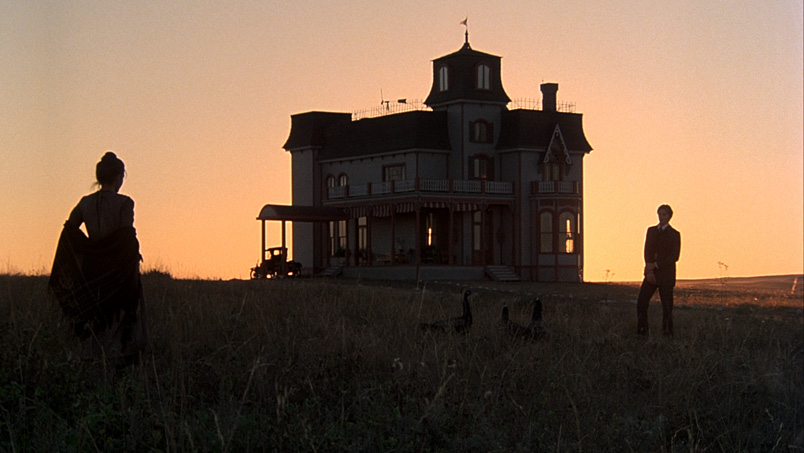

According to Almendros, the production was not “rigidly prepared”, allowing for improvisation. Daily call sheets were not very detailed and the schedule changed to suit the weather. This upset some of the Hollywood crew members not used to working in such a spontaneous way. Most of the crew were used to a “glossy style of photography” and felt frustrated because Almendros did not give them much work. On a daily basis, he asked them to turn off the lights they had prepared for him. Some crew members said that Almendros and Malick did not know what they were doing. Some of the crew quit the production. Malick supported what Almendros was doing and pushed the look of the film further, taking away more lighting aids, and leaving the image bare. Due to union regulations in North America, Almendros was not allowed to operate the camera. With Malick, he would plan out and rehearse movements of the camera and the actors. Almendros would stand near the main camera and give instructions to the camera operators.


Almendros was beginning to deal with deteriorating eyesight by the time shooting began. To evaluate his setups, “he had one of his assistants take Polaroids of the scene, then examined them through very strong glasses”. According to Almendros, Malick wanted “a very visual movie. The story would be told through visuals. Very few people really want to give that priority to image. Usually the director gives priority to the actors and the story, but here the story was told through images”. 


Much of the film would be shot during “magic hour”, which Almendros called “a euphemism, because it’s not an hour but around 25 minutes at the most. It is the moment when the sun sets, and after the sun sets and before it is night. The sky has light, but there is no actual sun. The light is very soft, and there is something magic about it. It limited us to around twenty minutes a day, but it did pay on the screen. It gave some kind of magic look, a beauty and romanticism”. This “magic look” would extend to interior scenes, which often utilized natural light.


Almendros said, “In this period there was no electricity. It was before electricity was invented and consequently there was less light. Period movies should have less light. In a period movie the light should come from the windows because that is how people lived.”

Wednesday, October 24, 2012

Dsquared2: Twin gay brothers

Identical twin gay brothers Dean and Dan Caten, born with the surname Catenacci, are a Canadian creative design duo who are fashion designers. They are founders and owners of the high end international fashion house DSQUARED2.

DSquared2: not your grandmother’s runway show


Now in their late forties, Dean and Dan Caten say they started out by designing denim, because they weren't allowed to wear it when they were growing up. "Our Dad, like a lot of older people, thought denim is for poor people," said Dean in an interview. The twins were in a family of nine children, raised by a single father, a welder, in Toronto. They say their success in the fashion world is probably due to that modest background. "I think sometimes the less you have, the more creative you have to become," Caten said. "It's not having the things you want in the fashion sense. We didn't have great clothes growing up, and we didn't have fashion accessible to us."

DSquared is based in Milan, Italy, and it now has moved light years beyond denim, but the twin’s collections are still tinged with Canadian themes, Dan said. "Doing a collection, we start with a theme, and that gives us a point of departure – cowboys, matadors," he said. "We're telling a story. It's like making a short film. When it comes time for the runway, we have the set, the music, the lighting – will we make it rain or snow?"

Their clothing, the denim in particular, is a favorite among musicians like Justin Timberlake, Christina Aguilera, Rihanna, and Madonna, who asked the duo to create more than 150 pieces for her 2002 Drowned World Tour. The design duo did the costumes for a recent Usher world tour, as well. The brothers opened their flagship store in Milan in 2007, complete with an exclusive Champagne bar, and subsequently launched locations in Capri, Kiev, Istanbul, and Hong Kong. In 2010, they were the hosts of Launch My Line, a design competition reality show on Bravo. They have launched a signature fragrance, have designed football team uniforms and have collaborated with Fiat automobiles. In 2009 they launched Dsquared for Sirius Satellite Radio's BPM Channel, and somewhere in there I forgot to mention that they have a designer line of sunglasses. Their products may be purchased in the U.S. at high retailers such as Saks Fifth Avenue and at select fashion boutiques. A link to their on-line shopping site is at the end of this post.

Dean and Dan, who divide their life/work between Milan and London, create their collections in Italy: “Born in Canada, living in London, made in Italy”.

“We are the two simplest people on the face of the earth. We have come from nothing, have made something, and we’re giving back to everything that we ever came from, everything that we support.”

http://www.dsquared2.com


Thursday, October 18, 2012

John Horne Burns

Born the son of a wealthy Irish Catholic lawyer in Massachusetts, John Horne Burns (1916-1953) attended Andover Academy, where he studied music. His Phi Beta Kappa graduation from Harvard in 1939 resulted in a teaching position at a boys' boarding school, the Loomis School in Windsor, Connecticut. Answering his country’s call, he was drafted into the army in 1942. Thus a gay soldier found himself lucky enough to be stationed in Casablanca, Algiers, and Naples, spending WW II in a military intelligence job censoring the content of mail written by enemy prisoners. Burns used his war experiences, including pickups in gay bars in Naples, in his brilliant first novel, The Gallery (1947), a set of nine vignettes, reissued in 2004 by New York Review of Books Classics. The novel is a semi-autobiographical fictionalized account of his Italian war experiences.

The Gallery – "The first book of real magnitude to come out of the last war."
– John Dos Passos

Set in occupied Naples, Italy, in 1944, The Gallery takes its name from the Galleria Umberto, a bombed-out arcade where everybody in town comes together in pursuit of food, drink, sex, money and oblivion. A daring and enduring novel – one of the first to look directly at gay life in the military – The Gallery poignantly conveys the mixed feelings of those who fought the war that made America a superpower. The book captures the shock that war dealt to the preconceptions and ideals of the victorious Americans. Each of the stories gives the reader a glimpse into the social and sexual practices of American GIs during WW II, from a censorship office run by an egomaniac to an Italian girl finding love in an America officer's club to a gay bar. These portraits are linked by the narrator's own experiences from Casablanca to Naples and his realization of what love and the war mean to him. Upon publication in 1947, the book became a critically-acclaimed bestseller.


His literary debut launched him alongside James Michener and Irwin Shaw (photo above). Two years later, however, Burns suffered a second novel comedown with Lucifer with a Book (1949), a satire which drew on his experiences as a boarding school teacher. Lucifer with a Book was one of the most talked about new novels, because it dealt with the naughty goings-on at an all boys' prep school, something Americans could not handle in 1947. Burns was savagely attacked by the same critics who had praised him as a war novelist. Disappointed, disillusioned and disaffected with American culture, Burns moved to Florence, Italy, where he began drinking himself to death. A third novel,  A Cry of Children (1952), also garnered bad reviews. Supporting himself as a travel writer, he began working on a fourth novel, but died at age 36 of a cerebral hemorrhage brought on by alcoholism.

According to Gore Vidal, Burns once said "To be a good writer, one must be homosexual."

The Gallery: Burns has a brilliant facility for reproducing the sights, sounds, color, feel, and smell of the places he has seen. He uses this to startling effect to recapture what many Americans beyond the frontiers of their antiseptic homeland for the first time found in exotic and warped war centers as Casablanca, Fedhala, Algiers, and of course the twisted and diseased Napoli itself. – William Hogan, San Francisco Chronicle

No one will ever forget this book: a story torn from impassioned experience of modern wars in a shattered city of the ancient world. The Gallery is unique, unsparing, immediate; inextinguishable.
– Shirley Hazzard

The Gallery – John Horne Burns; 392 pages, paperback.