Role models of greatness.

Here you will discover the back stories of kings, titans of industry, stellar athletes, giants of the entertainment field, scientists, politicians, artists and heroes – all of them gay or bisexual men. If their lives can serve as role models to young men who have been bullied or taught to think less of themselves for their sexual orientation, all the better. The sexual orientation of those featured here did not stand in the way of their achievements.

Sunday, March 1, 2020

Charles Griffes

We know that the young musician from Elmira, NY, had a thing for men in uniform, because he wrote about it in his meticulously kept diaries. Subsequent studies abroad opened his mind to the emerging European homophile movement of Edward Carpenter, Magnus Hirschfeld, Oscar Wilde and André Gide, and he began to feel more comfortable with his sexual orientation. Nevertheless, once he returned to the United States in 1907 to take a job as a teacher at the Hackley School for Boys* in Tarrytown, NY, he became more circumspect and lived out the remainder of his short life as a closeted man. His departure from Europe was necessitated by the death of his father, leaving the young Griffes to support his widowed mother and other family members.

A brilliant concert pianist and composer, Charles Griffes (1884-1920, pronounced GRIFF-ess), was one of the first American composers to adapt avant-guard influences that were championed by Debussy and other Europeans. Called an "American Impressionist" by critics who didn't know how else to categorize him, he wrote highly listenable and sophisticated classical music that received praise from critics and composers, most notably Stokowski, Busoni, Pierre Monteux  and Prokofiev. His symphonic works received performances by the prestigious New York Philharmonic and Boston Symphony orchestras.

His home-town music teacher financially supported his flight from Elmira to study piano and composition in Berlin, Germany, while Griffes was still in his late teens. During his time in Europe he had affairs with several men, most notably Emil Joel, an older fellow student. Over a period of four years Joel guided Griffes’ artistic development, procured concert tickets and introduced him to such prominent musical figures as Richard Strauss, Enrico Caruso, Ferrucio Busoni, and Engelbert Humperdinck, with whom Griffes studied music. Joel even supported Griffes financially, enabling him to extend his time in Europe by a year.

As comfortable as he became among his peers in gay circles, Griffes never divulged his orientation to straight friends or associates. There was too much at stake for a man who had to support himself, especially when the job he held until his untimely death was at a boys’ school. Griffes was in a precarious position when he became infatuated with one of his male students, because no man of his time and position could have been openly gay without public disgrace. Nevertheless, he was constantly frustrated that gay men could not meet openly in public.

*The Hackley School (shown at right) is a private, exclusive all-male prep school in Tarrytown, NY. Internationally renowned gay architect Philip Johnson was a 1923 graduate just three years after Griffes's death. Most of the students go on to attend Harvard University.


However, Griffes was able to sneak away from Tarrytown to sample the gay life of NYC. He was known to patronize the Lafayette Place and Produce Exchange bath houses, for reasons that were obvious. He even entered into an intimate relationship with Officer John Meyer, a married New York policeman (remember that fetish for men in uniform).

Griffes composed song cycles, piano pieces, orchestral works and chamber music, much of the latter written as incidental music for stage plays. It is astonishing that he was able to do this while holding down a full-time job on the faculty of the Hackley School*. He composed, performed, arranged, revised and orchestrated everything, acted as his own agent and overcame difficulties with his publisher (G. Schirmer), all without outside assistance. Unable to afford editors or copyists, he had to correct proofs and prepare copies of his own large orchestral scores against the mounting deadlines that came with his enhanced reputation.

His most enduring compositions are "The Pleasure Dome of Kubla Khan" (1917), "The White Peacock" (1915), "Poem for Flute and Orchestra" (1918), and "Two Sketches Based on Indian Themes" (1916-1920). He also wrote a bold, passionate and difficult "Sonata for Piano" (1918).

Note: adjust your speakers, because this performance of The Pleasure Dome of Kubla Khan starts very softly and slowly:


Tragically, at the height of his fame, Griffes contracted influenza in 1919. Shortly after a Carnegie Hall performance of his music, he collapsed at the Hackley School for Boys in early December and was subsequently hospitalized. He died on April 20, 1920, only 35 years old, and his funeral was held in New York City. Musicologist B. Collins relates a poignant tale about the funeral service, held at the Church of the Messiah at Park Avenue and 34th Street. Unexpectedly, the strains of a Bach chorale wafted from across the street, where a music festival was being held in the 71st Regiment armory.  Standing on the parapets of the armory building, a choir of trombonists played a sort of “accidental” requiem. Both the sight and sound of the performance would have pleased Griffes, as all of the trombonists were in uniform. The building that replaced that church is a structure that now hosts rehearsals of the New York City Gay Men's Chorus.

Griffes had kept a diary in German in which he reported on his various forays to bathhouses and other favorite gay-friendly haunts. Unfortunately, several of the diaries were destroyed by his sister after his death to prevent widespread knowledge of Griffes's gay recreational New York City life, his attraction to men in uniform, and his long-term relationship with a married policeman. At the time of his death he was working on a festival drama based on the poetry of Walt Whitman.

Sources: Most of the information in this post comes from biographical studies by Howard Pollack, B. Collins and Thomas Riis.

Saturday, February 15, 2020

Dave Kopay - Jerry Smith: NFL team love affair

Washington Redskins: NFL’s Gayest Team?

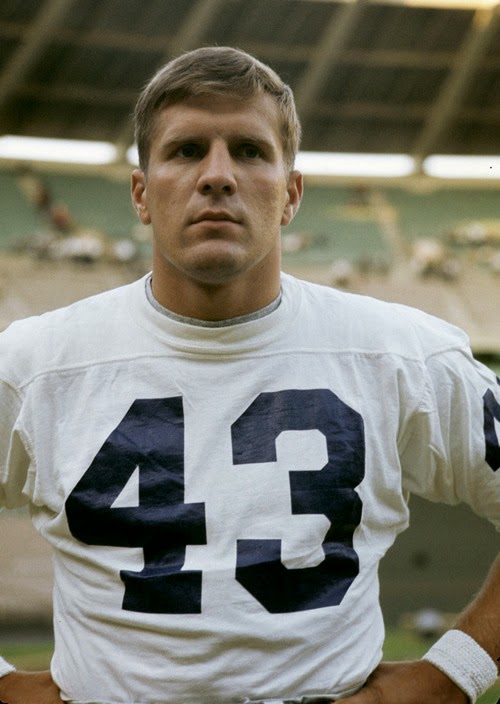
At least four players and a General Manager of the Washington Redskins football team were known to be gay. The players were Dave Kopay (left), Jerry Smith, Wade Davis and Roy Simmons, and the  GM was David Slattery. Not to mention team publicist Joe Blair.

While a running back for the Washington Redskins, Dave Kopay (b. 1942) had a relationship with teammate Jerry Smith, a star tight end for the team from 1965-1977. In 1975, three years after his career in football had ended, Kopay gave an interview to the Washington Star (newspaper) in which he declared his homosexuality. He is believed to be the first professional athlete to do so. It was while playing for the Redskins under legendary coach Vince Lombardi that Kopay and Smith had their affair.

In 1977 he wrote his autobiography, “The David Kopay Story: An Extraordinary Self-Revelation,” currently in its 5th printing. The book remains a perennial favorite with people coming to grips with their sexual identities.

Kopay told the cable sports network ESPN about his relationship with Jerry Smith, calling it his “first real coming-out experience.” Although Smith died of complications from AIDS in 1987 at age forty-three, he never publicly acknowledged his homosexuality. Smith caught 421 passes and had 60 touchdowns during his career, astonishing for a tight end at the time. Upon his retirement, Smith held the NFL record for most career touchdowns by a tight end. According to Jim Buzinski (Outsports), Smith's absence from the Pro Football Hall of Fame is a disgrace. In addition to Smith and Kopay, the Redskins 1969 training camp included gay running back Ray McDonald (cut from the roster prior to the start of the season). McDonald also died of complications from AIDS.

Kopay's teammate and lover Jerry Smith:


At the Gay Games VII in Chicago (July 2006), Kopay was a featured announcer in the opening ceremonies. Currently active as a motivational speaker, Kopay announced in September 2007 that he would be leaving $1 million as an endowment to the University of Washington Q Center, a resource and support center for gay, lesbian, bisexual and transgender students and faculty. In early 2008 Kopay left the Los Angeles area to relocate to Seattle, where he still receives hundreds of letters from fans of his book who received understanding, support and inspiration from his life story.

In 1992, Roy Simmons, who had been a linebacker for the Washington Redskins and New York Giants in the 1980s, came out on the national television talk show, “Donahue.” In 2003, on World AIDS Day, he revealed that he had been diagnosed with AIDS in 1997. His book that tells his story about being in the closet while playing with the NFL is titled "Out of Bounds."

In 1993 David Slattery, general manager of the Washington Redskins in the early 1970s, came out as homosexual, long after he had left the sport.

Wade Davis (below) was a defensive back for the Redskins for the 2003 season. He announced he was gay when he participated in the Gay Lesbian Straight Education Network's "Changing The Game" program, which is designed to fight against homophobia in K thru 12 athletics by starting a dialogue about the issue.


Tuesday, February 11, 2020

Edward Tanner, a.k.a. Patrick Dennis

Author of Auntie Mame

Edward Everett Tanner III was born in 1921 in Illinois into a prominent family of staunch Republicans. Edward, nicknamed "Pat", was a popular high school student who excelled in writing and theater. In 1942, at the age of 21 he joined the American Field Service, working as an ambulance driver in North Africa and the Middle East. After WW II he married Louise Stickney, with whom he had two children, even though he had struggled with homosexual leanings his entire adult life.

Under an assumed name at the age of 36 he wrote a best-selling novel, which remained on the NYT Bestseller list for more than two years, selling more than 2 million copies in the first edition. A year later he became the first writer to have three books on the NYT Bestseller list at the same time. His books were mostly biting social satires which almost single-handedly introduced "camp" into mainstream American culture. He also wrote several books under the female pseudonym, Virginia Rowans.

Tanner made millions from his 16 books and became the toast of New York society. His novels were made into wildly popular films, plays, television series and musicals, but by the 1970s his writing style had fallen out of fashion. A week after he was profiled in Life magazine, he attempted suicide and was committed to a mental hospital for eight months. After years of leading a double life as a gay man, he had fallen in love with another man and decided he had to abandon his family. He had always been a profligate spender, and by the time he left his wealthy wife, he was broke and had to go to work as a butler, a job he actually enjoyed. Giving full vent to his homosexual orientation, he became a fixture in the Greenwich Village gay scene in New York.

His employers at the time, Mr. and Mrs. Ray Croc (founder of McDonalds), had no idea that their butler, Edward Tanner, was in fact the writer Patrick Dennis, author of Auntie Mame, which in stage, movie and musical forms would provide Rosalind Russell and Angela Lansbury with major theatrical roles.

Mr. Dennis died from pancreatic cancer in 1976, at the age of 55, his days as a dilettante long behind him. In the year 2000 his ashes were interred with the body of his wife Louise in St. James’s Cemetery in Stony Brook, Long Island.

Note: I can especially recommend an obscure book by Mr. Dennis: Tony (1966). The narrator, whose name is never disclosed, meets Tony, a name-dropping scoundrel, when they become college roommates. Tony is a complete fraud and a pathological liar, yet the narrator chronicles their decades long love-hate friendship in hilarious style. Tony morphs into whatever form will get him ahead. An inveterate social climber, even Tony’s sexuality is “fluid” when a wealthy homosexual man falls in love with him (the man’s mother writes a very large check to have Tony fly the coop). Many aspects of  Tony’s character are autobiographical (the author had three real life identities as Edward Tanner, Patrick Dennis and Virginia Rowans, not to mention the bisexuality), and the reader can easily lose track of the number of times Tony reinvents himself . This is perfect “beach” reading, and used copies are readily available from Amazon and Alibris.

A 2002 biography, Uncle Mame: The Life of Patrick Dennis, written by Eric Myers, is available in a Kindle edition, and used copies of the print editions are likewise available from Amazon and Alibris.