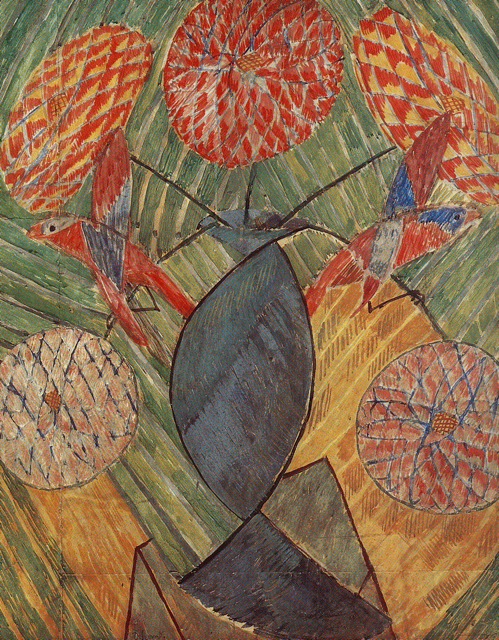
Duncan Grant: Bathing (1910)
Scottish born artist
Duncan Grant (1885-1978) accomplished much more than the homoerotic nudes for which he is best remembered. He also worked in interior design and forged a career in costume and stage set design. At age 28, along with art critic and fellow Bloomsbury figure Roger Fry, Grant founded the Omega Workshops, which changed the course of applied art and design in Britain. In this capacity Grant made major contributions to pottery and textile design.
One of his greatest commissions, however, was never realized. Hired to decorate the interiors of the great ocean liner, the Queen Mary, he completed the task, submitted his designs and was paid for his work. Although he was offered no explanation as to why his designs were not used, it was commonly understood that his work was too avant garde for tastes of the time.
Self portrait in mirror (1920)
Grant grew up an only child in Scotland, Burma and India, where his father served in British military regiments. Duncan’s English nanny encouraged his painting and took delight in his juvenile designs for wedding dresses. The young Duncan was influenced by the spectacle of the weekly regimental ceremonies and parades that took place in the numerous cities in India where his family was stationed at the close of the 19th century. They enjoyed a life of privilege, strictly maintaining British customs while living in the Subcontinent. At age nine Grant returned to Britain to attend boarding school. Although he won awards for art and music, he was otherwise a poor student. Coupled with his father’s financial difficulties, Grant was unable to attend the prestigious schools his mother had hoped for. Instead, he settled into the Westminster School of Art (London). From that time forward, he never strayed from pursuing a career as an artist.
Duncan studied in Paris in 1906, and later at the Slade School of Art. He moved to 21 Fitzroy Square (London) in 1909 and thereafter became a regular at gatherings of members of the Bloomsbury group. Sharing with Roger Fry and Vanessa Bell a commitment to the decorative arts, he became co-director of the Omega Workshops in 1913.
Duncan Grant: textile design for embroidered firescreen, 1913
By all accounts a handsome, kind and charming person, Grant’s lovers included Adrian Stephen, Maynard Keynes and David Garnett, as well as his cousin Lytton Strachey. Though his sexual orientation remained homosexual throughout his life, he was the father of Vanessa Bell's daughter Angelica, and lived for many years at Charleston farm with the Bell family.
Charleston manor house
1930s photograph of the drawing room at Charleston, decorated by Duncan Grant
Herself an accomplished artist, Angelica grew up believing that Clive Bell was her father; she bore his surname and his behavior toward her never indicated otherwise. Angelica had sexual relations with two of Duncan Grant’s lovers, the Russian painter George Bergen and David Garnett, whom she married, unaware that her husband had been her father’s lover. I’m not making this up. In 1994 Angelica donated more than 8000 sketches and drawings by Duncan Grant and Vanessa Bell to The Charleston Trust. Some of Grant’s major works hang in London’s prestigious Tate Gallery and National Portrait Gallery.
Duncan Grant: Interior with the Artist’s Daughter (oil on canvas, 1935)
In Grant's later years, poet Paul Roche (1916–2007), whom he had known since the mid-1940s, took care of him and enabled Grant to maintain his accustomed way of life at Charleston for many years. When Grant had been commissioned to decorate the Russell Chantry in Lincoln Cathedral in the late 1950s, Grant used his lover Paul Roche, youthful, blond and handsome, as the model for the face and body of Christ (below). The murals have recently been restored and the chantry reopened. Roche was made co-heir of Grant's estate, and Grant eventually died in Roche's home in 1978.