Role models of greatness.

Here you will discover the back stories of kings, titans of industry, stellar athletes, giants of the entertainment field, scientists, politicians, artists and heroes – all of them gay or bisexual men. If their lives can serve as role models to young men who have been bullied or taught to think less of themselves for their sexual orientation, all the better. The sexual orientation of those featured here did not stand in the way of their achievements.
Showing posts with label George Nader. Show all posts

Wednesday, October 10, 2012

George Nader

After appearing in small roles in forgettable films in the 1950s, a pair of strapping, handsome young gay actors were hungry for leading roles in higher quality films, and they were chasing the same dream. They were friends, but the competition did not always end up amicably. One of them, Rock Hudson, got lucky with Magnificent Obsession (1954), which turned him into a star and a hot commodity. The other, George Nader (1921-2002), was not so lucky. These two gay men with stunning physiques and charisma to spare were about to be involved in a Hollywood studio intrigue that left only one man standing.


According to insider reports at the time, Rock Hudson was a bit too indiscreet with a man he picked up, and their dalliance was photographed. Universal Studios bosses received a phone call from Confidential magazine saying they were about to expose Hudson’s homosexuality on their front page. The studio panicked at the thought of losing its hottest new star, so they cut a deal with the magazine. They made a decision that made Rock Hudson a Hollywood legend while simultaneously dashing the career of Nader to hopeless obscurity. The magazine agreed to ruin Nader's career by outing him as a homosexual in exchange for accepting a large cash payment to keep Rock Hudson's gay activities out of print forever. Another version of this story relates that Confidential was about to expose a relationship between Nader and Hudson himself, but both men later said they never had a sexual relationship. In fact, Nader and Mark Miller (Nader’s life partner) became Hudson’s de facto family and were especially supportive in the months leading up to Hudson’s death from AIDS in 1985. BTW: I can find no evidence that a magazine article exposing Nader as homosexual was ever published, although the threats may have been real. Photo below: Rock Hudson (left) wth fellow beefcake actor George Nader.

Nader’s Hollywood career sank, but he was not down for the count. Astonishingly, he became the second biggest film star in Germany, playing a James Bond type character by the name of Jerry Cotton in 8 films released in a five year span from 1965 to 1969. He continued working in B movies until 1974, but his career was thwarted a second time. An automobile accident resulting in a detached retina made it difficult and uncomfortable to work in front of the bright lights used on movie sets, so he switched to an entirely different career as an author. He wrote a popular science fiction novel titled Chrome (1978), in which two gay men were the principal characters.

Even more astonishingly, Nader and Hudson remained good friends. Nader began dating Mark Miller while the two were fellow actors at the Pasadena Playhouse, and Miller went on to work as Hudson’s private secretary. Nader and Miller became lovers and remained partners for 55 years, and Miller, Hudson and Nader became so close that Nader was included in Rock Hudson’s will, receiving the interest from his estate.

But we need to back up a moment. Miller had intended to study opera in NYC but abandoned his plans to stay in California to help Nader launch his career. Miller took odd jobs to provide income while Nader established himself as an actor. By 1952 Nader was successful enough that Miller became his business manager.

In 1953 Nader starred in a 3-D film called Robot Monster (at right), which grossed more than a million dollars on a $16,000 production budget. Nader played Roy, the often shirtless hero who saves the world from the clutches of a robot in a gorilla suit. Shot in just 4 days, it went on to become a camp cult classic. It also has the dubious distinction of being named one of the worst movies of all time.

In 1954 Nader won a Golden Globe award as Most Promising Male Newcomer of the year, but the Confidential gossip magazine incident in the early 1960s brought a premature close to his Hollywood career.

Universal Studios tried to protect Nader  by arranging dates with actresses such as Mitzi Gaynor, Martha Hyer and Piper Laurie, while suggesting he get married briefly to one of the studio secretaries to quell the gay rumors (neither Miller nor Nader publicly acknowledged their homosexuality until the mid-1980s). Nader couldn’t bring himself to participate in such a sham, and he left the studio in 1958 to work freelance. After some mediocre work in television, he and Miller moved to Germany in 1963, where Nader made eight successful films as a James Bond clone. By 1972, Nader decided to move back to Hollywood, and Miller joined him.

In 1978 Nader wrote his first novel, a homoerotic science-fiction book titled Chrome, which went into six printings. Conveniently, Nader had earned a degree in English from Occidental College in 1943, so he was able to put those skills to good use.

Nader finally came out of the closet in 1986, a year after Rock Hudson’s death from AIDS. Nader and Miller collaborated on a second novel, The Perils of Paul, which Nader didn't want published until after his death. Centering on the gay community in Hollywood with names changed to protect the guilty(!), it was published privately in 1999 (good luck acquiring a copy). In retirement, Nader and Miller lived in Palm Springs, California. Nader contracted a bacterial infection in Hawaii and died on February 4, 2002, at age 80, at the Motion Picture and Television Fund Country Home in Woodland Hills, CA.
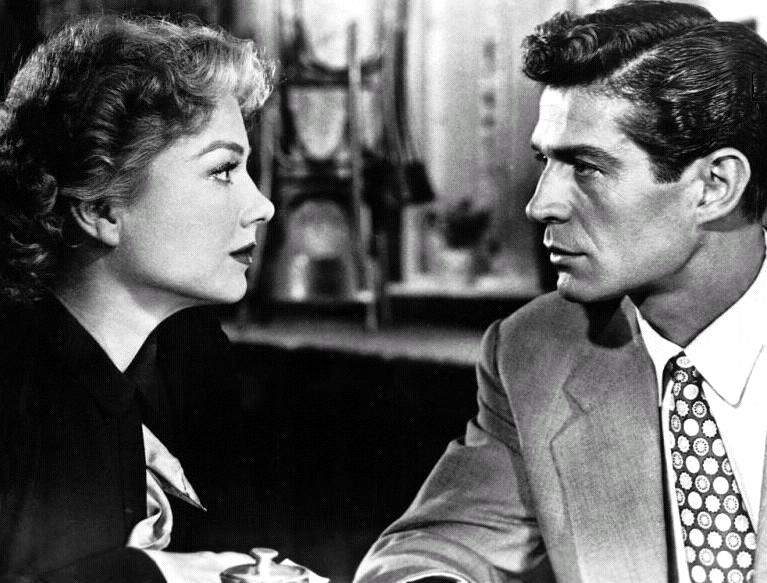
 With Anne Baxter in Carnival Story (1954)


As Jerry Cotton (above), an FBI agent in German language films.

With actress Julie Adams in Four Girls in Town (1956)

(


With a young Maggie Smith (above) in Nowhere to Go (1958).


Sex kitten (and ex-blond Bond girl) Shirley Eaton disciplines George in Million Eyes of Su-Muru (1967). Frankie Avalon (!) was his co-star. George was still looking great at age 46.


George could really fill out a uniform (above). He was a U.S. Navy communications officer stationed on Johnson Island in the Pacific during WW II.

Pure, 100% Hollywood beefcake:


Thursday, August 18, 2011

Rock Hudson: Closeted Hollywood Star

Hudson at home his Beverly Hills residence: 9402 Beverly Crest Dr.

Looking down over Beverly Hills, “The Castle” was the 3.5 acre estate of actor Rock Hudson (1925-1985), where he lived from 1962 until his death. At the height of his career, Universal Studios purchased it for him as part of his contract renewal. Constructed with a stucco finish and red tile roof, the house was protected by a massive gate in the front (always left open) and steep cliffs on three sides, which ensured the closeted actor’s privacy.

Hudson gave a detailed description of the house to his authorized biographer. He loved his home and spent 23 years meticulously restoring it. The interior boasted two living rooms, four fireplaces, a steam room and gym, and a theater with stage and footlights. Anyone who entered became aware of his sexual orientation, even though he led a closeted public life. His bed was carved with a large male figure and on the pool deck stood large slightly abstract sculptures of naked boys; one depicts a boy throwing a smaller lad into the pool (photo below).

One of his favorite spots was the home theater, which had originally been a garage. It housed a vast collection of films and up-to-date projection equipment, while a collection of rare records filled one wall. He rehearsed upcoming roles on the wooden stage. Also on the grounds was a greenhouse overflowing with orchids.

The Castle was decorated in what one of Hudson‘s friends termed “early butch” – dark wood, pewter candlesticks, zebra skins, and heavy doses of wrought iron. The patio led to a 40-foot pool with jacuzzi and lion’s head fountain. A 20-foot barbecue that could cook enough meat to feed a hundred people. Hudson liked to give large pool parties, to which he’d invite a hand-picked assortment of handsome youthful males. He cruised Melrose Ave. in Hollywood in the vicinity of the Spike and the Eagle (gay bar), riding around in a chauffeured limo with black out windows, pulling over when someone young and handsome caught his eye. Invariably, they returned to Rock’s “Castle” in Beverly Hills.

Rock Hudson did what most other gay movie stars did at the time. He agreed to a studio sanctioned smoke-screen marriage to Phyllis Gates (now a Beverly Hills based interior designer); the studio also promoted the wedding and the honeymoon. Three years later it was all over. Shortly thereafter Rock Hudson bought his favorite house on Beverly Crest Drive. However, everyone he worked with in Hollywood knew his story. Hudson found an acceptance and compassion among show people that he feared he would never find among his fans. His greatest accolade was an Academy Award nomination for his performance in Giant (1956), co-starring Elizabeth Taylor and James Dean, although his fans most fondly remember his many romantic comedy films with co-star Doris Day.

Hudson lived most of his years at his “castle” with just his female housekeeper and seven dogs. But occasionally, he had a live-in male lover. When he did, he was careful to maintain two separate phone lines for “appearances,” and to make sure he was never photographed with the other man. His years of diverting the truth about his sexual orientation from the general public came to an end in 1985. He died in seclusion at his “castle” from complications of AIDS on October 2 of that year.

Photo below: Rock Hudson and co-star Elizabeth Taylor in Giant (1956).


Shown below with actor George Nader, the lover of Mark Miller, who was Hudson's personal secretary: