Role models of greatness.
Sunday, August 3, 2025
Prince Henry of Prussia
Seriously.
Born Friedrich Heinrich Ludwig in Berlin, Prince Henry of Prussia (1726-1802) was the younger brother of Frederick the Great. Prince Henry was a distinguished soldier and statesman who in 1786 was backed by Alexander Hamilton, Baron von Steuben and other disgruntled American politicians as a cultured and liberal-minded candidate for “king” of the United States, when Americans were considering a constitutional monarchy form of government (George Washington had declined an offer to serve as "king"). Prince Henry was 60 years old at the time. In the end, a republic form of government won out, headed by a president, so the offer was not open long enough for Henry to accept, and George Washington was selected as the unanimous choice of the electors to serve as our first president.
While it might seem far-fetched that a Prussian man would be accepted by the American people as their leader, it must be recalled that without the military leadership of the Prussian Baron von Steuben, our continental army would likely not have prevailed against the British. Benjamin Franklin, while based in Paris, recommended Baron von Steuben to General George Washington, who brought von Steuben to Valley Forge. Von Steuben affected an astonishing military turnaround, whipping into shape Washington’s rag-tag band of soldiers.
Prince Henry (childless), Frederick the Great (childless), and Baron von Steuben (never married) all had one thing in common, and that is sexual relations with men (some historians promote an opinion that Alexander Hamilton's intense relationship with John Laurens included intimate physical relations). Benjamin Franklin was well aware of Baron von Steuben’s proclivity for young men but did not tell Washington that von Steuben was about to be run out of France for his “immoral” acts, which von Steuben never denied. Fellow countryman Prince Henry was also brazenly open about his sexual interest in young men. Both Prussians had advanced military skills, and Prince Henry led Prussia’s troops so successfully during the Seven Years' War that he never lost a battle. Baron von Steuben never married, but Prince Henry entered into a childless marriage of convenience, as was the custom of high-born homosexuals of the time.
Three of Prince Henry’s affairs with younger men are documented: the 17-year-old French émigré Count of Roche-Aymon, Major Christian Ludwig von Kaphengst (1743-1800) and an actor known as Blainville. It is known that Major Kaphengst exploited the prince's interest in him to lead a dissipated, wasteful life on a Prussian estate not far from Rheinsberg, Prince Henry's castle near Berlin. It was also reported that Henry often chose the officers in his regiment for their handsomeness rather than for their military competence.
After the death of his brother Frederick the Great, Henry became an advisor to his nephew, the new King Frederick William II of Prussia (regent 1786-1797), and during the last five years of his life advised his grand nephew, King Frederick William III, who reigned over Prussia from 1797 to 1840.
Sources:
Keith Stern’s Queers in History (2009)
Warren Johansson essay in Wayne R. Dynes’s Encyclopedia of Homosexuality
Wikipedia
Monday, September 9, 2024
King Ludwig II of Bavaria (1845-1886)
From a letter sent by Paul to Ludwig on May 5, 1866, when King Ludwig was 20 years old:
“Dear and Beloved Ludwig! I am just finishing my diary with the thought of the beautiful hours which we spent together that evening a week ago which made me the happiest man on earth… Oh, Ludwig, Ludwig, I am devoted to you! I couldn’t stand the people around me; I sat still and, in my thoughts I was still with you...How my heart beat when, as I passed the Residenz, I saw a light in your window.”
Paul and Ludwig also shared a passion for composer Richard Wagner and the theater. Paul was gifted with a beautiful voice and sang for the king many times. When Paul and Ludwig visited Wagner’s home, the lads shared a “cosy little room,” as described in one of Paul’s letters. Wagner rehearsed Paul in a portion of his opera Lohengrin, which was performed for the 20th birthday of the king on August 25, 1865, at the Alpsee in Hohenschwangau, where Ludwig’s family had a favorite castle. It was magnificently staged with Paul dressed as the hero Lohengrin, wearing silver armor, drawn over the lake by an artificial swan as the scenery was illuminated by electric lights. The King sat enraptured as his intimate friend sang his favorite music.
A year later, on New Year’s day, 1867, all Bavaria was delighted to hear the announcement of their dashing King Ludwig’s engagement to Princess Sophie, a native Duchess and sister to “Sisi,” the beloved Empress of Austria. The royal wedding was arranged to take place on Ludwig’s 22nd birthday, August 25, but an official announcement early in the summer postponed the nuptials until October 12. However, Ludwig broke off the engagement a week before the marriage was to take place. In a long letter to Princess Sophie, he stated that the engagement and wedding had been forced upon him; he loved the Princess “like a sister” and hoped to remain her friend.
Ludwig's Coronation Portrait
There was a reason for the postponement and ultimate cancellation. During the summer Ludwig had met Richard Hornig, a groom employed at one of his stables. A blond, blue-eyed Prussian, five years older than the king, he was to become one of the most important people in Ludwig’s life. Hornig was a superb horseman, and their mutual love of horses allowed a friendship to develop. In a short time Hornig was seeing the king constantly and intimately. Hornig soon occupied the office of Crown Equerry and Master of the Horse. He controlled all horse transport, coaches and carriages, stabling, purchase, breeding and training of the Royal horses, which numbered around 500. The king and Hornig often visited the king’s remote castles, chalets and mountain huts, mostly in a four-horse carriage, but sometimes in a romantic, illuminated sleigh in the moonlight. When the two dined at the king’s castles, they were waited on by footmen dressed in 18th-century livery.
Hornig was soon acting as go-between for the king and his ministers, much as Queen Victoria’s John Brown, which caused much tongue-wagging and criticism. Ludwig and Hornig also set out on a journey through Germany to France, with the King traveling incognito as Count von Berg. It was during this time that the king issued a postponement of his wedding. The appearance of Richard Hornig in his life led to the king’s full break with Sophie. Ludwig’s homosexual relationship with Hornig made him realize that a normal love for any woman was not possible.
In fact Ludwig II went on to have a succession of handsome male companions, two of whom were Hungarian theater star Josef Kainz and courtier Alfons Weber. They were both good-looking young men, and Ludwig treated them as other royal males treated their mistresses. Ludwig showed Kainz special favor, giving him expensive gifts, inviting him for stays in the king’s castles and asking him along for a vacation in Switzerland.
They even had their photo taken together, although it is scandalous that in this portrait Kainz is seated, and the king is standing (photo above). The king was an imposing figure at 6'4" tall.
King Ludwig was an obsessive, devoted patron of the composer Richard Wagner. The king wiped out Wagner’s enormous debts, built him a theater in Bayreuth custom designed for his operas as well as a private villa across town. Wagner lived on money supplied by the king. As the king aged, he became an eccentric recluse caught up in the building of fantasy castles decorated with murals depicting scenes from the legends upon which Wagner’s operas were based, all the while ignoring matters of state, which were left to his staff of ministers. It was during Ludwig’s reign that Prussia launched a successful campaign to unify all the disparate German kingdoms into one unified German Empire, with Prussian King Wilhelm I as kaiser.
When the king’s ministers caught wind that Ludwig was planning to dismiss his entire cabinet and replace them, they acted first. They plotted to depose him constitutionally, on grounds of mental illness, subsequently issuing a statement that he was unable to rule. However, this was accomplished without any medical examination, so the king’s diagnosis of insanity remains suspect. Among the list of bizarre behaviors described in this “medical report” was the fact that his young groomsmen were often ordered to strip naked and dance for the king’s entertainment. Poor taste, perhaps, but not insanity. Three of the four psychiatrists who signed the damning medical report had never met the king, and none had ever examined him.
Even so, the ministers made plans to place Ludwig’s younger brother on the throne. On June 12, 1886, a commission arrived at Neuschwanstein castle and served the king with an order of deposition, escorting him to Schloss Berg on the shores of Lake Starnberg. The next day the king’s body was discovered floating in the lake, alongside the corpse of Dr. Gudden, one of the psychiatrists who had declared the king insane. Gudden’s body showed evidence of a struggle and attempted strangulation, suggesting that the king tried to kill him (Ludwig was 6'4" tall and heavy-set, so there is validity to this theory). The exact cause of the king’s death remains open to speculation, since an autopsy found no water present in his lungs.
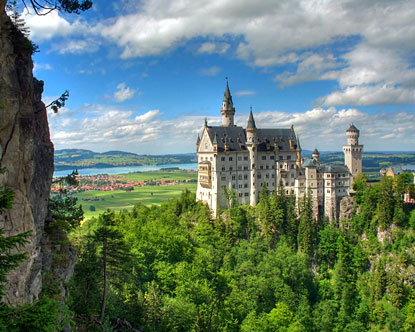
Ludwig is best known as an eccentric whose legacy is intertwined with the history of art and architecture. He commissioned the construction of several extravagant fantasy castles and palaces, the most famous being Neuschwanstein. Since his legacy of these grandiose castles lives on in the form of massive tourist revenue, King Ludwig is revered by many in Bavaria today. Here is a photo of the extravagant ceramic stove adorned with figures of Tristan and Isolde in the bedroom of Ludwig II at Neuschwanstein palace in southern Bavaria.
The three most-visited of Ludwig's castles:
top to bottom: Neuschwanstein, Linderhof and Herrenchiemsee
Franz, Duke of Bavaria (b. 1933, age 91) is the present head of the Wittelsbach dynasty. "Duke of Bavaria" is a courtesy title, since the Wittelsbach dynasty ceased to exist in 1918. His great grandfather King Ludwig III (deposed in 1918) was the last ruling monarch of Bavaria.
Franz is a gay man who continues to live in a suite of apartments in Schloss Nymphenburg (Munich), the summer residence of the Wittelsbach kings of Bavaria. King Ludwig II was born in this palace (see sidebar for link). Here Franz is photographed in 1993 with his nieces Duchess Marie Caroline of Württemberg (b. 1969) on the left and Duchess Elizabeth in Bavaria (b. 1973).
Since 1980 Franz has had a life partner, Dr. Thomas Greinwald, although they have never married. In the 2023 photo below, Greinwald is to the right of Franz. The occasion was a 90th-birthday tribute to Franz held in Munich in July that year. In 2021 the couple appeared in an official portrait (with their dog) that is thought to be the first public acknowledgment of a same-sex relationship by the head of a current or former royal dynasty. Unfortunately, that portrait is copyrighted.
Interior of Nymphenburg Palace, where Franz lives and King Ludwig II was born in 1845.
The Wittelsbachs were opposed to the Nazi regime in Germany, and in 1939 Franz's father Albrecht took his family to Hungary. They lived in Budapest for four years before moving to Somlovar Castle in late 1943. In March 1944, Nazi Germany occupied Hungary, and on October 6, 1944, the entire family including Franz, then aged 11, was arrested. They were sent to a series of Nazi concentration camps including Dachau. At the end of April 1945 they were liberated by the United States Army.
Note: Franz also uses Schloss Berg, the modest castle on Lake Starnberg, as a retreat. This is the location where King Ludwig II's body was found in 1886. Today a memorial cross rises from the water's surface a few yards off shore, marking the exact spot where Ludwig's body was discovered in waist-deep water. The "official" cause of death was by drowning, but this is still disputed. 40-year-old Ludwig was a strong swimmer, and no water was found in his lungs.
Wednesday, January 11, 2023
Archduke Ludwig Viktor
The Habsburg dynasty had a consequential problem with inbreeding, resulting in a family that, how shall we say, lacked handsome physical attributes. Archduke Ludwig Viktor was no exception. His only advantage was the fact that his older brother, Franz Josef, was the Emperor of Austria-Hungary.

The archduke (1842-1919) had a face only a mother could love (evidence at left). After having produced three male heirs, Ludwig’s mother ignored the fact that he wasn’t the girl she had wanted and dressed him like one. It didn’t help that everyone called him Luzi-Wuzi (pronounced Loot-see Voot-see). He was an impetuous, openly homosexual pleasure-seeker whose life revolved around the theatre and collecting art and antiques. He wore women’s clothing (photo below), kvetched and gossiped incessantly and couldn’t be trusted with a secret from anyone. His über-vain sister-in-law Sissi (Empress Elizabeth), adored by the Austrians as an antidote to their dull, stuffy emperor, was initially kindly disposed toward Ludwig Viktor, until things she told him in confidence got back to her. It got so bad that she eventually refused to have a conversation with him unless a third party was present to verify what transpired. Incredibly, Sissi’s favorite sister Sophie was singled out as a possible bride for Ludwig Viktor, but she rejected him, only to become engaged to and then dumped by another gay royal, the King of Bavaria, Ludwig II, of Neuschwanstein fame.
Trivia: In related tragic family news, another of Ludwig Viktor’s brothers, Emperor Maximilian I of Mexico (emperors seemed to run in the family), was executed by firing squad while in Mexico City in 1867. Maximilian and Ludwig looked so much alike (unfortunately) they could have been twins. To be a Habsburg royal was a big deal. From the early thirteenth century to 1918 this dynasty controlled vast properties in which more than a dozen languages were spoken, and not just in Europe. A Habsburg was Emperor of Mexico, and another the Empress of Brazil. In addition to Austria and Hungary, the Habsburg dynasty at one time ruled over major portions of Spain, Slovenia, Serbia, Switzerland, Croatia, Poland, Italy, Ukraine, the Czech Republic, Portugal, Slovakia and Romania. Impressive.
But I digress. At age 21, the archduke needed new digs to host his notorious and extravagant “stag” parties, so he built an Italian Renaissance palace on the new Ringstraße, the grand boulevard encircling central Vienna sited along the path of the recently razed city walls. Built on Schwarzenbergplatz just two blocks from the State Opera House, Ludwig Viktor’s city palace, designed by famed architect Heinrich von Ferstel, had a glaring deficiency – it had no swimming pool. This oversight gave the archduke reason to patronize a nearby public establishment, the Centralbad, Vienna's "largest and finest bathhouse." The archduke, a frequent visitor, went there regularly for “Turkish baths.”
Ludwig Viktor’s homosexuality was an open secret. Even his brother Franz Josef joked about it. But in 1906, the archduke was slapped and knocked to the ground by one of the young Centralbad* patrons, an athletic middle-class man, apparently as the result of an unwanted advance by the archduke. Ludwig Viktor used his family ties to have the young man arrested, but it was determined that the man’s actions were warranted, and he was released from jail. When informed of his brother’s scandalous behavior, Emperor Franz Joseph became disgusted and banished Ludwig Viktor to the archduke’s summer palace, Schloss Kleßheim, a former residence of the Archbishops of Salzburg, and ordered him not to return to Vienna during his brother's lifetime. Ludwig Viktor was also forced to resign his patronages, and most of his staff was moved to other positions.
*Trivia: the Centralbad is now the Kaiserbründl, one of Europe’s most luxurious gay male saunas, complete with chandeliers, erotic frescos, marble columns, restaurants and bars. Kaiserbründl means "Emperor's Spring."
At Schloss Kleßheim (above) Ludwig Viktor had a grand blue and white swimming pool installed. He invited army officers to use it, but could never seem to find swimsuits for them to wear. As a result, Austrian soldiers were subsequently forbidden to go there. In Salzburg the archduke eventually won the hearts of the locals for his charitable efforts, and by an amazing coincidence, outlived the Habsburg empire, dying on January 18, 1919, on the first day of the post-WW I conference in Versailles, which would abolish all royal orders. He is buried just a mile or so south of Schloss Kleßheim in the cemetery of the local Pfarrkirche in Siezenheim. Notice the "LV" on the pedestal supporting the cross.
It is noteworthy that he was not buried in the Imperial Crypt in Vienna, along with all his other family members.
Both of Ludwig Viktor’s palaces can be visited today. Schloss Kleßheim was used as a dance school in the 1920s, but the Nazis later took it over as a guest house. Hitler and Mussolini held meetings here, and the palace was notoriously riddled with listening devices. During the Cold War, the neutral Austrian government used Schloss Kleßheim to hold conferences and host international guests, among them U.S. President Richard Nixon, who met here with Austrian Chancellor Bruno Kreisky on his way to Moscow in 1972. The palace now serves as Salzburg’s main gambling casino and features glamorous bars and restaurants.
As for Ludwig's downtown Vienna palace on Schwarzenbergplatz (above), the military used it as an officer’s casino before the First World War. Ludwig Viktor would turn over in his grave if he saw the TGI Friday’s restaurant on the ground floor, but he’d take more kindly to the fact that today, the palace’s great hall functions both as a rehearsal space for the Burgtheater and an alternative venue for the theater’s smaller productions. Fortunately, the restaurant and theater entrances are around the corner from each other. With only two hundred seats, “Burgtheater im Kasino,” as it is known, offers a small and intimate setting for one of Vienna’s best theater companies.
Sources: James Conway (Strange Flowers), Wikipedia
Tuesday, December 22, 2020
Lord Mountbatten
Edward Prince of Wales and his cousin Lord Louis Mountbatten “relax” in a canvas swimming pool on board H. M. S. Renown during their 1920 Empire Tour.
Lord Louis was a great grandson of Queen Victoria and the uncle of Prince Philip (consort of Queen Elizabeth II). Mountbatten was also a promiscuous bisexual who was famously rumored to have had an affair with Edward VIII (who was Prince of Wales at the time) when he accompanied him on his Empire tours (see photo above). Another “close friend” was an Irish student whom he met at Cambridge – James Jeremiah Victor Fitzwilliam Murphy - who was known by the name of Peter Murphy, a leading Cambridge homosexual with strong left wing leanings. He became Mountbatten's close and constant companion, and Mountbatten supported him with an annual allowance of 600 pounds until Murphy's death in 1966. The well-known homosexual Noel Coward was also included among Lord Louis’s close circle of friends.
Although Lord Louis married Edwina, a fabulously wealthy socialite, he cut a wide swath through both high and low born men and women. As Mountbatten himself once put it, “Edwina and I spent all our married lives getting into other people's beds.” His wife was to have a torrid affair while in India with Panditji Nehru, Prime Minister of India, so it appears a merry old time was had by all. Edwina, Nehru and Mountbatten (photo at right) were fully engaged in a classic love triangle, but it is generally acknowledged that Nehru was the love of Edwina’s life. All three of them were known by insiders as having bisexual proclivities. Mountbatten said they were a "happy little threesome." As for Mountbatten and Edwina, they fought most of the time and lived apart for much of their lives.
Between affairs Lord Louis became Admiral of the Fleet (British Royal Navy), the last Viceroy of India, the Earl Mountbatten of Burma and the first Governor-General of an independent India. A former favorite of Winston Churchill, after 1948 Churchill never spoke to him again over Mountbatten’s role in the independence of Pakistan and India. On August 15, 1947, on Mauntbatten's watch, Britain relinquished its Indian Empire. Churchill’s infamous bigoted quote about Indians: “They are a beastly people with a beastly religion.” As Supreme Allied Commander for Southeast Asia during WW II, Mountbatten's war service culminated in the recapture of Burma from the Japanese.
Mountbatten forged a close bond with his grand nephew Prince Charles, the Prince of Wales, who was deeply affected by his murder in 1979. Mountbatten had a strong influence on Prince Charles, who declared that things would never be the same after the loss of his mentor. Lord Louis was known as “Dickie” to family and close friends, which was unusual, considering that Richard was not among his given names. Oh, I nearly forgot. "Dickie" was widely known in the military as "Mountbottom." I'm not making this up.
Mountbatten’s indiscretions paled in comparison to his elder brother George, who inherited the title Marquis of Milford Haven on the death of their father. George was also a promiscuous bisexual who was married to another bisexual: Nadeja, Countess of Torby, who was a niece of Czar Nicholas II.
George Mountbatten's claim to infamy was his vast collection of pornography, which he lavished money on, lovingly binding it into volumes emblazoned with the family crest. Some of the pornography consisted of photos of aristocrats having intercourse with their servants, but far more disturbing were the pictures of family orgies in which children were involved in active sexual participation and bestiality. On George's death the collection was inherited by his son, so part of it is it still in the hands of the Mountbatten descendants, although the bulk of it was donated to the British Museum. Don't expect to see it on display.
*When WWI bred increasing anti-German sentiment in Britain,
astute observers noted that the Kaiser was Queen Victoria’s grandson
and King George V’s first cousin. In recognition of the delicacy of
the position, George V changed the name of his royal house from
Saxe-Coburg-Gotha to Windsor, after the castle. At the same time, he
also took the modern step of adopting Windsor as a surname for his
family.
Note: This post was updated December, 2020
Sources:
The Mountbattens -- Their Lives and Loves by Andrew Lownie (2019)
FBI files (dating back to 1944) obtained by Freedom of Information Act
Friday, February 7, 2020
Grand Duke Sergei Alexandrovich
Grand Duke Sergei Alexandrovich (1857-1905), one of the fabulously wealthy Romanovs, was notorious for his homosexual exploits. While serving as Governor of Moscow from 1891 to 1905, he proved partial to young male flesh, often of the prostitute variety. However, his elevated social status as the younger brother of Tsar Alexander III and uncle of Tsar Nicholas II afforded him protection to be able to live an indiscreet gay life.
There were at least seven gay grand dukes at the time – uncles, nephews and cousins of the last two tsars (Alexander III and Nicholas II) – and "Serge", as he was called, was at the top of the heap. He was involved in a series of homosexual affairs between 1874 and 1884, when he was living in St. Petersburg. Imperial Chancery Chief Alexander Mossolov complained that Serge’s scandalous private life was the talk of the town. Although there were laws criminalizing homosexuality, the Romanovs chose not to enforce them. During this same time period there was even a gay tsar -- but not a Russian. Tsar Ferdinand I, of German/French ancestry, ruled neighboring Bulgaria from 1887-1918 (see separate post in sidebar).
Although Grand Duke Sergei married Princess Elizabeth of Hesse (a granddaughter of Queen Victoria), his sexual orientation assured a childless marriage. However, they became the guardians of the son and daughter of Sergei’s younger brother, Grand Duke Paul, with whom Sergei had enjoyed a special closeness as a youth. Brother Paul had been banished from Russia and stripped of all titles and privileges when, after the death of his first wife, he married a divorced woman of lower social class in 1902, without being granted permission by his nephew, Tsar Nicholas II.
As for his legacy, he had enjoyed a successful military career, earning promotion to Colonel and eventually General. After active duty in the Russo-Turkish War of 1877-78, he was awarded the Order of Saint George for bravery and courage in action with the enemy. After a visit to the Holy Lands, he became Patron of the Russian presence in Jerusalem, including chairmanship of a society dedicated to the upkeep of Orthodox shrines in the Holy Lands. As Governor of Moscow, however, he oversaw the expulsion of 20,000 Jews, victims of infamous government-sponsored pogroms under Tsarist
Russia.
Sources:
Dan Healey – Homosexual Desire in Revolutionary Russia (2001)
Sunday, October 6, 2019
Prince Andrew of Greece
Queen Elizabeth II’s husband, Prince Philip the Duke of Edinburgh, had a mother who was born profoundly deaf and a father who was bisexual. His father, Prince Andrew of Greece (1882-1944), was a disgraced military commander, charged with treason for failure to carry out orders in the Greco-Turkish War (1919-1921) and subsequently stripped of his royal titles. Blamed for the loss of Greek territory in that disastrous war, he was imprisoned and sentenced to death. His wife, Princess Alice of Battenberg*, arranged for intervention by British King George V, who negotiated for Andrew’s release. The British Royal Navy rescued the family, with infant Philip nestled in a converted orange crate. The family was then able to relocate to a suburb of Paris, where they lived in exile. The photo at right shows Prince Andrew and Princess Alice in 1905, two years into their ill-fated marriage.
Andrew had always lived a lascivious lifestyle, carrying on one affair after another with both men and women, so it is not surprising that he largely ignored his wife and children. Princess Alice suffered a mental breakdown when young Philip was nine years old, and she was placed in an asylum in Switzerland for three years. Prince Andrew then relocated to Monaco to live with his mistress, abandoning Philip, who was sent to England to be cared for by his relatives, the Mountbattens. Philip's four sisters moved to Germany, where they married local aristocrats and nobles. Prince Andrew lived the rest of his life in exile in Monaco, all the while continuing a string of affairs. Prince Andrew, who had been near-sighted from his early days, was always seen wearing glasses, but in later years he sported a monocle as a dashing accessory.
But before things fell apart, Andrew, tall and good looking, cut a fine figure with Alice of Battenberg, one of Europe’s loveliest princesses, as the photo attests. They were living in a modest villa in Corfu when their only son (their fifth and youngest child), Prince Philip, today's consort of Queen Elizabeth II, was born in 1921.
Andrew (shown in painting at left) had grown up the son of King George I (a German speaking Danish Prince and King of Greece) and the Russian Grand Duchess Olga Konstantinova. After his father was assassinated, Andrew’s brother Constantine became King of Greece. Unfortunately, Constantine was forced to abdicate because of his neutral stance during WW I, but was reinstated in 1920.
Unfortunately, Andrew died before his son married the British Princess Elizabeth in 1947. Andrew succumbed to a heart ailment and died at the Hotel Metropole in Monaco in 1944, and was subsequently buried in the gardens of Tatoi, the Greek royal residence to the north of Athens. Just before his marriage to Elizabeth in 1947, Prince Philip became a British subject, taking his mother's surname, Mountbatten, thus renouncing his right to the Greek and Danish thrones. When Elizabeth's father, King George VI, died in 1952, she became queen of England, and upon her coronation in 1953, Philip served as Prince Consort.
A more detailed chronology of Prince Andrew’s life can be discerned from the video at the end of this post.
*Prince Philip’s mother, Princess Alice of Battenberg, was born profoundly deaf at Windsor Castle in the presence of her great grandmother Queen Victoria. She grew to become one of Europe’s most beautiful princesses, adept at lip reading and speaking German and English. At the coronation of King Edward VII in 1902, Alice met Prince Andrew, ultimately marrying him in Darmstadt, Germany, the very next year. She spent her early married life in the turbulent political arena of Greece. After being ignored by her husband and shamed by his blatant affairs and political disgrace, she suffered a severe nervous breakdown and eventually entered the Greek Orthodox Church to became a nun, founding a female religious order. She creating quite a stir as a nun who chained smoked and played canasta. Princess Alice lived out her final years in Britain and died at Buckingham Palace, where she had been invited to live after the fall of King Constantine II of Greece (her brother-in-law) and the imposition of military rule there in 1967. Upon her death in 1969 she was interred in the royal crypt at Windsor Castle, but her wish to be buried in Jerusalem was finally realized in 1988, when her remains were transferred to a crypt below a convent in Gethsemane.
Princess Alice had attended the royal wedding of Queen Elizabeth II to her son Prince Philip in 1947, but her three daughters (Prince Philip’s sisters) were conspicuously excluded, because all of them had married German nobles who were high ranking Nazi officers. Oddly, Prince Philip never told Princess Diana that his mother had been born severely deaf, all the more astonishing in light of the tireless work Princess Diana did on behalf of the deaf community in Britain.
In this photo a young Prince Philip is shown holding his mother's hand. Philip learned sign language to be able to communicate with his mother. Prince Andrew is shown seated and surrounded by his four daughters. Philip was the only male child in the immediate family.
Prince Philip’s German ancestry was always problematic. When his sister Cécile died in a plane crash in 1937, her funeral was attended by Hermann Göring. There are photographs of the then 16-year-old Prince Philip at the funeral, surrounded by relatives in SS and brownshirt uniforms. Philip’s sister Sophia was photographed sitting opposite Hitler at the wedding of Hermann and Emmy Göring. Sophia herself was married to Prince Christopher of Hesse-Cassel, an SS Colonel attached to Himmler's personal staff. Their eldest son, Karl Adolf (Prince Philip’s nephew), was named in Hitler's honor. During WW I the Battenbergs “translated” their name from German to the English word Mountbatten (remember that Prince Philip’s mother was a Battenberg; "berg" in German means "mountain"). Accordingly, Prince Philip anglicized his name to Lieutenant Philip Mountbatten (the German House of Battenberg was a branch of the House of Hesse), to distance himself from his actual German/Danish family name of Schleswig-Holstein-Sonderburg-Glücksburg (on his father’s side). Similarly, the House of Hanover (German) changed its name to the House of Windsor. The late Queen Mother was strongly opposed to the marriage of her daughter Elizabeth to Philip, but eventually gave in to her daughter’s entreaties.
Prince Philip the Duke of Edinburgh and his young bride, Queen Elizabeth 11, on their honeymoon in 1947.
The British royal family has spent more than sixty years trying to downplay or disguise Prince Philip’s heritage and the monarchy's German roots. Queen Elizabeth II’s own grandmother, Queen Mary, had been born a German princess, and the British Royal family’s strong German heritage caused uneasiness during the two world wars. Hoping to sweep all this German business under the carpet for good, in 1960 Queen Elizabeth II decreed by special order that all of her children and grandchildren were to use the name Mountbatten-Windsor (which sounds a lot less German than Battenberg-Hanover). Thus the recently married Prince William has the official name: William Arthur Philip Louis Mountbatten-Windsor.
Prince Andrew of Greece and Princess Alice of Battenberg
Prince Philip’s cousin, Prince Charles Edward, had a career that further embarrassed England. Charles Edward was born into the British royal family at Claremont House (Surrey, England) in 1884. He accepted a German dukedom and found himself fighting for the Kaiser in World War I. Later he was deprived of all his British titles and branded a traitor. But the worst was his assistance in Hitler's rise to power, so Prince Charles Edward ended his days as a convicted Nazi. Charles Edward had been Queen Victoria's favorite grandson, and he was first cousin to three European monarchs: English King George V, Kaiser Wilhelm II of Germany, and Nicholas II, Russia’s last Tsar.
Unfortunately, Queen Victoria made a decision that ruined his life by decreeing that Prince Charles Edward would become the Duke of Saxe-Coburg-Gotha, the German principality from which Victoria’s husband Albert originated. At 16 years of age and speaking no German, Charles Edward left England to become Carl Eduard, Duke of Saxe-Coburg-Gotha, with 13 castles in Germany and Austria, hunting lodges, hotels, a power station, tens of thousands of acres of farmland in Bavaria and a duchy with an income worth £17 million pounds at today's value. In no time flat the German Kaiser married him off to his own niece, Victoria. In retrospect, I’m sure Charles Edward realized that sometimes it’s better to stand up to one’s grandmother, even if she is the queen.
While things are much more progressive these days, royals are perpetual sources of scandal and gossip. Prince Harry, who for years supplied the tabloid press with ample fodder, recently married Meghan Markle (a bi-racial commoner), and just a year ago Lord Ivar Mountbatten married his male partner, James Coyle. This was the British royal family's first ever same sex wedding (held in the Mountbatten family's private chapel). Fifty-something Lord Ivar Mountbatten is a cousin of Queen Elizabeth, and like the Queen, he is a direct descendant of Queen Victoria. He is also a great-nephew of Earl Louis Mountbatten, who was Prince Philip's uncle.
Sources:
Wikipedia
Vanity Fair
http://crownstiarasandcoronets.blogspot.com/2016/07/princess-alice-of-battenberg-princess.html
Wednesday, March 21, 2012
India's Prince Manvendra
As expected in a culture of arranged marriages, Manvendra took a wife in 1991. Because he was homosexual, the marriage was not consummated, and a divorce was granted in 1992, after he confessed his sexual orientation to his wife.
“I regret ruining her life. I feel tremendously guilty.”
Manvendra has stated that he thought his homosexual urges would dissipate upon marrying, because his isolated and artificially protected upbringing did not afford him access to a modern understanding of homosexuality. His only male/male sexual experiences had been during his adolescent years, in physical explorations with one of his servants.
After a hospitalization due to a nervous breakdown, Manvendra’s doctors revealed his homosexual orientation to his parents, who eventually disowned him for bringing shame to the royal family. In an unusual move, he has since chosen to be honest with his citizens, speaking publicly in 2006 about his sexual orientation with the hope of changing how Indians viewed homosexuality. That year the story of Manvendra's coming out made headlines in India and around the world. His effigies were burnt in Rajpipla, where traditional society was shocked.
In 2007 Manvendra appeared as a guest on the Oprah Winfrey Show as one of three persons featured in a segment titled 'Gay Around the World'. He stated that he had no regrets about coming out, and that he believed the people of his state respect him for his leadership in preventing and educating his citizens about HIV/AIDS. As well, he revealed that he had become involved in a social network to help gay people in Gujarat. Manvendra explained that 85 percent of India’s gay men are married to women, most of them forcibly, through arranged marriage. At the time of his TV appearance, homosexual acts were still a crime in India, but decriminalization legislation was passed in 2009.
“The people in Rajpipla look up to us royals in times of crisis, and I try to carry out the duties of my forefathers from the past. My main purpose in coming out openly was that I wanted to break the myth that prevails in Indian society that homosexuality is a Western influence and that homosexuality only exists among those in the lower economic status.” The prince recently participated in Adam Bouska's NoH8 world-wide photographic protest against California's Proposition 8.
Somewhat surprisingly, Prince Manvendra has thrived since coming out and reappeared on Oprah last year to tell how his life has moved forward. He has reconciled with his father and has founded the Lakshya Trust, which supports sexual minorities in India. The prince was a recent keynote speaker for a symposium on gay tourism in India. In his state of Rajpipla, there is now a restaurant with out, HIV-positive employees, a Transgender Welfare Board, and plans for a retirement home for LGBT individuals.
“It was difficult to be gay in my family. The villagers worship us and we are role models for them. My family didn't allow us to mix with ordinary or low-caste people. Our exposure to the liberal world was minimal. Only when I was hospitalized after my nervous breakdown in 2002 did my doctor inform my parents about my sexuality. All these years I was hiding my sexuality from my parents, family and people. I never liked it, and I wanted to face the reality. When I came out and gave an interview to a friendly journalist, my life was transformed. Now, people accept me.”
Prince Manvendra, still unattached romantically in his mid-40s, uses gay dating websites in India.
“The problem is that people don't believe it is actually me. Whenever they see my profile and photographs, they tell me to take my profile down. They think I am a fake and ask me not to spoil the image of the prince they respect so much. I have a difficult time convincing them.”
Manvendra recently announced that he planned to adopt a child in the near future. If the adoption proceeds, it will be the first known case of a single gay man adopting a child in India.
“Adoption has been common in most royal families in India. The male is very important to carry on the family lineage. I made this announcement to answer the questions of the people in Rajpipla, who are looking forward to the next in line. I have not yet reached the stage where I have taken action, since my father still has the authority to make decisions. Once I take charge, then I will adopt a full-grown male from our extended family.”
Gohil serves as a sort of touchstone for closeted men and women the world over. Lately, it seems, everywhere he turns, someone is desperate to come out to him. “A lot of people have confided in me,” he says, “and they’ve been from royal families, not only in India but across the world. They’ve been industrialists, business tycoons, men and women with high-profile lives. Almost every week someone comes out to me.”
There are plans to turn Prince Manvendra's life story into a major motion picture. The script is to be written by another royal, Prince Amarjit Singh, a member of the Kapurthala royal family.
Tuesday, February 21, 2012
Ferdinand I of Bulgaria
Although Ferdinand I (1861-1948) eventually entered into a marriage of convenience with a rich Italian princess (Maria Louisa of Bourbon-Parma, who bore him four children), his penchant for young men was well-known throughout his life. Ferdinand's regular holidays on the Italian island of Capri, then a famous haunt for wealthy gay men, were common knowledge in royal courts throughout Europe.
Ferdinand was born in the opulent Palais Coburg* (photos at end of post) in Vienna, Austria, as the Duke of Saxony. He later became Prince of the Koháry (Hungarian) branch of Saxe-Coburg-Gotha, a ruling house dynasty of central Europe. You may recall that Prince Albert, husband of Queen Victoria of the United Kingdom, was born into this family. Ferdinand, from an immensely wealthy and well-connected noble heritage, was the grandson of King Louis Philippe I of France, the nephew of Ferdinand II of Portugal, cousin of both Queen Victoria and Leopold II of Belgium and second cousin of King Edward VII of Britain – not to mention being the nephew of Emperor Franz Joseph I of Austria.
Ferdinand was given a military upbringing, but showed no aptitude for it. He was much more literary, interested in jewels, clothes and, indeed, those young blond men. Queen Victoria, his most prominent relative, greeted his 1887 accession as Prince Regent of Bulgaria with disbelief. She stated to her Prime Minister, “He is totally unfit, delicate, eccentric and effeminate ... he should be stopped at once.”
Emperor Franz Joseph I of Austria was no fan, either. When Bulgaria and Russia affected a reconciliation in 1896, Ferdinand’s infant son Boris was converted from Roman Catholicism to Eastern Orthodox Christianity, the dominant religion in Bulgaria and Russia. In fact, the Bulgarian constitution required it (not to mention that Russian Tsar Nicholas II was the godfather of Boris). Franz Joseph was outraged and successfully petitioned the Pope to excommunicate Ferdinand. Ferdinand's wife, who was not consulted in the matter, was so horrified that she left Bulgaria and returned to her father in Italy, but she got no sympathy there, either. Her father ordered her to return to Bulgaria to her loveless marriage and ever domineering mother-in-law, who detested her.
Well, there you have it. One big happy family.
Sofia’s population was a paltry 11,649 at the time it was taken by Russian forces during the Russo-Turkish War (1877-1878). Sofia was declared the capital of an autonomous Principality of Bulgaria in 1879, and by the time Ferdinand arrived eight years later, the population had increased to nearly 19,000. Things were tough in Bulgaria in 1886. Twenty-nine year old Alexander I of Battenberg, the first non-Ottoman ruler of the newly autonomous state, had just been forced to abdicate at gunpoint in Sofia and was exiled to Austria. When the Bulgarian delegation set out to find a new leader for their country, it was no easy task. Their country was young, poor and stunted by difficult if not impossible political complications. They courted Ferdinand mostly because he was from a well-connected ruling house that would mean, if he were put on the throne, their fledgling nation would be tied to nearly every crown dynasty of Europe – plus he was available.
Ferdinand’s imagination started spinning out of control as he dreamed of a triumphal entry onto Bulgarian soil dressed as a dashing monarch. This idea was sparked by the arrival of a splendid military uniform replete with medals, epaulets, sashes and effusive gold trim, delivered to Ferdinand by the Bulgarian delegation in Vienna, playing deftly to Ferdinand’s lifelong bent for ostentation, pomp and show. The guy loved his clothes.
Bear in mind that Ferdinand was not the first choice as Prince Regent of Bulgaria. Not even close. He was a rather effeminate 25-year-old bachelor who obsessed over fashion, jewelry and flowers (violets were his favorites) – with no experience as a soldier, ruler or diplomat. However, every other European prince, duke, and assorted noble who was approached wanted no part of their political intrigues and turned it down, even the neighboring King of Romania. Ferdinand mulled it over and stalled, awaiting the approval of Europe’s great powers, but the impatient Bulgarian National Assembly went ahead and elected him in absentia – and Ferdinand ultimately accepted their call. Bulgaria had its giant neighbor Russia breathing down its neck and needed a man on its vacant throne post haste. As it played out, Central Europe would never be the same.
Ferdinand's handsome eldest son Boris (right), who would eventually succeed him at age twenty-four, as Tsar Boris III of Bulgaria.
To the amazement of his initial detractors, Ferdinand made a success of his reign until the political complexities leading up to WWI. Ferdinand ruled over Bulgaria for 33 years (1887-1918), first as Prince Regent, then as Tsar, after Bulgaria secured its complete independence from the Ottoman Empire in 1908. He re-established the royal dynasty of Bulgaria with legitimacy, since he could trace his ancestry back to medieval rulers of Bulgaria, who used the term Tsar instead of King. Thus Ferdinand's son Boris became the first Bulgarian monarch born on Bulgarian soil in a thousand years. On October 5, 1908, Ferdinand declared Bulgaria's independence while proclaiming himself Tsar (see above photo taken on proclamation day). He then went on a building spree, ordering the construction of many prominent and architecturally distinguished buildings still seen in Sofia today.
His ambitious and very rich mother, Princess Clementine of Bourbon-Orléans, was both the daughter of a king (Louis Philippe of France) and the mother of one. She set about making over the rather tatty nation her son was ruling. She built hospitals, orphanages, and the like as proof of filial affection. For her son’s birthday, she built a railway line connecting Bulgaria to the rest of Europe. She was a force of nature who completely dominated her husband and children. Ferdinand was her favorite son, and she habitually spoiled him rotten.
During Ferdinand's state visit to Paris in 1910, his first as Tsar of Bulgaria, the Parisians were effusive in their welcome. The president, prime minister and other leaders greeted the arrival of his train with a royal gun salute and loud cheers from the crowds lining the route from the station to his quarters at the Ministry of Foreign Affairs, where his apartment was furnished for the occasion with items from the palaces of the former French kings, notably Louis XIV and Louis XV. Every item in his bedroom had belonged to his grandfather, King Louis Philippe, including a vase with the portrait of his mother as young Princess Clémentine. At a speech in Ferdinand's honor at the Hôtel de Ville (city hall), the royal connection was illuminated by the words, "While we bow respectfully before the Tsar of Bulgaria, we also honor in his person the gallant son of our beloved France." Ferdinand swooned. When he drove through the grand boulevards of Paris, enthusiastic crowds cheered, "Long live the King!" It almost seemed as if the monarchy had been restored to France.
Ferdinand, however, turned out to be a genius at politics, playing the Great Powers against each other for almost 20 years, earning him the moniker “Foxy Ferdinand”. At the same time, he played arbiter to his country’s parliament and essentially did as he pleased, despite being merely a constitutional monarch. He even managed to gay up negotiations in the years prior to the First World War. As he expertly courted both major blocs, each of them included in their delegations a strapping young blond chauffeur who would take the Prince out for a drive into the woods between all these tiresome negotiations. Similarly, they invariably engaged their youngest, handsomest representative when they were seeking favors or concessions from Ferdinand. Worked like a charm.
In Proust's great novel A la Recherche du Temps Perdu, the author incorporated his impressions of Ferdinand during the time of the Tsar's triumph in Paris. When a duchess was asked by Ferdinand if she was ever jealous, she replied, "Yes, sir, of your bracelets." In the same book it is explained that the turnaround in relations between arch enemies Kaiser Willem and Tsar Ferdinand to forging an alliance in WW I was due to the fact that they shared strong homosexual* proclivities.
*In 1895 a newspaper interview given by the embittered former Prime Minister, Stefan Stambolov (who had worked to place Ferdinand on the Bulgarian throne), created a nine-day scandal across Europe, when Stambolov focused on his personal witness of Ferdinand’s homosexual activity. Ferdinand, who considered Stambolov an obstacle to his authority, had forced Stambolov’s resignation in 1894, and Stambolov's “interview” with the press the following year was blatant retribution. However, Stambolov was assassinated in a brutal street assault in Sofia shortly after the interview appeared in print. Hmmm....
Ferdinand’s first missteps emerged when he championed the 1912 formation of the Balkan League, consisting of Bulgaria, Serbia, Greece and Montenegro, with a goal of dismembering Turkey. Thus the First Balkan War of 1912 came about. Despite finishing up on the winning side, Ferdinand's territorial ambitions were stunted when his allies could not agree on sharing the Turkish spoils in Bulgaria’s favor. Thus an alliance was formed by Greece and Serbia against Bulgaria, and later Turkey and Romania joined them. From this atmosphere the Second Balkan War arose in 1913, with disastrous results for Bulgaria. Ferdinand’s people suffered a ruinous humiliation. Worse, when a young Bosnian Serb assassinated Archduke Franz Ferdinand in 1914 as payback for Austria’s annexation of Bosnia six years earlier, the stage was set for WWI.
Bulgaria tried to maintain neutrality but ended up a member of the Central Powers, consisting of members of the Austria-Hungarian and Ottoman Empires and Germany. In 1915 Bulgaria declared war on Serbia; days later the U.K., Montenegro, France, Italy and Russia declared war on Bulgaria. Unfortunately, this put Bulgaria on the losing side of the war. WWI shattered the monarchies of the Central Powers, overthrowing Kaisers, Emperors and Sultans alike. When it was all over, only one throne was left standing – and to preserve it Ferdinand abdicated to his 24-year-old son, who became empowered as Tsar Boris III of Bulgaria on October 3, 1918.
Fortunately, Ferdinand had other pursuits to fall back on. A true polymath, he distinguished himself as an author, botanist, entomologist and philatelist – and a world class homosexual philanderer. But we need to back up a bit. When his first wife died giving birth to their fourth child, Ferdinand's indomitable mother stepped in to raise the children. After his mother died, to satisfy dynastic obligations and to provide his children with another mother figure, Ferdinand married Eleonore Caroline Gasparine Louise (in photo at right), an East German Princess, on February 28, 1908. It was another marriage of convenience, and she knew what sort of relationship she was getting into. Most assume the marriage was never consummated. Ferdinand even demanded separate bedrooms for himself and Eleonore during their honeymoon as guests of King Carol I of Romania. It was no surprise that Eleonore remained neglected by Ferdinand throughout their marriage.
Ferdinand was ever the master of ostentation and self promotion. Addicted to luxury motorcars, he ordered a Mercedes that took the factory three years to build. Known as the Royal Mercedes, it boasted an interior of rosewood and mahogany set with inlaid floral designs of ivory and gold. This Mercedes was the first car ever built with an ashtray, which Ferdinand had requested, and it was considered the most expensive automobile ever built at the time. Note the custom radiator cap fashioned in the shape of his Bulgarian royal crown.
Ferdinand was known for his pugnacious behavior. When visiting German Emperor Wilhelm II, his second cousin, in 1909, Ferdinand was leaning out the window of the palace in Potsdam when the Emperor came up behind him and slapped him on the bottom. Ferdinand demanded an apology, and the Emperor complied; however, Ferdinand exacted revenge by awarding a valuable arms contract he had intended to give to the Krupp's factory in Germany to a French arms manufacturer instead. Industrialist Friedrich "Fritz" Krupp had often crossed paths with Ferdinand on the isle of Capri, where both men pursued underage males for sexual gratification. On a happier note, during a visit to Belgium in 1910 Ferdinand became the first head of state to fly in an airplane, making sure photographers were there to record the event. But I digress.
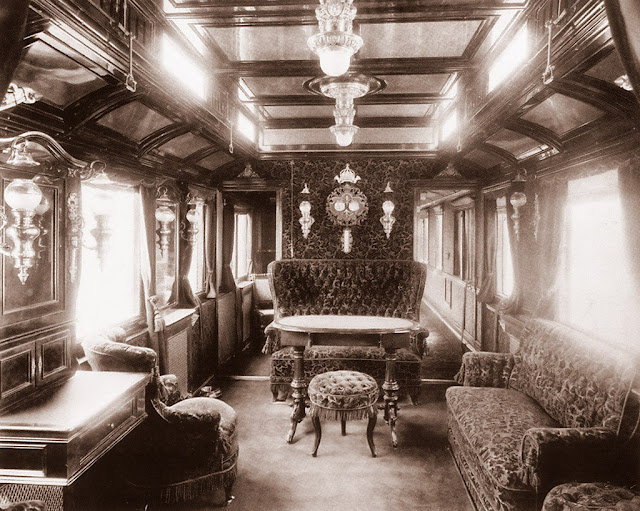
On his journey to the funeral of his second cousin, British King Edward VII in 1910, a dispute over protocol erupted about the placement of Ferdinand’s private railroad car (above) in relation to that of Archduke Franz Ferdinand, heir to the Austro-Hungarian throne. The Archduke won out, having his carriage positioned directly behind the engine, with Ferdinand's placed second. The dining car was the third coach from the front, and Ferdinand stubbornly refused the Archduke access through his own carriage to the dining car. Ferdinand wore a flamboyant silk turban on the day of Edward VII’s funeral, while other assembled crowned heads shared their disdain at Ferdinand’s ostentation in calling himself a Tsar. As well they gossiped about the fact that he kept a Byzantine Emperor’s full regalia, designed by a Parisian theatrical costumer, against the day when he might reassemble the Byzantine dominions beneath his scepter. The man loved his clothes! Nine kings, Ferdinand among them, led the funeral procession. After them came five heirs apparent, forty more imperial or royal highnesses, seven queens and a scattering of special ambassadors from uncrowned countries. Former President Theodore Roosevelt attended as a special envoy of the United States. Together they represented seventy nations in the greatest assemblage of royalty and rank ever gathered in one place, and the last of its kind.
In the video below, King Ferdinand can be seen in a display of temper at the 1932 wedding of Prince Gustaf Adolf, Duke of Västerbotten, to Princess Sibylla of Saxe-Coburg-Gotha (future parents of King Charles XVI of Sweden) in Coburg. Victoria Melita, Grand Duchess of Russia (and granddaughter of Queen Victoria) was among the first guests to exit the church at the conclusion of the ceremony. After the bride and groom’s car had departed, as Grand Duchess Victoria was about to climb into the car that brought her, King Ferdinand of Bulgaria appeared behind her, ready to leave as well. The king kicked up a fuss that it was against protocol and unacceptable that the grand Duchess leave before him, since he “outranked” her, even as a deposed king – she was, after all, a mere Grand Duchess. Ferdinand prevailed, marching toward the car between an insulted and confused Grand Duchess and her 23-year-old daughter, Princess Kira, who had served as a bridesmaid. The onlookers were shocked by the king’s fiery displeasure.
After his forced abdication in 1918, Ferdinand lived a life of luxurious exile in Coburg, Germany. He commented, “The main thing in life is to support any condition of bodily or spiritual exile with dignity. If one sups with sorrow, one need not invite the world to see you eat.” He was pleased that the throne had passed to his son, and Ferdinand was not made despondent by exile, spending most of his time devoted to pleasant artistic endeavors, gardening, travel and natural history. He died of natural causes at age 87 in 1948 at the Bürglaß-Schlösschen ("little palace", photo above), a dynastic residence of the Saxe-Coburg-Gotha ruling house in Coburg, thirty years after abdicating his throne to his son. Tsar Ferdinand I's unusually long life spanned important world events, from the U.S. Civil War to the French commune of 1871 and on through two devastating world wars. Ferdinand’s 18th-century “little palace” still stands opposite the State Theatre in modern day Coburg, but is today used as a municipal building where weddings take place. The rear garden is the largest and most popular Biergarten in Coburg.
Tragically, Ferdinand outlived both his sons. His eldest son and successor, Boris III, died under mysterious circumstances*** after returning from a visit to Hitler in Germany in 1943. Boris III's son, Simeon II, succeeded him as Tsar (at age 6) only to be deposed by the Soviets in 1946, ending the Bulgarian monarchy that Ferdinand had re-established. The Kingdom of Bulgaria was succeeded by the People's Republic of Bulgaria, under which Ferdinand’s sole surviving son, Kyril, was executed. Amazingly, after the fall of the Soviet Union, Ferdinand's grandson Simeon II returned from exile in Spain in 1998 and resumed the role of leader of the nation upon taking office as Prime Minister of the Republic of Bulgaria. During his time in power, from July 2001 until August 2005, Bulgaria joined NATO and the European Community (full membership in the EU did not occur until 2007). The royal Vrana Palace buildings and grounds on the outskirts of Sofia were returned to Simeon and his sister in 1998. Simeon and his wife, who donated most of the acreage back to the city for use as a public park, to this day reside in the hunting lodge on the property. At age 74 Simeon is today one of the last living heads of state from the World War II-era, the only living person who has borne the Bulgarian title "Tsar", and one of the few monarchs in history to have become a head of government through democratic election. Update: In early 2012 Simeon ceded his rights as head of the princely house of Saxe-Coburg-Gotha-Koháry to his sister, Princess Marie Louise of Bulgaria.
***Conspiracy theories abound, since Boris III had defied Hitler’s demand to send Bulgaria’s 50,000 Jews to concentration camps. Under Tsar Boris III, Bulgaria was the only nation in Europe to save its entire Jewish population during the Holocaust, and Boris was the only world leader to defy Hitler face to face during the war. Two weeks after the acrimonious meeting between Boris and Hitler, Boris died after his return to Bulgaria, officially from heart failure. His two private doctors determined that Boris had died from a slow working poison that takes several weeks to kill its victim, the same sort of poison that had killed the Greek Prime Minister two years earlier. After the end of the war, when the king’s body was disinterred for examination, it was discovered that Communist forces had removed his coffin to a secret location, which remains unknown to this day. Only the king’s heart was found in the grave where he had been buried. In 1994 the United States Congress proclaimed King Boris III the savior of fifty thousand Bulgarian Jews, and King Boris III was posthumously awarded the Jewish National Fund's Medal of the Legion of Honor, the first non-Jew to receive the award, considered one of the Jewish community's highest honors.
Trivia: The one and only time I visited Bulgaria (the country is favored by a beautiful, mountainous landscape), I was astonished that the head movements for "yes" and "no" are the reverse of what the rest of us use. If you ask someone's permission to take a photo and he moves his head from left to right, you're in the clear. The same goes for Greece, and it trips me up every time. True, I swear.
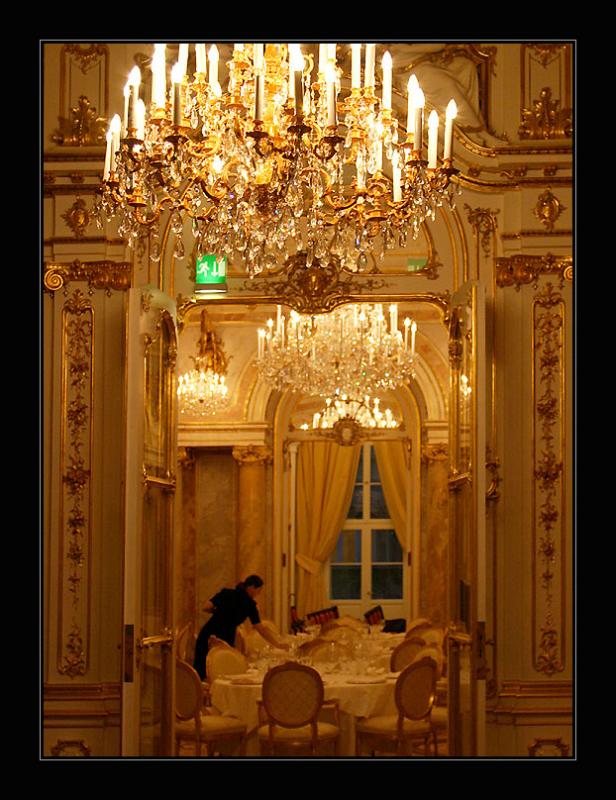
*Palais Coburg (above), Ferdinand’s boyhood home in Vienna, is now a luxury hotel where, for a high price, it is possible to soak up the aura of Ferdinand and his ancestors. The Palais faces the Ringstrasse, opposite the Stadtpark in downtown Vienna. It’s wicked expensive, so the closest I’ve come is a drink at the bar (also at a ruinous price); the hotel restaurant is popular with Vienna’s elite. There are just 35 rooms, each a suite. If you’re feeling flush, room rates are €670-€860 per night (converted to U.S. dollars = $885-$1,135). Photo below shows the opulent interior; the parquet floors are exceptional.
www.palais-coburg.com/_en/