Henry Willson with Shirley Temple in 1945.
During the 1950s, Hollywood talent agent Henry Willson (1911-1978) was responsible for discovering and manufacturing careers of a stable of handsome, but not necessarily talented, movie stars, who became known as “beefcake” actors. His roster included Rock Hudson (born Roy Scherer), Tab Hunter (Arthur Kelm), Guy Madison (Robert Moseley) and Troy Donahue (Merle Johnson), men born with far too pedestrian names, willingly rechristened by the fertile imagination of Willson. Ditto Yale Summers, Rad Fulton and Race Gentry.
He provided fan magazines and other media outlets with a steady stream of his male “stars” photographed with as little clothing as possible. Rarely was there evidence of so much as a shirt. He was able to get right to the point, and his business card read: "If you're interested in getting into the movies, I can help you. Henry Willson. Agent." For those who fell for his come-on, Willson heightened the lure with comments such as, “You are already a star. Now it’s up to me to let Hollywood know.”
Willson, who grew up in New York City (Forest Hills), was reared in the underbelly of Hollywood. While still in high school he went to Broadway shows and wrote about them for Variety. His first major Hollywood job, as a talent scout for David Selznick, included duties of procuring women for his employer. Once out on his own, Willson could fully realize his homosexual fantasies by dealing in the beefcake trade. Indeed, many say that Willson “invented” the beefcake trade, which was pretty much defined as pure male beauty, undiluted by talent.
Try to keep a straight face as you read this photo caption: “Calling All Girls: Whistle-bait in the beefcake brigade. Tab Hunter and Roddy McDowall do some prowling of their own!” Hollywood insiders knew that both Tab and Roddy were gay, although deeply closeted at the time.
Unfortunately, many of his clients were also objects of Willson’s hands-on lechery, taking the casting-couch technique to new heights. He also had an unfortunate habit of insinuating himself into the lives of his clients, something for which any talent agent would be fired today. There exists a photo of Henry at home at the breakfast table with the maid serving Guy Madison, dressed in his sailor’s uniform. It was a publicity shot for a story about how Guy stayed at Henry Willson’s house when on shore leave. Madison’s only complaint was how the bed at Henry’s was too big and too soft. Really. Save that thought – we’ll get back to Mr. Madison.
Yet Willson exacted a tremendous influence over Hollywood during the 1950s and 1960s. He could also project a genuine and even paternal side, not to discount his success in discovering bona fide talent (Natalie Wood, Rhonda Fleming, Gena Rowlands and Lana Turner). Shirley Temple talked about going to Henry’s house, where they enjoyed having séances together. She recalled that Henry served hot dogs and was like a dear uncle to her.
From left to right:
Jack Warner, Natalie Wood, Henry Willson, Phyllis Gates and Rock Hudson. Gates, Willson's secretary, entered into an arranged marriage to Rock Hudson for two years, to deflect persistent rumors of Hudson's homosexuality (the rumors were all true). Phyllis, by the way, was lesbian, and she and Rock never had a physical relationship.
Fortunately, Willson’s instincts led him to exercise caution in some instances. He wouldn’t take liberties with an actor the likes of John Gavin or others who hailed from moneyed, high society families. Henry was more apt to molest the naïve, off-the-bus types who would do anything to see their names in lights. And often did. Henry favored inexperienced actors who needed a father figure. He fixed their teeth, bought them clothes, taught them how to speak, even which fork to use. He yanked handsome truck drivers off the street and dazzled them with dinners at the finest restaurants, pointing out the stars at other tables, then telling them he could make them a movie star – quickly followed by a hand on the knee. Incipient acting talent was entirely optional.
As time went on, however, Willson’s reputation as a notorious homosexual adversely affected his professional life, as more and more of his clients distanced themselves from his agency for fear they’d be labeled homosexual themselves, which was the kiss of death to many a Hollywood career – witness William "Billie" Haines and George Nader (entries in sidebar). As a result, Willson’s final years were spent in poverty; he was accepted as a charity case at the Motion Picture Country Home in Woodland Hills, where in 1978, Willson died from cirrhosis of the liver.
In his heyday, however, Willson was drunk on his own power, proving adept at publicity stunts and manipulation of his clients’ careers. When Confidential magazine was about to out Rock Hudson as gay, Willson arranged Hudson’s marriage to one of his own secretaries, Phyllis Gates. Willson traded dirty secrets about some clients to tabloid reporters in exchange for silence about others, and it was known that he employed off-duty LAPD officers to intimidate would-be blackmailers.
Rock Hudson, like his agent/mentor Willson, was seldom discreet. While nearly every actor and actress liked the always affable Rock Hudson, others in the know used their insider knowledge of his sexual orientation to taunt him. Hudson had to sell his favorite sailboat, which he piloted on many a weekend over to Catalina Island, because vandals kept spray painting “faggot” and “queer” on the bow. This, during the time Rock Hudson was voted the number one box office star in 1957.
Willson’s life, achievements and scandals are recounted in Robert Hofler’s tell-all book, The Man Who Invented Rock Hudson: The Pretty Boys and Dirty Deals of Henry Willson (2006, available in e-reader formats).
Now, back to Guy Madison, one of Willsons’ handsomest clients, and a completely manufactured Hollywood star. His story is typical of a Willson-discovered beefcake actor. Robert Moseley (1922-1996) was a former California lifeguard working as a telephone lineman when he answered his nation’s call by enlisting in the Coast Guard at the onset of WWII. During a weekend leave in 1943 Moseley attended a broadcast of a Lux Radio Theater program, where he was spotted by Henry Willson, then a talent scout for David O. Selznick. Selznick was looking for an unknown to play a sailor in a cameo role in a new film, Since You Went Away. Willson spotted the spectacularly handsome soldier among the audience and thought he looked terrific in his uniform. Turns out he looked even better without it.
With no experience, training or ambition to be an actor, Moseley was signed as an extra. He completed his scene while on a weekend pass and returned to duty. When the big-budget war epic was released in 1944, Selznick’s studio received thousands of fan letters for the unknown actor. Three minutes of on-screen time had in fact elicited 43,000 pieces of fan mail. Willson thought Robert Moseley too lackluster a name, so he created the more tantalizing moniker Guy Madison, who thus joined Henry’s stable of male stars whose physical appeal transcended lack of talent.
So long as he kept his shirt off, Madison’s public was more than happy to buy tickets to his movies. His unselfconscious screen persona, shy smile and mind-altering good looks delivered him to the very peak of the 1950s beefcake craze. His wooden acting, however, sent him straight into the arms of television, where he became a household name as the star of The Adventures of Wild Bill Hickok, a startlingly successful TV series that ran from 1951 to 1958.
You might want to know that subsequent lack of work led Madison to Europe, where he starred in a string of spaghetti westerns and B-grade German adventure films for ten years. But any more text in this post would deprive space better taken up by photographs of one of the all-time most photogenic entertainment stars. Need an eye-candy fix? Watch a Guy Madison movie. If for nothing else, we owe the lecherous Henry Willson for the discovery of "pretty boys" the likes of hearth-throb Guy Madison. So here we go:
Genetic evidence that beauty is inherited, as revealed in this photo of Madison's only son Roberto (born 1967 in Rome), who is today a major star of Italian television:
Role models of greatness.
Here you will discover the back stories of kings, titans of industry, stellar athletes, giants of the entertainment field, scientists, politicians, artists and heroes – all of them gay or bisexual men. If their lives can serve as role models to young men who have been bullied or taught to think less of themselves for their sexual orientation, all the better. The sexual orientation of those featured here did not stand in the way of their achievements.
Showing posts with label Rock Hudson. Show all posts
Tuesday, June 18, 2013
Wednesday, October 10, 2012
George Nader
After appearing in small roles in forgettable films in the 1950s, a pair of strapping, handsome young gay actors were hungry for leading roles in higher quality films, and they were chasing the same dream. They were friends, but the competition did not always end up amicably. One of them, Rock Hudson, got lucky with Magnificent Obsession (1954), which turned him into a star and a hot commodity. The other, George Nader (1921-2002), was not so lucky. These two gay men with stunning physiques and charisma to spare were about to be involved in a Hollywood studio intrigue that left only one man standing.
According to insider reports at the time, Rock Hudson was a bit too indiscreet with a man he picked up, and their dalliance was photographed. Universal Studios bosses received a phone call from Confidential magazine saying they were about to expose Hudson’s homosexuality on their front page. The studio panicked at the thought of losing its hottest new star, so they cut a deal with the magazine. They made a decision that made Rock Hudson a Hollywood legend while simultaneously dashing the career of Nader to hopeless obscurity. The magazine agreed to ruin Nader's career by outing him as a homosexual in exchange for accepting a large cash payment to keep Rock Hudson's gay activities out of print forever. Another version of this story relates that Confidential was about to expose a relationship between Nader and Hudson himself, but both men later said they never had a sexual relationship. In fact, Nader and Mark Miller (Nader’s life partner) became Hudson’s de facto family and were especially supportive in the months leading up to Hudson’s death from AIDS in 1985. BTW: I can find no evidence that a magazine article exposing Nader as homosexual was ever published, although the threats may have been real. Photo below: Rock Hudson (left) wth fellow beefcake actor George Nader.
Nader’s Hollywood career sank, but he was not down for the count. Astonishingly, he became the second biggest film star in Germany, playing a James Bond type character by the name of Jerry Cotton in 8 films released in a five year span from 1965 to 1969. He continued working in B movies until 1974, but his career was thwarted a second time. An automobile accident resulting in a detached retina made it difficult and uncomfortable to work in front of the bright lights used on movie sets, so he switched to an entirely different career as an author. He wrote a popular science fiction novel titled Chrome (1978), in which two gay men were the principal characters.
Even more astonishingly, Nader and Hudson remained good friends. Nader began dating Mark Miller while the two were fellow actors at the Pasadena Playhouse, and Miller went on to work as Hudson’s private secretary. Nader and Miller became lovers and remained partners for 55 years, and Miller, Hudson and Nader became so close that Nader was included in Rock Hudson’s will, receiving the interest from his estate.
But we need to back up a moment. Miller had intended to study opera in NYC but abandoned his plans to stay in California to help Nader launch his career. Miller took odd jobs to provide income while Nader established himself as an actor. By 1952 Nader was successful enough that Miller became his business manager.
In 1953 Nader starred in a 3-D film called Robot Monster (at right), which grossed more than a million dollars on a $16,000 production budget. Nader played Roy, the often shirtless hero who saves the world from the clutches of a robot in a gorilla suit. Shot in just 4 days, it went on to become a camp cult classic. It also has the dubious distinction of being named one of the worst movies of all time.
In 1954 Nader won a Golden Globe award as Most Promising Male Newcomer of the year, but the Confidential gossip magazine incident in the early 1960s brought a premature close to his Hollywood career.
Universal Studios tried to protect Nader by arranging dates with actresses such as Mitzi Gaynor, Martha Hyer and Piper Laurie, while suggesting he get married briefly to one of the studio secretaries to quell the gay rumors (neither Miller nor Nader publicly acknowledged their homosexuality until the mid-1980s). Nader couldn’t bring himself to participate in such a sham, and he left the studio in 1958 to work freelance. After some mediocre work in television, he and Miller moved to Germany in 1963, where Nader made eight successful films as a James Bond clone. By 1972, Nader decided to move back to Hollywood, and Miller joined him.
In 1978 Nader wrote his first novel, a homoerotic science-fiction book titled Chrome, which went into six printings. Conveniently, Nader had earned a degree in English from Occidental College in 1943, so he was able to put those skills to good use.
Nader finally came out of the closet in 1986, a year after Rock Hudson’s death from AIDS. Nader and Miller collaborated on a second novel, The Perils of Paul, which Nader didn't want published until after his death. Centering on the gay community in Hollywood with names changed to protect the guilty(!), it was published privately in 1999 (good luck acquiring a copy). In retirement, Nader and Miller lived in Palm Springs, California. Nader contracted a bacterial infection in Hawaii and died on February 4, 2002, at age 80, at the Motion Picture and Television Fund Country Home in Woodland Hills, CA.
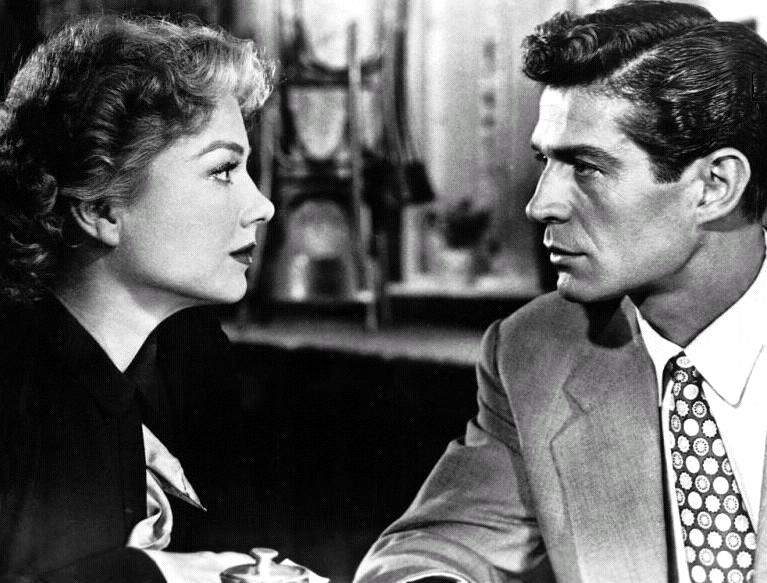
With Anne Baxter in Carnival Story (1954)
As Jerry Cotton (above), an FBI agent in German language films.
With actress Julie Adams in Four Girls in Town (1956)
With a young Maggie Smith (above) in Nowhere to Go (1958).
Sex kitten (and ex-blond Bond girl) Shirley Eaton disciplines George in Million Eyes of Su-Muru (1967). Frankie Avalon (!) was his co-star. George was still looking great at age 46.
George could really fill out a uniform (above). He was a U.S. Navy communications officer stationed on Johnson Island in the Pacific during WW II.
Pure, 100% Hollywood beefcake:
According to insider reports at the time, Rock Hudson was a bit too indiscreet with a man he picked up, and their dalliance was photographed. Universal Studios bosses received a phone call from Confidential magazine saying they were about to expose Hudson’s homosexuality on their front page. The studio panicked at the thought of losing its hottest new star, so they cut a deal with the magazine. They made a decision that made Rock Hudson a Hollywood legend while simultaneously dashing the career of Nader to hopeless obscurity. The magazine agreed to ruin Nader's career by outing him as a homosexual in exchange for accepting a large cash payment to keep Rock Hudson's gay activities out of print forever. Another version of this story relates that Confidential was about to expose a relationship between Nader and Hudson himself, but both men later said they never had a sexual relationship. In fact, Nader and Mark Miller (Nader’s life partner) became Hudson’s de facto family and were especially supportive in the months leading up to Hudson’s death from AIDS in 1985. BTW: I can find no evidence that a magazine article exposing Nader as homosexual was ever published, although the threats may have been real. Photo below: Rock Hudson (left) wth fellow beefcake actor George Nader.
Nader’s Hollywood career sank, but he was not down for the count. Astonishingly, he became the second biggest film star in Germany, playing a James Bond type character by the name of Jerry Cotton in 8 films released in a five year span from 1965 to 1969. He continued working in B movies until 1974, but his career was thwarted a second time. An automobile accident resulting in a detached retina made it difficult and uncomfortable to work in front of the bright lights used on movie sets, so he switched to an entirely different career as an author. He wrote a popular science fiction novel titled Chrome (1978), in which two gay men were the principal characters.
Even more astonishingly, Nader and Hudson remained good friends. Nader began dating Mark Miller while the two were fellow actors at the Pasadena Playhouse, and Miller went on to work as Hudson’s private secretary. Nader and Miller became lovers and remained partners for 55 years, and Miller, Hudson and Nader became so close that Nader was included in Rock Hudson’s will, receiving the interest from his estate.
But we need to back up a moment. Miller had intended to study opera in NYC but abandoned his plans to stay in California to help Nader launch his career. Miller took odd jobs to provide income while Nader established himself as an actor. By 1952 Nader was successful enough that Miller became his business manager.
In 1953 Nader starred in a 3-D film called Robot Monster (at right), which grossed more than a million dollars on a $16,000 production budget. Nader played Roy, the often shirtless hero who saves the world from the clutches of a robot in a gorilla suit. Shot in just 4 days, it went on to become a camp cult classic. It also has the dubious distinction of being named one of the worst movies of all time.
In 1954 Nader won a Golden Globe award as Most Promising Male Newcomer of the year, but the Confidential gossip magazine incident in the early 1960s brought a premature close to his Hollywood career.
Universal Studios tried to protect Nader by arranging dates with actresses such as Mitzi Gaynor, Martha Hyer and Piper Laurie, while suggesting he get married briefly to one of the studio secretaries to quell the gay rumors (neither Miller nor Nader publicly acknowledged their homosexuality until the mid-1980s). Nader couldn’t bring himself to participate in such a sham, and he left the studio in 1958 to work freelance. After some mediocre work in television, he and Miller moved to Germany in 1963, where Nader made eight successful films as a James Bond clone. By 1972, Nader decided to move back to Hollywood, and Miller joined him.
In 1978 Nader wrote his first novel, a homoerotic science-fiction book titled Chrome, which went into six printings. Conveniently, Nader had earned a degree in English from Occidental College in 1943, so he was able to put those skills to good use.
Nader finally came out of the closet in 1986, a year after Rock Hudson’s death from AIDS. Nader and Miller collaborated on a second novel, The Perils of Paul, which Nader didn't want published until after his death. Centering on the gay community in Hollywood with names changed to protect the guilty(!), it was published privately in 1999 (good luck acquiring a copy). In retirement, Nader and Miller lived in Palm Springs, California. Nader contracted a bacterial infection in Hawaii and died on February 4, 2002, at age 80, at the Motion Picture and Television Fund Country Home in Woodland Hills, CA.
With Anne Baxter in Carnival Story (1954)
As Jerry Cotton (above), an FBI agent in German language films.
With a young Maggie Smith (above) in Nowhere to Go (1958).
Sex kitten (and ex-blond Bond girl) Shirley Eaton disciplines George in Million Eyes of Su-Muru (1967). Frankie Avalon (!) was his co-star. George was still looking great at age 46.
George could really fill out a uniform (above). He was a U.S. Navy communications officer stationed on Johnson Island in the Pacific during WW II.
Pure, 100% Hollywood beefcake:
Labels:
Actor,
Author,
George Nader,
Hollywood,
Rock Hudson,
Television,
Writer
Saturday, January 7, 2012
Gene Raymond
Raymond (above) with Dolores del Rio in Flying Down to Rio* 1933.
His wife of 28 years, Jeanette MacDonald, was much more famous, but Gene Raymond (1908-1998) had a solid career as a leading man of stage, film and TV. He had a strapping physique with blond hair and blue eyes. He was also a singer and composer, writer, director and producer – and a decorated military pilot.
Louis B. Mayer of MGM studios arranged the marriage to prevent MacDonald from marrying her on-screen partner Nelson Eddy, which would have ruined her career. Mayer was concerned that a MacDonald-Eddy marriage would end in divorce, due to their temperaments, then he would lose his lucrative box office team. MacDonald had an affair with Eddy anyway, and Gene Raymond continued to have affairs with other men. In fact, on their honeymoon MacDonald caught Raymond in an embrace with actor Buddy Rogers.
Raymond and wife Jeanette MacDonald (below).
But it gets even messier. Raymond, whose career peaked during the 1930s and 40s, was arrested three times for having sex with men, the last of which occurred in England during WWII. In 1938 Raymond began sharing a house with a 19-year-old actor and was arrested on a morals charge following a raid on a homosexual night club, requiring MacDonald to bribe police in order to obtain his release. An enraged Louis B. Mayer ordered the couple to resume the appearance of a happily married couple. Although he had arranged the marriage, Mayer had Raymond blacklisted following his 1938 arrest for homosexual activity; he made only 7 films from 1940-1948, whereas he had averaged four movies a year prior to the 1938 arrest. Raymond also had affairs with Rock Hudson, Cesar Romero and Robert Stack.
He appeared opposite W.C. Fields, Humphrey Bogart, Ann Southern, Charles Laughton, Loretta Young, Bette Davis, Jean Harlow, Dolores del Rio, Fred Astaire, Joan Crawford, Robert Montgomery, Carole Lombard, Robert Mitchum and his own wife, who recorded “Let Me Always Sing,” which Raymond composed. Jeanette MacDonald also sang several of Raymond’s songs in her concerts. In 1948's Million Dollar Weekend, Raymond was also director and writer, in addition to being a cast member.
Raymond remarried after Jeanette MacDonald’s death but continued to attend meetings of the Jeanette MacDonald International Fan Club. He retired from the Air Force in 1968 as a colonel. For his contribution to the motion picture and television industries, Raymond has two stars on the Hollywood Walk of Fame: at 7003 Hollywood Boulevard and 1704 Vine Street, respectively.
Enjoy this clip from Flying Down to Rio (1933) with Delores del Rio. Raymond is very blond and a very young 25:
Friday, October 14, 2011
Steve McQueen
"In my own mind, I'm not sure that acting is something for a grown man to be doing."
– Steve McQueen
His father abandoned him and his mother was an alcoholic prostitute who seduced him sexually; so did some of her “johns”. A gang member practically from the day he could walk, he bounced back and forth between his mother and grandparents and seemed set for a career as a petty thief and vandal (arson was among his specialties), before ending up in a California reformatory, where he was gang raped. Upon release, he enlisted in the Marine Corps at age 17. Since he was already a fan of bikes and fast cars, he enjoyed his duties as a mechanic and tank driver, but continued to have trouble with authority figures. After three years of military service he drifted around the the Caribbean. In a bordello in Santo Domingo, he hired himself out as a sex object and porn performer. Those early years would lead to McQueen's future problems with authority and relationships.
Gravitating to New York City, he hustled on the streets of Times Square to support his two loves: acting and motorcycles. A little later, in a borrowed tux, he became a "gentleman for rent," the boy toy of rich, aging women, two of whom were Joan Crawford and Lana Turner. When stardom finally came, the abused became the abuser, and sex was his weapon of choice. "The last thing I want is to fall in love with a broad," he said. The string of seductions that followed earned him an almost mythical status as a pansexual Love Machine. His A-list conquests included Jacqueline Bissett, Faye Dunaway, Lauren Hutton, Sharon Tate, Mamie Van Doren, Tuesday Weld, Natalie Wood, and Marilyn Monroe. He married one of them, Ali MacGraw, for whom he abandoned the mother of his two children (and wife of sixteen years), Filipino-born actress Neile Adams.
Publicly, he insisted that he loathed homosexuals (nice try!), yet he often went to bed with them, favoring bikers and race car drivers. To admit to any of this would have meant the end of his acting career. Nevertheless, he had a tumultuous sexual relationship with James Dean, and a longer love/hate affair with Paul Newman. Other sexual relations developed with Peter Lawford, Montgomery Clift, Sal Mineo, Rock Hudson, Chuck Connors, and George Peppard.
By all accounts McQueen was a difficult, prickly individual. He abused drugs, drank to excess, smoked three packs a day and was riddled with self-destructive urges . He landed bit parts in stage dramas and TV episodes, and his role on Dead or Alive made him a bona fide TV star. This led to the film role in The Magnificent Seven, and the rest is a lightning fast trajectory into Hollywood superstardom. Like his onscreen characters, McQueen went his own way and pretty much did what he wanted. He turned down the film Butch Cassidy and The Sundance Kid because he refused second billing to Paul Newman. He was an independent, sexy movie star whose sense of “cool” defined the era.
In his heyday, with a salary of $5 million a movie, Steve McQueen was the highest paid actor in the world. If you want to see him at his best, watch Love with the Proper Stranger (1963) or The Getaway (1972). In the former he is sexy and appealing; in the latter he is sexy, tough and violent (his costar was future wife Ali MacGraw). McQueen was a good actor and a true cinema icon.
McQueen lived life at top speed, like the machines he raced so famously. Always difficult on film sets, he became a diva, firing crew on a whim. In the end fewer scripts came his way, because he had burned too many bridges. He was well on his way out in Hollywood when he contracted cancer. His early death at age 50 in 1980 remains a source of speculation, all of it explored in a biography by celebrity chronicler Darwin Porter: Steve McQueen, King of Cool: Tales of a Lurid Life. Others were shocked by the sex and violence in this book; I was shocked to learn that he was a staunch Republican and evangelical Christian.
His actor grandson, Steven R. McQueen (Vampire Diaries), is doing his best to follow in the footsteps of his iconic Hollywood relative (finger at right).
Steve McQueen, as sexy as his car, is shown here with one of his signature muscle cars, a 1956 Jaguar XKSS Le Mans racer. Only 16 were produced. This Jaguar was powered by a straight six engine with triple Webers, packing 250 horsepower. It was said to be brain-meltingly loud at 6,000 RPM, and also very pretty – like its owner.
The film Bullitt (1968) contains one of the most influential car chase sequences in movie history. Screeching through the streets of San Francisco, McQueen, in a 1968 green Ford Mustang GT390 Fastback, chases a 1968 black Dodge Charger R/T 440 Magnum. When McQueen, an accomplished race car driver, overshot a turn and smoked the tires (around the 1:10 mark), it was decided to replace him with a stunt driver. The Mustang’s interior rear view mirror gives clues as to who is behind the wheel. When the mirror is up (visible) McQueen is behind the wheel, and when it is down (not visible) stuntman Ekins is driving. It took more than three weeks to shoot the footage that took up less than ten minutes of screen time in the final edit.
Other than acting, McQueen's great love was fast cars and motorcycles. He filmed a spectacular motorcycle jump in the 1963 film, The Great Escape. Worth checking out. Here he's riding with one hand behind his back.
– Steve McQueen
His father abandoned him and his mother was an alcoholic prostitute who seduced him sexually; so did some of her “johns”. A gang member practically from the day he could walk, he bounced back and forth between his mother and grandparents and seemed set for a career as a petty thief and vandal (arson was among his specialties), before ending up in a California reformatory, where he was gang raped. Upon release, he enlisted in the Marine Corps at age 17. Since he was already a fan of bikes and fast cars, he enjoyed his duties as a mechanic and tank driver, but continued to have trouble with authority figures. After three years of military service he drifted around the the Caribbean. In a bordello in Santo Domingo, he hired himself out as a sex object and porn performer. Those early years would lead to McQueen's future problems with authority and relationships.
Gravitating to New York City, he hustled on the streets of Times Square to support his two loves: acting and motorcycles. A little later, in a borrowed tux, he became a "gentleman for rent," the boy toy of rich, aging women, two of whom were Joan Crawford and Lana Turner. When stardom finally came, the abused became the abuser, and sex was his weapon of choice. "The last thing I want is to fall in love with a broad," he said. The string of seductions that followed earned him an almost mythical status as a pansexual Love Machine. His A-list conquests included Jacqueline Bissett, Faye Dunaway, Lauren Hutton, Sharon Tate, Mamie Van Doren, Tuesday Weld, Natalie Wood, and Marilyn Monroe. He married one of them, Ali MacGraw, for whom he abandoned the mother of his two children (and wife of sixteen years), Filipino-born actress Neile Adams.
Publicly, he insisted that he loathed homosexuals (nice try!), yet he often went to bed with them, favoring bikers and race car drivers. To admit to any of this would have meant the end of his acting career. Nevertheless, he had a tumultuous sexual relationship with James Dean, and a longer love/hate affair with Paul Newman. Other sexual relations developed with Peter Lawford, Montgomery Clift, Sal Mineo, Rock Hudson, Chuck Connors, and George Peppard.
By all accounts McQueen was a difficult, prickly individual. He abused drugs, drank to excess, smoked three packs a day and was riddled with self-destructive urges . He landed bit parts in stage dramas and TV episodes, and his role on Dead or Alive made him a bona fide TV star. This led to the film role in The Magnificent Seven, and the rest is a lightning fast trajectory into Hollywood superstardom. Like his onscreen characters, McQueen went his own way and pretty much did what he wanted. He turned down the film Butch Cassidy and The Sundance Kid because he refused second billing to Paul Newman. He was an independent, sexy movie star whose sense of “cool” defined the era.
In his heyday, with a salary of $5 million a movie, Steve McQueen was the highest paid actor in the world. If you want to see him at his best, watch Love with the Proper Stranger (1963) or The Getaway (1972). In the former he is sexy and appealing; in the latter he is sexy, tough and violent (his costar was future wife Ali MacGraw). McQueen was a good actor and a true cinema icon.
McQueen lived life at top speed, like the machines he raced so famously. Always difficult on film sets, he became a diva, firing crew on a whim. In the end fewer scripts came his way, because he had burned too many bridges. He was well on his way out in Hollywood when he contracted cancer. His early death at age 50 in 1980 remains a source of speculation, all of it explored in a biography by celebrity chronicler Darwin Porter: Steve McQueen, King of Cool: Tales of a Lurid Life. Others were shocked by the sex and violence in this book; I was shocked to learn that he was a staunch Republican and evangelical Christian.
His actor grandson, Steven R. McQueen (Vampire Diaries), is doing his best to follow in the footsteps of his iconic Hollywood relative (finger at right).
Steve McQueen, as sexy as his car, is shown here with one of his signature muscle cars, a 1956 Jaguar XKSS Le Mans racer. Only 16 were produced. This Jaguar was powered by a straight six engine with triple Webers, packing 250 horsepower. It was said to be brain-meltingly loud at 6,000 RPM, and also very pretty – like its owner.
The film Bullitt (1968) contains one of the most influential car chase sequences in movie history. Screeching through the streets of San Francisco, McQueen, in a 1968 green Ford Mustang GT390 Fastback, chases a 1968 black Dodge Charger R/T 440 Magnum. When McQueen, an accomplished race car driver, overshot a turn and smoked the tires (around the 1:10 mark), it was decided to replace him with a stunt driver. The Mustang’s interior rear view mirror gives clues as to who is behind the wheel. When the mirror is up (visible) McQueen is behind the wheel, and when it is down (not visible) stuntman Ekins is driving. It took more than three weeks to shoot the footage that took up less than ten minutes of screen time in the final edit.
Other than acting, McQueen's great love was fast cars and motorcycles. He filmed a spectacular motorcycle jump in the 1963 film, The Great Escape. Worth checking out. Here he's riding with one hand behind his back.
Thursday, August 18, 2011
Rock Hudson: Closeted Hollywood Star
Hudson at home his Beverly Hills residence: 9402 Beverly Crest Dr.
Looking down over Beverly Hills, “The Castle” was the 3.5 acre estate of actor Rock Hudson (1925-1985), where he lived from 1962 until his death. At the height of his career, Universal Studios purchased it for him as part of his contract renewal. Constructed with a stucco finish and red tile roof, the house was protected by a massive gate in the front (always left open) and steep cliffs on three sides, which ensured the closeted actor’s privacy.
Hudson gave a detailed description of the house to his authorized biographer. He loved his home and spent 23 years meticulously restoring it. The interior boasted two living rooms, four fireplaces, a steam room and gym, and a theater with stage and footlights. Anyone who entered became aware of his sexual orientation, even though he led a closeted public life. His bed was carved with a large male figure and on the pool deck stood large slightly abstract sculptures of naked boys; one depicts a boy throwing a smaller lad into the pool (photo below).
One of his favorite spots was the home theater, which had originally been a garage. It housed a vast collection of films and up-to-date projection equipment, while a collection of rare records filled one wall. He rehearsed upcoming roles on the wooden stage. Also on the grounds was a greenhouse overflowing with orchids.
The Castle was decorated in what one of Hudson‘s friends termed “early butch” – dark wood, pewter candlesticks, zebra skins, and heavy doses of wrought iron. The patio led to a 40-foot pool with jacuzzi and lion’s head fountain. A 20-foot barbecue that could cook enough meat to feed a hundred people. Hudson liked to give large pool parties, to which he’d invite a hand-picked assortment of handsome youthful males. He cruised Melrose Ave. in Hollywood in the vicinity of the Spike and the Eagle (gay bar), riding around in a chauffeured limo with black out windows, pulling over when someone young and handsome caught his eye. Invariably, they returned to Rock’s “Castle” in Beverly Hills.
Rock Hudson did what most other gay movie stars did at the time. He agreed to a studio sanctioned smoke-screen marriage to Phyllis Gates (now a Beverly Hills based interior designer); the studio also promoted the wedding and the honeymoon. Three years later it was all over. Shortly thereafter Rock Hudson bought his favorite house on Beverly Crest Drive. However, everyone he worked with in Hollywood knew his story. Hudson found an acceptance and compassion among show people that he feared he would never find among his fans. His greatest accolade was an Academy Award nomination for his performance in Giant (1956), co-starring Elizabeth Taylor and James Dean, although his fans most fondly remember his many romantic comedy films with co-star Doris Day.
Hudson lived most of his years at his “castle” with just his female housekeeper and seven dogs. But occasionally, he had a live-in male lover. When he did, he was careful to maintain two separate phone lines for “appearances,” and to make sure he was never photographed with the other man. His years of diverting the truth about his sexual orientation from the general public came to an end in 1985. He died in seclusion at his “castle” from complications of AIDS on October 2 of that year.
Photo below: Rock Hudson and co-star Elizabeth Taylor in Giant (1956).

Shown below with actor George Nader, the lover of Mark Miller, who was Hudson's personal secretary:
Looking down over Beverly Hills, “The Castle” was the 3.5 acre estate of actor Rock Hudson (1925-1985), where he lived from 1962 until his death. At the height of his career, Universal Studios purchased it for him as part of his contract renewal. Constructed with a stucco finish and red tile roof, the house was protected by a massive gate in the front (always left open) and steep cliffs on three sides, which ensured the closeted actor’s privacy.
Hudson gave a detailed description of the house to his authorized biographer. He loved his home and spent 23 years meticulously restoring it. The interior boasted two living rooms, four fireplaces, a steam room and gym, and a theater with stage and footlights. Anyone who entered became aware of his sexual orientation, even though he led a closeted public life. His bed was carved with a large male figure and on the pool deck stood large slightly abstract sculptures of naked boys; one depicts a boy throwing a smaller lad into the pool (photo below).
One of his favorite spots was the home theater, which had originally been a garage. It housed a vast collection of films and up-to-date projection equipment, while a collection of rare records filled one wall. He rehearsed upcoming roles on the wooden stage. Also on the grounds was a greenhouse overflowing with orchids.
The Castle was decorated in what one of Hudson‘s friends termed “early butch” – dark wood, pewter candlesticks, zebra skins, and heavy doses of wrought iron. The patio led to a 40-foot pool with jacuzzi and lion’s head fountain. A 20-foot barbecue that could cook enough meat to feed a hundred people. Hudson liked to give large pool parties, to which he’d invite a hand-picked assortment of handsome youthful males. He cruised Melrose Ave. in Hollywood in the vicinity of the Spike and the Eagle (gay bar), riding around in a chauffeured limo with black out windows, pulling over when someone young and handsome caught his eye. Invariably, they returned to Rock’s “Castle” in Beverly Hills.
Rock Hudson did what most other gay movie stars did at the time. He agreed to a studio sanctioned smoke-screen marriage to Phyllis Gates (now a Beverly Hills based interior designer); the studio also promoted the wedding and the honeymoon. Three years later it was all over. Shortly thereafter Rock Hudson bought his favorite house on Beverly Crest Drive. However, everyone he worked with in Hollywood knew his story. Hudson found an acceptance and compassion among show people that he feared he would never find among his fans. His greatest accolade was an Academy Award nomination for his performance in Giant (1956), co-starring Elizabeth Taylor and James Dean, although his fans most fondly remember his many romantic comedy films with co-star Doris Day.
Hudson lived most of his years at his “castle” with just his female housekeeper and seven dogs. But occasionally, he had a live-in male lover. When he did, he was careful to maintain two separate phone lines for “appearances,” and to make sure he was never photographed with the other man. His years of diverting the truth about his sexual orientation from the general public came to an end in 1985. He died in seclusion at his “castle” from complications of AIDS on October 2 of that year.
Photo below: Rock Hudson and co-star Elizabeth Taylor in Giant (1956).

Shown below with actor George Nader, the lover of Mark Miller, who was Hudson's personal secretary:
Subscribe to:
Posts (Atom)