Role models of greatness.

Here you will discover the back stories of kings, titans of industry, stellar athletes, giants of the entertainment field, scientists, politicians, artists and heroes – all of them gay or bisexual men. If their lives can serve as role models to young men who have been bullied or taught to think less of themselves for their sexual orientation, all the better. The sexual orientation of those featured here did not stand in the way of their achievements.
Showing posts with label Composer. Show all posts

Wednesday, February 19, 2025

Karol Szymanowski


Celebrated Polish pianist and composer Karol Szymanowski was born in 1882 in a small village in Ukraine into a Catholic family of wealthy Polish nobles. His compositional style progressed from post-Wagnerian romanticism to impressionism, then orientalism, finally settling on inspiration from Polish folk music. Part of it was geography, with Protestant Germany to the west, Orthodox Russia to the east and Islamic Turkey to the south. All of these cultures were reflected in his music. Tracking this musical journey, Karol became the foremost Polish composer of the early twentieth century.

He was also a distinguished homosexual. Szymanowski fell deeply in love with a 15-year-old Russian boy, Boris Kochno (Бори́с Евге́ньевич Кохно́), and he wrote four explicitly gay poems for him. Szymanowski later rediscovered Kochno in Paris, learning that Boris had become the lover and collaborator of Diaghilev (see sidebar), before moving on to a torrid affair with the American song-writer Cole Porter (see sidebar). Szymanowski also authored a two-volume gay novel, Efebos (1918), of which only fragments survive. Following two visits to Sicily as the guest of a wealthy male friend and admirer, Szymanowski told the great Polish pianist Artur Rubenstein, “There I saw a few young men bathing, and I couldn’t take my eyes off them. They could have been models for Antinous (see sidebar).” Rubenstein related to others that Szymanowski had thus confirmed his homosexuality. At ease with his sexual orientation, Karol wrote some of the most ecstatic music ever composed for the opera house in “King Roger” (Król Roger, 1924), in which a Sicilian king falls in love with a shepherd.

Curiously, Szymanowski was more highly regarded outside of Poland during his lifetime. During the last two decades, however, there has been a renaissance of Szymanowski’s music, and his works are programmed all over the world. There are hundreds of YouTube videos of his music.

Szymanowski died from tuberculosis in Switzerland in 1937 at age 54.

Sources: Wikipedia, Interlude.hk, Queer Places, Bay Area Reporter


Monday, January 8, 2024

Leonard Bernstein

*UPDATED January 7, 2024 to include mention of the 2023 bio-film MAESTRO.


a gay man who dabbled in the straight world


Bernstein photographed in 1988 at home in Connecticut.


Leonard Bernstein* (1918-1990) was a celebrity American conductor and composer. As principal conductor and music director of the New York Philharmonic, he was without peer, so much so that the orchestra had a difficult time recovering when he departed the podium. He composed music for the concert hall, cinema and the theater, making him the most celebrated American composer since George Gershwin.

*He pronounced his surname BURN-stine, not BURN-steen.

Photo:
In the green room at Carnegie Hall 1951, with sister Shirley.

His personal life, however, was one of deception. Bernstein’s homosexual proclivities were undisputed and well documented. Because he married and had children, many people assume he was bisexual. But Arthur Laurents, who collaborated with Bernstein on West Side Story, related that Bernstein was simply "a gay man who got married. He wasn't conflicted about his sexual orientation at all. He was just gay." Leonard Bernstein, Jerome Robbins, Arthur Laurents and Stephen Sondheim were the four gay Jewish men, all working at the very top of their craft, who created West Side Story, one of the most enduring musicals of the 20th century. Like many gay men of his generation, Bernstein appeared to be a devoted husband and father in public while carrying on a promiscuous homosexual life behind the scenes.

While still a student at Harvard, Bernstein had an affair with his mentor, famed conductor Dimitri Mitropoulos, and after a sexual dalliance he became close to gay composer Aaron Copland. Many say that Bernstein chose to marry to dispel rumors about his homosexual activity, which would have made it difficult to secure a major conducting appointment, given the conservative nature of orchestra boards. Bernstein had an on-again, off-again relationship with his future wife Felicia, a Chilean actress, but Bernstein broke off their engagement, telling Felicia that he was homosexual. In spite of this, she continued to pursue him. Their arrangement was such that, so long as he did not embarrass her publicly, he was free to pursue his homosexual affairs.

Photo:
With wife Felicia and children 1956.

A major event in Bernstein's personal life was his decision that he could no longer repress his homosexuality; he left his wife in 1976 to live with  Tom Cothran, his male lover at the time. Bernstein was going to Paris to spend half a year with Cothran, whom Felicia detested. At the Carnegie Hall holiday concert of Peter and the Wolf that year, Lenny conducted and Felicia narrated. The two had been booked long in advance of their personal turmoil, but there was no question of the Bernsteins not fulfilling their obligation. When Bernstein took the podium, the audience went wild. At the end of the concert, an assistant brought a hundred red roses to him. Lenny walked across the stage to hand the roses to Felicia,  but as he did so, she pivoted on her heel and stormed offstage. The giant bouquet fell to the floor with a thwump, and the audience gasped. Afterward, Bernstein was disconsolate, but went through with his plan to join Cothran in Paris. The next year Felicia was diagnosed with lung cancer, and Bernstein moved back in to care for her until she died in 1978 (Bernstein himself was to die of progressive lung failure). Most biographies of Bernstein relate that his lifestyle became more excessive and his homosexual activities cruder and less discrete after her death. Cothran died of AIDS in 1981.

Just three years before his marriage, Bernstein visited Israel (1948) and had an affair with Azariah Rapoport, a stunning young Israeli soldier who was his guide. Bernstein was madly in love: "I can't quite believe that I should have found all the things I've wanted rolled into one. It's a hell of an experience – nerve-racking and guts-tearing and wonderful. It's changed everything."

*In late 2023 Netflix released MAESTRO, a biographical film starring Bradley Cooper (with a prosthetic nose) as Bernstein. The screenplay focused on Bernstein's relationship with his wife Felicia and the impact his dalliances with men (often his younger students), alcohol and drug abuse had on their marriage. Cooper directed the film and co-wrote the screenplay.

Professionally, however, Bernstein felt that his homosexuality was a curse. He underwent psycho-analysis with Hungarian-born Dr. Sandor Rado, whose specialty was "curing" homosexual men of their "inversion". Bernstein felt marriage could “save” him from a homosexual life style. (A personal comment here: homosexuality is not a life style. “Preppy” is a life style; homosexuality is a sexual orientation)

A friend of the Bernsteins who was visiting their home recalled finding Bernstein in a hallway making out with a beautiful twenty-year old boy while his wife was sitting by herself in the living room. His wife also suffered the humiliation of receiving phone calls and discovering love letters from her husband's many boyfriends. Shortly after 1973, when Bernstein met the young Tom Cothran (musical director of Radio KKHI-FM in Denver), he became so infatuated with the boy that he allowed his wife to catch them in bed together.

Photo:
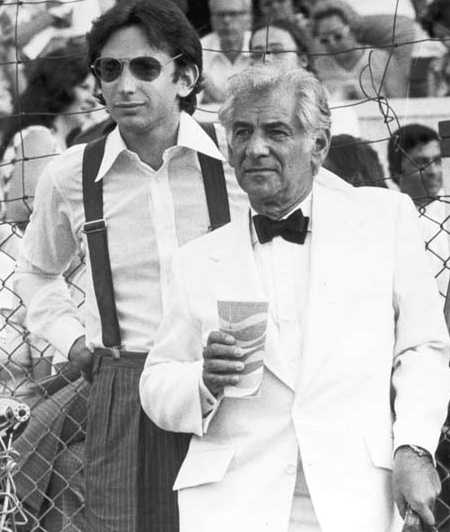
With young gay conductor 
Michael Tilson Thomas 1974

After his wife died Bernstein abandoned all caution. By this time addicted to alcohol and drugs, he became open and crude about his homosexual activity. Pianist William Huckaby, after performing at a White House recital, was talking with President Carter when he "felt these hands clamped on my shoulders.” He was whirled around and forced into a deep French kiss right in front of the President, who walked away in astonishment and embarrassment. During his sixties and seventies, Bernstein surrounded himself with an entourage of beautiful boys, each one as intoxicated and obnoxious as his patron.

Many who knew him suggest that Bernstein became frustrated and cantankerous in his later years because he had never able to match the brilliance and popularity of West Side Story (1957), composed when he was in his late thirties. He was forever chasing and trying (unsuccessfully) to live up to his own fame. He also became increasingly intolerant of being called "Lenny" by those outside his inner circle and forever corrected those who pronounced his last name Burn-steen; he pronounced his name closer to the German way, BURN-stine. Bernstein means "amber" in German. In truth, Bernstein had changed his first name to Leonard when he was fifteen years old; he had been born Louis Bernstein.

After Felicia's death, Bernstein dealt with much guilt over how his homosexual activity adversely affected her. Some of this guilt and conflict was expressed in his 1983 opera, A Quiet Place, which tackled issues close to Bernstein’s life. Its story is one of suffering the loss of a loved one and a father’s acceptance of a gay son.

Bernstein's obituary in the New York Times (1990) made clear mention of his homosexuality. Since then many fans still visit his grave at Green-Wood Cemetery in Brooklyn, New York.

Photo: Bernstein at the piano in 1944 at age 26.


Most of the information in this post comes from Meryle Secrest’s “Leonard Bernstein: A Life” and Charles Kaiser's “The Gay Metropolis.”

Note: Bisexuality is a thorny label. Do we call Bernstein bisexual because he married and fathered three children? The recently deceased Arthur Laurents did not think we should. He said Bernstein was a "gay man who married." I go about it this way. If a person has sexual relations regularly with both men and women, then I call that person bisexual. Bernstein's sexual relations before, during and after his marriage were overwhelmingly homosexual, so I agree with Laurents' assessment. The same with actor Anthony Perkins, who did not have a sexual experience with a female until he was 39 years old (he was so closeted and paranoid prior to that time that he insisted on parking blocks away from the homes of his male lovers and arrived at events and restaurants well before or after his boyfriends). Those who knew Perkins said that he'd let nothing stand in the way of his career, and getting married served his career goals. Once he sampled married life, he was so relieved that the gay rumors and suspicions no longer haunted him that he at last settled into a zone comfortable for him. If the gay rumors about George Gershwin proved true, I'd label him bisexual, because he was known to have regular sexual relations with women. Pete Townshend? I call him bisexual, too. Bernstein? Not so much.

And to those many responses in the comments section (below) who tell me that it is not my business to mention Bernstein's sexuality, I draw your attention to the first paragraph at the top of this blog, which I created to give encouragement to young men who were bullied, discriminated against, and/or shunned by their teachers or parents. You can succeed in realizing your life goals -- and it really does get better with age. May you be inspired by the life stories of the men feature here.


Monday, November 21, 2022

Charles-Camille Saint-Saëns: 1835-1921

NOTE: Your blogger recently performed an organ work by Saint-Saëns, so this post has been expanded and updated.

When his father died when he was only three months old, Charles-Camille Saint-Saëns was raised by his mother in Paris and continued to live with her until her death. He became one of the world’s most famous composers in his day, and he was a homosexual possessed of a complicated private life, which often revealed his dark side.

Saint-Saëns was a child prodigy (on the level of Mozart), and made his debut as a concert pianist in 1846, before his eleventh birthday. As an encore, Saint-Saëns offered to play any of Beethoven's 32 piano sonatas from memory. Word of this incredible experience spread across Europe and as far as the United States, where it was mentioned in an article in a Boston newspaper. Having all 32 of Beethoven’s sonatas in ones fingers, ready for concert performance, was an unheard-of feat (then as now), all the more astonishing when offered by a ten year old.

By the age of 13, Saint-Saëns was attending the Paris Conservatory. He soon gained recognition among his peers as an organ virtuoso, eventually attaining the highly coveted position of chief organist at the Madeleine Church in Paris, a post he held from 1858, at the age of 23, until he was 42 years old. His weekly organ improvisations captured the attention of all Paris. As a composer, he was highly versatile, writing operas, symphonies, concertos, much chamber music, masses and other choral works, songs and solo literature for organ and piano. His opera Samson et Dalila still ranks among the standard repertoire of opera houses all over the world. His music was wildly popular during his lifetime, and he was well-connected with other composers, particularly Hector Berlioz and Franz Liszt. Gabriel Fauré, who was Saint-Saëns's favorite pupil, soon became his closest friend.


His now popular Le Carnaval des animaux (The Carnival of the Animals, 1886), for two pianos and orchestra, was intended as a private entertainment for friends, and Saint-Saëns forbade its public performance during his lifetime. The part of the narrator, now frequently included during performance, was added by others after his death. It is a little-known fact that Saint-Saëns had the distinction of being the first noted composer to write a musical score for a motion picture, The Assassination of the Duke of Guise (L'assassinat du duc de Guise, 1908), featuring actors of the Comédie Française in Paris.

Once called a second Mozart, Saint-Saëns soon made many enemies, who were envious of his stellar success and disdainful of his biting sarcasm. Later in life he was declared to be a “composer of bad music well written.” In old age he came to be mocked for his rabid conservatism, his dislike of modern music, the campaigns he mounted against French composers Claude Debussy and Cesar Franck, his shocked disapproval of Stravinsky's Rite of Spring (allegedly infuriated over what he considered the misuse of the bassoon in the ballet's opening bars) and his insistence, during World War I, that all German music be suppressed. He was never shy with opinion.

Saint-Saëns was a true polymath. In addition to conquering the world of music as composer, conductor, critic, teacher and concert organist and pianist, he excelled in the fields of geology, archaeology, botany, mathematics and lepidoptery. He held discussions with Europe's finest scientists and wrote scholarly articles on acoustics, occult sciences, ancient theatre decoration, and early musical instruments.  Saint-Saëns wrote a philosophical work that spoke of science and art replacing religion, and his pessimistic and atheistic ideas foreshadowed Existentialism. Other literary achievements included poetry and a successful farcical play. He was also a member of the Astronomical Society of France, giving lectures on mirages; he had a telescope made to his own specifications and planned concerts to correspond to astronomical events, such as solar eclipses.


The private life of Camille Saint-Saëns was filled with turmoil. He was homosexual but realized how much marrying would bolster his reputation. Understandably, he showed little outward sign of wanting to marry. However in 1875, at the age of almost 40, he began an affair with nineteen year old Marie-Laure Truffot, which led to marriage. Immediately after their wedding, Saint-Saëns declared that he was too busy for a honeymoon and took Marie straight home to live with his mother. Thereafter the composer treated his wife with deep disdain, until the arrival of children brought out a more sympathetic side. But tragedy intervened when both children died within six weeks of each other in 1878. André, aged two, fell from a fourth floor window, and soon afterward his baby brother Jean became ill and died. Saint-Saëns blamed Marie for the children's deaths, and a short time later he walked out on her in the middle of a holiday trip. Though there was no divorce, Marie never saw him again.

Saint-Saëns was solitary and secretive, prone to disappearing for weeks at a time. He could also be a remarkable host, often entertaining friends lavishly at his Paris home, where his performances in drag were well-known among his circle, particularly his impersonation of Marguerite, the female soprano lead in Charles Gounod's opera Faust. He is reputed to have danced in ballerina tutus for the entertainment of fellow gay composer, Tchaikovsky.

After abandoning his wife, Saint-Saëns traveled extensively. He began spending winters in French-speaking Algeria, which became a favored holiday spot for European homosexuals who enjoyed the adolescent male companionship easily available there. He was quoted as saying, "I am not a homosexual, I am a pederast." Saint-Saëns died of pneumonia in Algiers, at the age of 86, on December 16, 1921.

Have a listen to his hugely popular orchestral work, Danse Macabre. I’m sure you’ll recognize it.


Trivia: Pianist Franz Liszt made an astonishing piano solo transcription of this piece.


Saturday, August 20, 2022

Siegfried Wagner's Homosexual Circle

Siegfried Wagner (1869-1930), son of the great German opera composer Richard Wagner (father and son in photo at right), displayed a feminine demeanor while growing up and was greatly attached to his mother. During his student days he often dressed up as a ballerina, and he had affairs with several of his fellow male students.

Siegfried, who was also the grandson of pianist/composer Franz Liszt, became part of a circle of high-profile closeted homosexual men, including English composer Clement Harris, tenor Max Lorenz, writer Oscar Wilde, illustrator Franz Stassen and Prince Philipp of Eulenburg. In 1892 Clement Harris and 23-year-old Siegfried set off on an around-the-world tour together, and the two fell deeply in love. Wagner kept a portrait of Harris on his desk for the rest of his life.

When journalist Maximilian Harden later accused Prince Philipp of Eulenburg and others close to Kaiser Wilhelm II of homosexuality (Harden-Eulenburg Affair), Siegfried either had to get married or be exposed for what he was. So it was that in 1915 at the age of 46, after strong prodding from his mother, Siegfried Wagner married an 18-year-old Englishwoman named Winifred Klindworth, with whom he had four children, thus providing heirs for the continuation of the Wagner dynasty. His sexual orientation, however, became the source of both scandal and concerted attempts to erase it from the history of the Wagner family.

Siegfried Wagner in his twenties (left).


When the Wagner dynasty’s papers were bequeathed to Bayreuth’s Richard Wagner Foundation in 1973, Winifred Wagner included Siegfried’s musical scores but withheld her husband's correspondence. This was consistent with the family’s notorious stalling and purging of any revelations that would taint the legacy of Richard Wagner.


In response to Harden’s insinuations about his sexual nature, Siegfried replied, “There was ugly gossip about Frederick the Great, too, the greatest king of all time – and he made Prussia great and strong! So don't worry. I won't defile the House of the Festival.” The irony in that statement is that all the rumors and gossip about Frederick the Great were true.


Siegfried did not give up social and sexual relations with homosexuals, however, and he and Franz Stassen (1869-1949), a gay artist who had served as the best man at Siegfried’s wedding, continued a social and artistic relationship that lasted for decades. Stassen (at left) was a noted Art Nouveau painter and illustrator who also married. Siegfried introduced Stassen to Wagnerian tenor Max Lorenz (1901-1975), much admired by Hitler, even though Lorenz was a gay man married to a Jewish woman. For a time Stassen and Lorenz were involved in an affair. When Hitler, who was a financial supporter of the Bayreuth Festival, could no longer publicly endorse Lorenz, it was Siegfried’s wife Winifred who used her influence to rescue Bayreuth’s star heldentenor from public disgrace, exile and possible imprisonment over a charge of homosexuality.

Most historians concede that Hitler and Winnifred (below) carried on an affair after Siegfried’s death in 1930; there were even rumors of a possible marriage. Although Winifred was proud of her association with Hitler, when he visited her at Bayreuth, she took pains to conceal the connection. Hitler would register at the Hotel Bube in nearby Bad Berneck, and Winnifred would send her own car to pick him up, so that Hitler's ostentatious Mercedes would not be seen pulling into the driveway at Wahnfried, the Wagner family's villa built for Richard Wagner by King Ludwig II of Bavaria.


Following in his father’s footsteps, Siegfried Wagner was also a composer, but his operas, although popular during his lifetime, never entered the standard repertoire. In 1896 Siegfried began conducting at the Bayreuth Festival and from 1906-1930 was the festival’s sole artistic director. In Siegfried’s controversial 1930 staging of his father’s opera Tannhäuser, he boldly embellished several scenes with scantily clad male teenagers. In the opening Venusberg bacchanal scene their costume consisted of ballet slippers and loincloths -- nothing else. Don't believe me? There is archival video on YouTube.

Siegfried dedicated one of his eighteen operas to Franz Stassen, who designed stunning illustrations for the programs for Wagnerian opera productions at Bayreuth (example at right). Franz also published homoerotic drawings and paintings and went on to become a major player in the Teutonic Art Nouveau style. During the last decade of his life Stassen wrote recollections about his male "soul mate", thus publicly hinting at his own homosexuality. An aside -- Stassen was adept at illustrating male posteriors, most often naked, in a fashion we would describe these days as "perfect bubble butts".


In the previous decade Stassen had also become associated with the Nazi Party. He created four important tapestries for Hitler's Reich Chancellery in Berlin that illustrated motifs of the Germanic Edda sagas. In gratitude, Hitler awarded him the title of professor in 1939.

After 1941 Franz lived openly with his male partner and professed his homosexual orientation, but the Third Reich generously overlooked and ignored this declaration. In the final phase of World War II, Hitler included Stassen in the Gottbegnadeten (Gifted by God) list of important artists most crucial to Nazi culture.


Wagnerian tenor Max Lorenz (right) was homosexual as well, but in 1932 he married Lotte Appel, a Jewish singer who was aware of his sexual orientation going into the marriage. Max’s homosexuality was tolerated by the Nazis as a well-known secret, because Lorenz was a favorite of Hitler. When Lorenz was dragged into court because of an affair with a young man, Hitler advised Winifred Wagner, the director of the Bayreuth Festival after Siegfried’s death in 1930, that Lorenz would not be suitable for the Festival. She replied that in that case she would have to close the Festival, because, “...without Lorenz, there can be no Bayreuth.” Lorenz was thus retained.

As for his Jewish wife Lotte, Max insisted on being open about his marriage of convenience, which was taken as a provocation by the Nazis. Once when Lorenz was away from his house, the SS burst in and tried to take Lotte and her mother away. At the last moment Lotte Lorenz was able to make a phone call to Hermann Göring’s sister, and the SS was ordered to leave their residence and not bother the women. Göring stated in a letter dated March 21, 1943, that Lorenz was under his personal protection, and that no action should be taken against him, his wife, or her mother.


Siegfried Wagner -- Violin Concerto in One Movement (1915):


Second Movement (1927) of Siegfried Wagner’s Symphony in C (in the earlier 1925 first version of the symphony, the slow movement was recycled from the prelude to Der Friedensengel, an opera written in 1914):

Friday, January 7, 2022

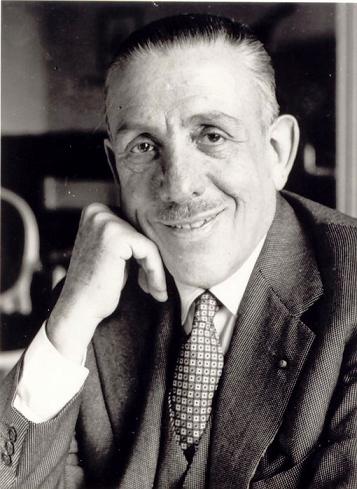
Composer Francis Poulenc

French composer Francis Poulenc, who engaged in a long string of homosexual relationships, was born January 7, 1899, into a wealthy Parisian family. In 1920 he became a member of a group of young composers dubbed “Les Six.” The others were Darius Milhaud, Arthur Honegger, Georges Auric, Germaine Tailleferre, and Louis Durey. Their music was a reaction against the music by the Impressionists (Debussy and Ravel) and late Romantics (Wagner, Puccini, etc.).

During the late 1920s Poulenc first acted on his homosexuality when he met painter Richard Chanlaire, who became his lover. Poulenc’s second lover, the bisexual Raymond Destouches, was a chauffeur and dedicatee of several of Poulenc’s compositions.
Musicologists suggested that Poulenc considered gay sex impure and thus had a difficult time with making homosexuality his identity.

The success of his 1924 ballet score for Diaghilev’s “Les biches” (The Deer) led to the commissions of his Concerto for Two Pianos* (1932) and the Organ Concerto (1938), both commissioned by fabulously wealthy lesbian American expatriate Winnaretta Singer, known as Princesse Edmond de Polignac. The organ concerto was premiered in the music salon of her private home, which housed a pipe organ. Famed organist Maurice Duruflé was the soloist.

Poulenc would later have a brief affair with a woman known as Frédérique and have a daughter by her in 1946. They did not marry. In a tour of the United States Poulenc met a friendly gay couple, Arthur Gold and Robert Fizdale, accomplished duo pianists who commissioned the Sonata for Two Pianos (1953). Poulenc found tours difficult, because they separated him from Lucien Roubert, his lover who died of pleurisy in 1955, just after Poulenc completed his masterpiece, the opera “Les dialogues des Carmélites.” In 1957 he met his last significant lover, Louis Gautier, who helped to revive his spirits. In that year, Poulenc produced his Flute Sonata (middle mvt. in YouTube excerpt below). 

Poulenc also composed a significant body of first-rate art songs, numbering more than 200; they remain staples of the genre.

"Hôtel" from a set of five songs "Banalités" (1940). Sung by Régine Crespin.


Leonard Bernstein commissioned Poulenc to write "Sept répons des ténèbres" (1961) for the opening of the Philharmonic Hall, hence known as Avery Fisher Hall, now David Geffen Hall (since 2015) at Lincoln Center, NYC. Shortly thereafter Poulenc died of a heart attack on January 30, 1963. One of the most honored composers of his time, he left an enduring legacy.


Sources:


Poulenc: A Biography by Roger Nichols

Poulenc: The Life in the Songs by Graham Johnson


*French conductor Georges Prêtre championed the works of Poulenc. I’ll never forget a performance in Paris (November 2004) of Poulenc’s Concerto for Two Pianos, selected by Prêtre to be performed on his 80th Birthday concert at the magnificently restored Art Deco masterpiece, the Théâtre des Champs-Elysées. Prêtre owns this piece. Here he conducts the Orchestra National de la RTF with the composer (piano on the left) and Jacques Février (piano on right) in the first movement of the concerto for two pianos.


Next: Poulenc at the piano with Jean-Pierre Rampal on flute (Rampal was the dedicatee). This middle movement of Poulenc's Flute Sonata (1957), marked Cantilena, is typical of his light, accessible style. This sonata has the honor of being the most often performed work in the entire repertoire of pieces written for flute and piano. Your blogger had the pleasure of rehearsing this sonata last evening (as accompanist). Pure pleasure.

Saturday, November 27, 2021

Stephen Sondheim

Update: Mr. Sondheim died suddenly on November 26, 2021,
at his home in Roxbury, Connecticut.
He was 91 years old.


Photo: Fred R. Conrad/NY Times

Original post from 2012 - I have not changed the verbs from present to past tense:

On September 15, 2010, eighty-year-old Stephen Sondheim, one of the greatest theater composers of our time, joined other legendary theatre artists who have had Broadway theatres named after them – Ethel Barrymore, David Belasco, Edwin Booth, George Broadhurst, George Gershwin, Alfred Lunt & Lynn Fontanne, Richard Rodgers, Helen Hayes, Eugene O'Neill, Neil Simon and August Wilson.

Sondheim (born March 22, 1930) gave a speech during the unveiling ceremony of the new marquee on the former Henry Miller’s Theatre at 124 W. 43rd Street. The signage on the marquee is Sondheim’s signature. The  restored neo-Georgian brick façade, which dates back to 1918, fronts an entirely new 1,055 seat theatre placed below street level. The restoration retained the “Henry Miller’s Theatre” letters, still visible etched in stone high above the Stephen Sondheim marquee
.


It should not be lost on my readers that Stephen Sondheim is a homosexual Broadway artist. Sondheim did not come out as a gay man until he was 40 and did not live with a partner (dramatist Peter Jones) until he was 61. Update: In 2017 Sondheim married Broadway singer/actor Jeffrey Romley, who survives him. Romley (b. 1980) is 50 years younger than Sondheim.

Sondheim wrote the lyrics for the landmark musical West Side Story (1957) in collaboration with bisexual Leonard Bernstein’s music and gay Arthur Laurents’s book. Laurents, born in 1918 (the same year as Bernstein), died on May, 2011. Sondheim, the baby of that creative team, was just 25 years old when he was hired to work on West Side Story. He followed with another smash hit with his lyrics for Gypsy in 1959.

Sondheim helped establish what is known as the “concept” musical, which sought to tell stories in fresh ways – Company (1970), Follies (1971) and Pacific Overtures (1976), for example. He changed the nature of musical theatre forever and has influenced subsequent generations of writers.

Sondheim is the winner of a Pulitzer Prize (Sunday in the Park with George), an Academy Award (for Sooner or Later, as performed by Madonna in the film Dick Tracy) and multiple Tony and Grammy Awards. He was the recipient of a Lifetime Achievement Award from the Kennedy Center Honors (1993), the National Medal of Arts (1996), the American Academy of Arts and Letters' Gold Medal for Music (2006) and a special Tony Award for Lifetime Achievement in the Theatre (2008).


Sondheim (above left) with Leonard Bernstein in 1965.

Among the many shows for which Sondheim wrote the music and lyrics are Into the Woods (1987), Sunday in the Park with George (1984), Sweeney Todd (1979), A Little Night Music (1973), Anyone Can Whistle (1964) and A Funny Thing Happened on the Way to the Forum (1962). Five shows are anthologies of his works: Side by Side by Sondheim (1976), Marry Me a Little (1981), You're Gonna Love Tomorrow (1983), Putting It Together (1993/99) and Sondheim on Sondheim (2010).

It is a lesser known fact that he has composed film scores, written songs for television productions and provided incidental music for stage plays.

Sondheim is currently working on a new musical, tentatively titled All Together Now, in collaboration with playwright David Ives, whose play Venus in Fur (2010) is enjoying an extended run at Broadway’s Lyceum Theatre.

In 2009 the Signature Theatre, in my home state of Virginia, established a new honor, The Sondheim Award, as “a tribute to America's most influential contemporary musical theatre composer.” The first award was presented at the Arlington, VA, theatre’s gala fund-raiser. Sondheim himself was the first recipient of the award, which includes a $5000 honorarium for the recipients' choice of a nonprofit organization. The 2010 honoree was Angela Lansbury, and in 2011 the recipient was Bernadette Peters.

Losing My Mind ("Follies" 1971) performed by Jeremy Jordan:


Sunday, March 1, 2020

Charles Griffes

We know that the young musician from Elmira, NY, had a thing for men in uniform, because he wrote about it in his meticulously kept diaries. Subsequent studies abroad opened his mind to the emerging European homophile movement of Edward Carpenter, Magnus Hirschfeld, Oscar Wilde and André Gide, and he began to feel more comfortable with his sexual orientation. Nevertheless, once he returned to the United States in 1907 to take a job as a teacher at the Hackley School for Boys* in Tarrytown, NY, he became more circumspect and lived out the remainder of his short life as a closeted man. His departure from Europe was necessitated by the death of his father, leaving the young Griffes to support his widowed mother and other family members.

A brilliant concert pianist and composer, Charles Griffes (1884-1920, pronounced GRIFF-ess), was one of the first American composers to adapt avant-guard influences that were championed by Debussy and other Europeans. Called an "American Impressionist" by critics who didn't know how else to categorize him, he wrote highly listenable and sophisticated classical music that received praise from critics and composers, most notably Stokowski, Busoni, Pierre Monteux  and Prokofiev. His symphonic works received performances by the prestigious New York Philharmonic and Boston Symphony orchestras.

His home-town music teacher financially supported his flight from Elmira to study piano and composition in Berlin, Germany, while Griffes was still in his late teens. During his time in Europe he had affairs with several men, most notably Emil Joel, an older fellow student. Over a period of four years Joel guided Griffes’ artistic development, procured concert tickets and introduced him to such prominent musical figures as Richard Strauss, Enrico Caruso, Ferrucio Busoni, and Engelbert Humperdinck, with whom Griffes studied music. Joel even supported Griffes financially, enabling him to extend his time in Europe by a year.

As comfortable as he became among his peers in gay circles, Griffes never divulged his orientation to straight friends or associates. There was too much at stake for a man who had to support himself, especially when the job he held until his untimely death was at a boys’ school. Griffes was in a precarious position when he became infatuated with one of his male students, because no man of his time and position could have been openly gay without public disgrace. Nevertheless, he was constantly frustrated that gay men could not meet openly in public.

*The Hackley School (shown at right) is a private, exclusive all-male prep school in Tarrytown, NY. Internationally renowned gay architect Philip Johnson was a 1923 graduate just three years after Griffes's death. Most of the students go on to attend Harvard University.


However, Griffes was able to sneak away from Tarrytown to sample the gay life of NYC. He was known to patronize the Lafayette Place and Produce Exchange bath houses, for reasons that were obvious. He even entered into an intimate relationship with Officer John Meyer, a married New York policeman (remember that fetish for men in uniform).

Griffes composed song cycles, piano pieces, orchestral works and chamber music, much of the latter written as incidental music for stage plays. It is astonishing that he was able to do this while holding down a full-time job on the faculty of the Hackley School*. He composed, performed, arranged, revised and orchestrated everything, acted as his own agent and overcame difficulties with his publisher (G. Schirmer), all without outside assistance. Unable to afford editors or copyists, he had to correct proofs and prepare copies of his own large orchestral scores against the mounting deadlines that came with his enhanced reputation.

His most enduring compositions are "The Pleasure Dome of Kubla Khan" (1917), "The White Peacock" (1915), "Poem for Flute and Orchestra" (1918), and "Two Sketches Based on Indian Themes" (1916-1920). He also wrote a bold, passionate and difficult "Sonata for Piano" (1918).

Note: adjust your speakers, because this performance of The Pleasure Dome of Kubla Khan starts very softly and slowly:


Tragically, at the height of his fame, Griffes contracted influenza in 1919. Shortly after a Carnegie Hall performance of his music, he collapsed at the Hackley School for Boys in early December and was subsequently hospitalized. He died on April 20, 1920, only 35 years old, and his funeral was held in New York City. Musicologist B. Collins relates a poignant tale about the funeral service, held at the Church of the Messiah at Park Avenue and 34th Street. Unexpectedly, the strains of a Bach chorale wafted from across the street, where a music festival was being held in the 71st Regiment armory.  Standing on the parapets of the armory building, a choir of trombonists played a sort of “accidental” requiem. Both the sight and sound of the performance would have pleased Griffes, as all of the trombonists were in uniform. The building that replaced that church is a structure that now hosts rehearsals of the New York City Gay Men's Chorus.

Griffes had kept a diary in German in which he reported on his various forays to bathhouses and other favorite gay-friendly haunts. Unfortunately, several of the diaries were destroyed by his sister after his death to prevent widespread knowledge of Griffes's gay recreational New York City life, his attraction to men in uniform, and his long-term relationship with a married policeman. At the time of his death he was working on a festival drama based on the poetry of Walt Whitman.

Sources: Most of the information in this post comes from biographical studies by Howard Pollack, B. Collins and Thomas Riis.

Friday, December 27, 2019

Jerry Herman

Jerry Herman (1931-2019) is the only Broadway composer/lyricist in history to have three musicals run more than 1500 performances each: Hello, Dolly!, Mame and La Cage aux Folles.

Raised in NYC, he spent summers in the Berkshires directing plays and musicals at his parents' camp. After college Herman produced the off-Broadway 1954 revue I Feel Wonderful, forged from material he had written at the University of Miami (the university’s theater, the Jerry Herman Ring Theatre, is now named after him). It was his only show his mother was able to see, since she died of cancer at the age of 44, shortly after the revue opened. Her death caused a crippling depression for Herman.

In an attempt to dispel his grief, Herman put together a revue called Nightcap in 1958. It ran for two years. His Broadway debut came in 1960 with From A to Z, a revue that featured contributions from newcomer Fred Ebb. Producer Gerard Oestreicher approached him after seeing his work and asked Herman to compose the score for a show about the founding of the state of Israel. The result was 1961's Milk and Honey, his first full-fledged Broadway musical.

In 1964, famed producer David Merrick hired Herman for a project that was to become his most successful endeavor, Hello, Dolly!, starring Carol Channing. The original production ran 2,844 performances, the longest running musical of its time, and the show fostered three revivals. It won 10 Tony Awards, a record that remained unbroken for 37 years, until The Producers won 12 in 2001.

Herman wrote in his memoir that David Merrick was "a very tough man who loved to intimidate people." After Merrick saw Milk and Honey, he asked to meet with Herman. Merrick was looking for a composer-lyricist to write the songs for Hello Dolly! Herman requested a copy of the script and asked if he could have the weekend to come up with some songs. "Those three days were the turning point of my career. I produced those four songs in two days of the wildest, most intensive writing binge of my life. I was like a crazed person, pacing up and down in the middle of the night, scribbling down lyrics and popping candy in my mouth. But I was young, I was full of energy, and I wanted this happy, brightly colored American musical more than anything in the world. I was determined to get this job. There was a new aggressiveness in me, this desperate need to prove something to myself. I killed myself for this job." On Monday morning, after hearing the songs, Merrick said, "Kid, the show is yours."

The production was an enormous hit and Herman developed a close friendship with its star, Carol Channing. Working on the show, however, was emotionally traumatic because of the difficult personality of Merrick.

In 1966, Herman delivered another smash hit, Mame, starring Angela Lansbury. Both shows introduced a string of Broadway standard tunes. A 1969 movie version of Hello Dolly! starred Barbra Streisand (ouch!), and Lucille Ball (double ouch!) starred in the film version of Mame (1974). For years both Streisand and Ball suffered invidious comparisons to Channing and Lansbury.

Hello Dolly! star Carol Channing (Dolly Levi) and Lee Roy Reams (Cornelius Hackl) flank composer/lyricist Herman in a photo at the time of the show’s 1978 Broadway revival.


Three disappointments followed: Dear World (1969, starring Angela Lansbury), Mack & Mabel (1974, starring Robert Preston and Bernadette Peters), and The Grand Tour (1979, starring Joel Grey). Interestingly enough, Herman considers the score of Mack & Mabel his personal favorite. The show had a successful revival in London’s West End in 2006.

After the initial failure of Mack & Mabel, Herman became depressed and did not want to write musicals anymore. The financial success of Dolly had allowed Herman to buy a rowhouse from playwright Edward Albee at 50 W. 10th St. (Greenwich Village), NYC, and refurbish it. The structure dated from 1868, when it served as stables. Prior to Albee, it had belonged to renowned Shakespearean actor Maurice Evans. House Beautiful ran an article on Herman's renovation, and a second career was born. During the 1970s, he turned to renovating and decorating houses and reselling them, finding decorating projects therapeutic.

In 1983, Herman struck gold again with La Cage aux Folles, breaking box-office records at the Palace Theatre, and winning another Tony Award for Best Musical. After the phenomenal success of La Cage aux Folles, Herman left the world of Broadway and moved to Bel Air, California, where he mourned the death of his long-term partner and dealt quietly with his own HIV-positive status, which was ungracefully made public in 1992 by New York Post columnist Cindy Adams.

His 1996 memoir, Showtune, relates stories “about that fabulous era when there were 20 musicals a season. Mary Martin in one and Gwen Verdon in another. It was a very heady, exciting time, and I had a little part in it," he says. "I also wanted to tell the story honestly of a gay man in America who was comfortable with that persuasion. But almost more than the stories about Ethel Merman and Pearl Bailey, I wanted to tell people in my situation that there are medications now that can normalize your system.”

Though his shows have raised the spirits of millions, Herman believes his participation in the mid-1990s experimental study of protease inhibitors was more important: "My medical records were sent to the FDA along with hundreds of others to help get the drug approved. I think that's the best thing I've done for this world." Update: Mr. Herman lived for 34 years after his HIV-positive diagnosis in 1985.

Herman had settled down with partner Marty Finkelstein, whom he met at a Christmas party.  They started their own business renovating Victorian houses in Key West, winning numerous architecture and restoration awards. But after five years together, Finkelstein came down with a bronchial infection that wouldn't go away. Two and a half years together, Finkelstein died of AIDS at the age of 36. "When I saw the grief of his mother, that hit me more than my own grief," Herman said.

At the Palm Springs, CA, home he shared with recently retired real estate broker Terry Marler, his partner of a dozen years, there is a 61-foot swimming pool. "That's my exercise," Herman said. "I'm there a great deal of the time; I swim and swim and swim as often as I can. It gets harder every year. You don't like to think of age as being a problem, so swimming keeps me fit. Terry keeps my life going. He's responsible for laughter and companionship. He's just a great, great partner."

The best Jerry Herman song you've never heard of:
TIME HEALS EVERYTHING (Mack & Mabel)
Sung by Bernadette Peters, who created the role on Broadway.


Herman was awarded a 2009 Special Tony Award for Lifetime Achievement, at age 77. "It's the most exciting thing that's ever happened to me, it really is," Herman said. "It doesn't get any better than this. That's an award from the people that I've worked with all my life. It's beautiful." The award was presented to him by Angela Lansbury, the inimitable star of Mame.

In 2010 he was a recipient of the Kennedy Center Honors, at age 80. The next year three of his works were staged in Australia: Milk and Honey, Dear World and Hello, Dolly! The PBS 90-minute documentary, Words and Music by Jerry Herman (2007), is available on DVD.

Update to original post: Mr. Herman died in a Miami hospital on December 26, 2019, at the age of 88. His partner, Terry Marler, survives him.