
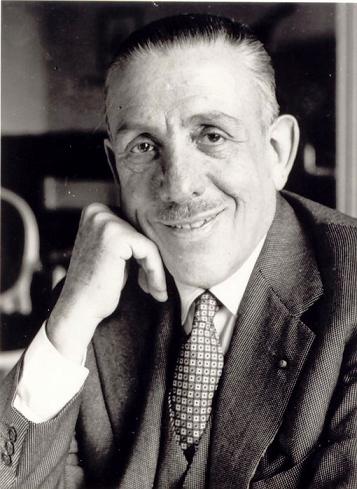
French composer Francis Poulenc, who engaged in a long string of homosexual relationships, was born January 7, 1899, into a wealthy Parisian family. In 1920 he became a member of a group of young composers dubbed “Les Six.” The others were Darius Milhaud, Arthur Honegger, Georges Auric, Germaine Tailleferre, and Louis Durey. Their music was a reaction against the music by the Impressionists (Debussy and Ravel) and late Romantics (Wagner, Puccini, etc.).
During the late 1920s Poulenc first acted on his homosexuality when he met painter Richard Chanlaire, who became his lover. Poulenc’s second lover, the bisexual Raymond Destouches, was a chauffeur and dedicatee of several of Poulenc’s compositions. Musicologists suggested that Poulenc considered gay sex
impure and thus had a difficult time with making homosexuality his
identity.
The success of his 1924 ballet score for Diaghilev’s “Les biches” (The Deer) led to the commissions of his Concerto for Two Pianos* (1932) and the Organ Concerto (1938), both commissioned by fabulously wealthy lesbian American expatriate Winnaretta Singer, known as Princesse Edmond de Polignac. The organ concerto was premiered in the music salon of her private home, which housed a pipe organ. Famed organist Maurice Duruflé was the soloist.
Poulenc would later have a brief affair with a woman known as Frédérique and have a daughter by her in 1946. They did not marry. In a tour of the United States Poulenc met a friendly gay couple, Arthur Gold and Robert Fizdale, accomplished duo pianists who commissioned the Sonata for Two Pianos (1953). Poulenc found tours difficult, because they separated him from Lucien Roubert, his lover who died of pleurisy in 1955, just after Poulenc completed his masterpiece, the opera “Les dialogues des Carmélites.” In 1957 he met his last significant lover, Louis Gautier, who helped to revive his spirits. In that year, Poulenc produced his Flute Sonata (middle mvt. in YouTube excerpt below).
Poulenc also composed a significant body of first-rate art songs, numbering more than 200; they remain staples of the genre.
"Hôtel" from a set of five songs "Banalités" (1940). Sung by Régine Crespin.
Leonard Bernstein commissioned Poulenc to write "Sept répons des ténèbres" (1961) for the opening of the Philharmonic Hall, hence known as Avery Fisher Hall, now David Geffen Hall (since 2015) at Lincoln Center, NYC. Shortly thereafter Poulenc died of a heart attack on January 30, 1963. One of the most honored composers of his time, he left an enduring legacy.
Sources:
Poulenc: A Biography by Roger Nichols
Poulenc: The Life in the Songs by Graham Johnson
*French conductor Georges Prêtre championed the works of Poulenc. I’ll never forget a performance in Paris (November 2004) of Poulenc’s Concerto for Two Pianos, selected by Prêtre to be performed on his 80th Birthday concert at the magnificently restored Art Deco masterpiece, the Théâtre des Champs-Elysées. Prêtre owns this piece. Here he conducts the Orchestra National de la RTF with the composer (piano on the left) and Jacques Février (piano on right) in the first movement of the concerto for two pianos.
Next: Poulenc
at the piano with Jean-Pierre Rampal on flute (Rampal was the dedicatee). This middle movement of Poulenc's Flute
Sonata (1957), marked Cantilena, is typical of his light, accessible style. This sonata has the honor of being the most often performed work in the entire repertoire of pieces written for flute and piano. Your blogger had the pleasure of rehearsing this sonata last evening (as accompanist). Pure pleasure.


