Hollywood’s Rogue Bisexual
UPDATED POSTING:
Today is the 100th anniversary of the birth of Marlon Brando (April 3, 1924 Omaha, Nebraska). It's time to light a candle to this revolutionary actor.
I have revised this post with information from more recent sources. So many readers have questioned the veracity of facts presented below that I have moved my bibliography to the front of this post.
Sources:
The Contender by William J. Mann (2019; 718 pages)
Brando's Smile by Susan Mizruchi (2014; 512 pages)
Brando: the Biography by Peter Manso (1994; 1,118 pages)
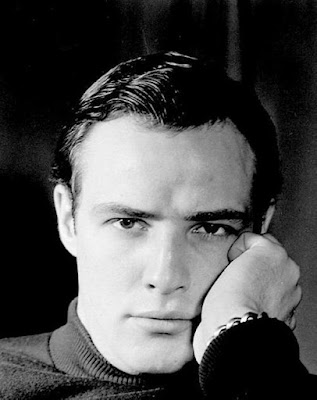
He was a tough guy with a stunningly beautiful face. At first he wanted to be a drummer. Then a dancer; he studied modern dance with Katherine Dunham in the early 40s. Turned out the only things he was good at were sports and drama, invariably coupled with a determined, rogue lifestyle. Known as "Bud," he got kicked out of high school for riding a motorcycle through the hallways. He once came to the rescue of a skinny 9-year-old kid being taunted and beaten by schoolyard thugs, helped him up, threw his arm around him and said, “I’m your new best friend.”
Thus began a bizarre, intimate relationship with fellow actor Wally Cox that would last a lifetime -- for 40 years until Cox's death. Both men were born in 1924, and for many years they were roommates. After Cox died in 1973, Brando kept the ashes for safekeeping, because he wanted his own ashes to be commingled with Wally’s when the time came. Sure enough, in 2004, Brando’s family honored his request. The Associated Press reported, “The ashes of Brando’s late friend Wally Cox, who died in 1973, were also poured onto the desert landscape of Death Valley as part of the ceremony of scattering Brando’s ashes.” Brando not only kept his friend’s ashes for more than 30 years, but, when lonely, would sometimes dine with the urn, holding conversations in which he would perfectly imitate Cox’s distinctive voice, even at times keeping the urn under his car seat.
Unlike many bisexuals (like Cary Grant), who denied their homosexual activity all their lives, Marlon Brando brazenly admitted it. In a 1976 interview, Brando said, “Homosexuality is now so much in fashion it no longer makes news. Like a large number of men, I, too, have had homosexual experiences, and I am not ashamed. I have never paid much attention to what people think about me.”

Brando was bisexual and possessed of a voracious libido. There were plenty of homosexual experiences to report – among his partners were Burt Lancaster, Laurence Olivier, John Gielgud, Leonard Bernstein, Noël Coward, Clifford Odetts, Christian Marquand (especially Christian Marquand), Tyrone Power, Paul Newman, Montgomery Clift (on a dare, they once ran naked down Wall Street together), James Dean and Rock Hudson. Striving for a balanced diet, however, his conquests also included Marilyn Monroe, Marlene Dietrich, Grace Kelly, Rita Hayworth, Shelley Winters, Ava Gardner, Gloria Vanderbilt, Hedy Lamarr, Tallulah Bankhead, Ingrid Bergman, Rita Moreno (especially Rita Moreno), Edith Piaf and Doris Duke (the world’s richest woman at the time).
By the age of 23 Brando had achieved stardom as Stanley Kowalski in Tennessee Williams's stage play, A Streetcar Named Desire (1947). When he reprised this role in the 1951 film version, Brando received an Oscar nomination for best actor. As success piled upon success, Brando had a hard time dealing with his fame and celebrity. By the time of his death, the American Film Institute had named Brando the fourth greatest male film star, and Time Magazine included him in its list of the 100 Most Important People of the 20th Century. Unfortunately, near the end of his career he had lost interest in acting; he took on roles only for the money.
He was a generous and tireless advocate for social justice, particularly for the rights of African-Americans and Native Americans. He supported statehood for Israel, and in 1946 he performed in Ben Hecht's Zionist play, A Flag is Born. When Brando read in a newspaper that actress Veronica Lake had fallen on hard times and was working as a cocktail waitress in Manhattan, he had his accountant mail her a check for $1,000; she never cashed it, out of pride, but framed it and hung it on a wall to show to her gay friends.

The roles he lived off-screen were even more provocative than those he created on film. When filming Mutiny on the Bounty in Tahiti in the early 1960s, he fell in love with the place and purchased a private 12-island atoll. He married the Tahitian actress who played his love interest in the film and became fluent in French, her native tongue (he conducted many interviews in French). Rita Moreno, a long-term lover, responded by attempting suicide.
The world knew of his predilection for “dark-skinned women”, particularly those of Tahitian and American Indian descent. That Brando had a skinny, bespectacled male lover called Wally didn’t fit the image. Yet he once admitted that he had never been happy with a woman, adding: “If Wally had been a woman, I would have married him, and we would have lived happily ever after.” Wally Cox was the only person Brando allowed to berate him – many was the time that Cox would put Brando in his place.
In his youth Brando was an electrifyingly handsome and talented star. Exuding a sense of brooding power and bottled-up anger, he changed the way stars, both male and female, acted and even the way young men dressed.
A fellow student, Mae Cooper, said after a workshop presentation, "people suddenly started looking at him. It gave you the chills, like the dawn of something great. It was like suddenly you woke up and there's your idiot child playing Mozart. It made your hair stand on end."
James Dean based his entire charisma on Brando, whom he worshiped. Marlon’s blue jeans and tight T-shirts became standard issue while he reigned as the male sex symbol of the 1950s. But he was much more than just a rebel. He later chalked up two Oscar-winning performances in On the Waterfront and The Godfather.
In later years he admitted, “I searched for, but never found, what I was looking for either on screen or off. Mine was a glamorous, turbulent life – but completely unfulfilling.” At the time of his death at 80 years old in 2004, he weighed well over 300 pounds and was suffering from diabetes, pulmonary fibrosis, congestive heart failure, liver cancer and failing eyesight. I found a photo of a hugely bloated, fat Brando taken shortly before his death, but I couldn't bear to post it. I'd rather be in denial of what came at the end of this remarkable life.
Born 1924, Omaha, Nebraska
Died 2004, Los Angeles, California
Brilliant, stubborn, eccentric actor
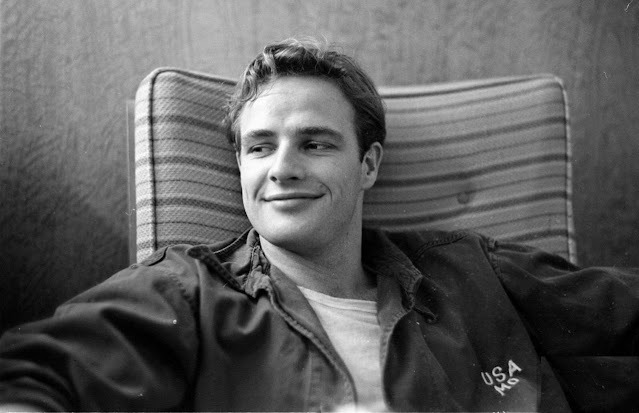
A performance on the night of December 3, 1947, made theatrical history. A Streetcar Named Desire opened at the Ethel Barrymore Theater in NYC, and no one could remember an actor or actress so electrifying an audience. For days people had lined up around the block to buy tickets. Theater doyenne Jean Dalrymple said, “From the moment Brando walked out on stage, all eyes were riveted on him. He was like an animal in heat, with those tight jeans and sweaty T-shirt. His Stanley was violent and crude, totally mesmerizing. I don’t recall having seen such utter rapture in a drama. It was more than a new star being born – we were devastated by the performance, as if a quart of our blood had been drained from us. I knew that I had witnessed Broadway history – in this performance acting, and theater itself, had changed for all time.”
Marlon Brando, at the tender age of 23, gave a performance that caused people to leap to their feet in a 30-minute ovation after the curtain went down. Jessica Tandy (portraying Blanche) was furious, because she knew the applause was not for her. In the audience were Cary Grant, David Selznick, Montgomery Clift, Edward G. Robinson, Geraldine Page, George Cukor and Paul Muni – all gasping for air. Tandy, whom younger readers might know from her Oscar-winning performance in Driving Miss Daisy, somehow coped with Brando's wildly erratic performances, each varying from night to night.
Below: Brando in 1955 with his Oscar for On the Waterfront.
![]()
![]()
![]()
![]()
![]()

Note: Elia Kazan also directed the 1951 film version of Streetcar. This time Blanche was portrayed by Vivien Leigh, an actress with whom Brando had greater chemistry than Tandy. For younger readers who might know Brando only from his role in The Godfather, this clip will be a revelation. But don’t take my word for it, watch Brando in action:
Marlon Brando & Vivien Leigh in A Streetcar Named Desire:


