Movie star Montgomery Clift struggled his whole life with his sexual orientation. He once said, “I love men in bed, but I really love women!” Nevertheless, Clift had affairs with choreographer Jerome Robbins and fellow actor Roddy McDowall, who attempted suicide after his breakup with Monty.
He kept his tormented sexuality a secret from most everyone he knew – making discreet trips to Ogunquit, Maine, where gay men could have trysts without being noticed, then to Fire Island, which was a well-known gay getaway. He had a taste for S&M homosexual activity. Little was published about his homosexual affairs, and he was fiercely determined to keep that aspect of himself under wraps. In 1940 he had his first regular male lover, who was a fellow actor. In 1949 he was arrested on 42nd Street in New York for soliciting, but his film studio intervened to ensure that the charge was dropped without publicity.
Montgomery (Monty) Clift’s mother, “Sunny,” was herself the child of southern aristocrats, but had been given up for adoption. She married a rich stock broker and spent her life treating Monty and his twin sister to the privileged life she never had. As young children, the Clift twins were taken on tours of Europe and tutored at home, but more than anything, they were victims of a severely controlling and manipulative mother.
At the age of 13, Monty appeared on Broadway and took stage roles in New York for over a decade before beginning to appear in films. By the time he was in his late teens, he’d acted on Broadway with Alfred Lunt, Lynn Fontaine and Tallulah Bankhead. He earned excellent theatrical reviews and soon attracted the interest of numerous lovelorn actresses. While working in New York in the early 1940s, he met a former jazz singer and heiress to the Reynolds Tobacco fortune, Libby Holman. At 38 years old she developed an obsession with the 21 year old actor, financing a play for him. His relationship with bisexual Holman was likely the last heterosexual relationship of his life and caused him further anguish over his sexuality.
Montgomery Clift brought a new vitality and depth to his film roles. He was a talented, devastatingly handsome actor. When Elizabeth Taylor first saw him on the set of "A Place in the Sun," she said he took her breath away (see photo above and at end of post). Soon enough she fell in love with him, but her feelings were not reciprocated. He inspired Marlon Brando and James Dean, who emulated his naturalistic acting style. The characters Monty played on screen were lost, confused souls, a new, post-war image of the American male. Off-screen, he led a tortured life. His addiction to pills and alcohol and his complicated sexual identity have been widely publicized. Analytical books and documentaries place blame for Clift's psychological problems on his repressed homosexuality.
By the early 1950s he was exclusively homosexual, though he continued to maintain a number of close friendships with theater women. His movie debut was “Red River” (1948) with John Wayne, but his second film that year, “The Search,” is the one that brought real attention to his talent, and an Academy Award Nomination ensued (see clip below). He received further Academy Award Nominations for “A Place in the Sun” (1951), “From Here to Eternity” (1953) and “Judgment at Nuremberg” (1961), but never won.
A 1956 tragic car accident, in which he drove into a telephone pole after leaving a dinner at Elizabeth Taylor’s home, severely damaged his facial features, and plastic surgery could not fully restore use of his facial muscles. This limited his range of expression and hurt his self-esteem. Subsequently, Clift took mostly unglamourous roles, only worsening his damaged public image.
A lawsuit with Universal Pictures and growing addictions forced him into a four-year retirement in 1962. In his final years, Clift plunged more deeply into drug and alcohol abuse and wild sexual behavior. He was considered unreliable by studio bosses. Sadly, by the time his companion Lorenzo James found him dead of a heart attack at their home in 1966, he was virtually unemployable. He was 45 years old.
Montgomery Clift and Elizabeth Taylor (1951): A Place in the Sun
The Search (1948) In Post-War Berlin, Clift, who portrays an American private, helps a lost Czech boy, a survivor of Auschwitz, find his mother. In this scene, Clift (almost too handsome to watch) shows his finely honed acting chops. He won his first Academy Award nomination for this film.
Role models of greatness.
Here you will discover the back stories of kings, titans of industry, stellar athletes, giants of the entertainment field, scientists, politicians, artists and heroes – all of them gay or bisexual men. If their lives can serve as role models to young men who have been bullied or taught to think less of themselves for their sexual orientation, all the better. The sexual orientation of those featured here did not stand in the way of their achievements.
Thursday, September 15, 2011
Monday, September 12, 2011
Tyrone Power, Hollywood Bisexual
Ohio-born movie star Tyrone Power (1914–1958) was the son of an actor. A practicing bi-sexual, Tyrone was involved with several men during his career, among them composer Lorenz Hart (lyricist of the Rodgers & Hart song writing team) and fellow actor Cesar Romero, who provided details about Power's same sex activity in interviews after Tyrone's death. Strikingly handsome Power had affairs with many of the attractive men on the movie lots. He was often seen in public with well known homosexuals, but he was so loved by the Hollywood community, that they turned a blind eye.
Power was liked and admired by men and women alike. His group of gay friends included director George Cukor and actors Clifton Webb, Lon McCallister (and his lover William Eythe), Cary Grant, Reginald Gardner, Van Johnson and bi-sexual billionaire Howard Hughes. Books and articles written about Power relate that the great gay love of Power's life was a lowly technician at 20th Century Fox, with whom he had a sexual and romantic relationship that lasted for decades.
Like most bi-sexual and homosexual Hollywood stars, Power lived in fear of being “found out.” Although studio head Darryl Zanuck liked Tyrone, he was afraid of losing Fox’s resident matinée idol and biggest moneymaker, should the truth of his homosexual activity become public. On the set of Suez (1939), Tyrone played opposite a French starlet named Annabella, who was older, self-assured and possessed of a frankness and down to earth attitude. Power liked her, and much to Hollywood's and his mother's surprise, they married. It was difficult to satisfy Zanuck, however, who was now worried that Power’s female fan base would be adversely affected by news of the marriage. Nevertheless, Power continued to have dalliances with both men and women alike. For a while in the early forties, he carried on a passionate affair with the young Judy Garland, which some felt led to the first of her many breakdowns.
With the advent of World War II, Power enlisted in the Marines and fought in the South Pacific, after which he negotiated a new contract with Fox. By 1946 he and Annabella had grown apart, and their marriage was over. He took a six week trip to South America with his on-again off-again male companion, gay actor Cesar Romero. Upon his return, he entered into a tempestuous relationship with Lana Turner, who was then the queen of MGM and between husbands. They made a striking couple, but Tyrone could see that life with Lana would be tempestuous and, instead, married Latin starlet Linda Christian, with whom he fathered two daughters before the marriage ended in the mid-fifties.
Reports of same sex relations continued. British comedian and actor Bob Monkhouse related in his 1994 autobiography Crying with Laughter that he had rejected sexual advances from Power. The fashion critic Mr. Blackwell had romantic moments in Power’s dressing room, as detailed in his 1995 autobiography From Rags to Bitches. In his book, Errol Flynn: The Untold Story, author Charles Higham reports that Power had a sexual relationship with Errol Flynn. According to William J. Mann, in his book Behind the Screen: How Gays and Lesbians Shaped Hollywood, 1910-1969, Power was involved in numerous same sex relationships. In his book, The Evening Crowd at Kirmser's: A Gay Life in the 1940s, Ricardo J. Brown confirms that Tyrone Power and Tallulah Bankhead were among thespians and movie stars who were bisexual. In Oops, I Lost My Sense of Humor, Lois M. Santalo writes that "many stars of the silver screen, dating back to Tyrone Power," had been gay or bisexual. In Robert Aldrich and Garry Wotherspoon's (both of Sydney University) Who's Who in Contemporary Gay and Lesbian History: From World War II to the Present Day, Power is listed among the "Top box office stars who were gay or bisexual". Your blogger has recently expanded this list of references for all those comments left by those who say I have no evidence, that I'm just repeating rumor. Read this post carefully -- I'm not saying Power was gay; I'm saying he was bisexual, engaging in sexual relations with both men and women.
Although Tyrone was only in his early forties, he was beginning to look older than his years. The busy Hollywood social life, the smoking, drinking, all night parties and other excesses were beginning to take their toll. He ignored the signs that he might have a weak heart like his father and continued to live as he always had. While filming Solomon and Sheba (1958), he did his own stunts and worked outside in the grueling sun, often in heavy armor. One afternoon on the set in Spain, during a dueling scene with George Sanders involving heavy swords, Tyrone collapsed. He'd suffered a massive heart attack and died before anything could be done. He was 44 years old.
In a brief career of 25 years, Tyrone Power had made 50 films. After his death those in the know began to speak openly of his homosexual dalliances. The women with whom he’d had affairs were incredulous, insisting that the rumors could not possibly be true. They proposed that the charges of homosexual relations were the work of jealous rivals who wanted to damage Power’s reputation. Sure. Why would they want to damage the reputation of a dead actor?
(above) Tyrone with popular harmonica player Jerry Adler, while serving in the South Pacific.
1936 photo by Alfred Cheney Johnston
Sunday, September 11, 2011
Paul Cadmus, controversial artist
Cadmus was born in 1904 New York City into a family of commercial artists. At 15, before he finished high school, he was enrolled in art classes at the National Academy of Design, where he won numerous prizes and scholarships. Cadmus worked at advertising jobs until 1931 and studied at the Art Students League, where he met the painter Jared French, who became his lover and urged him to quit commercial art. In 1931, Cadmus made one of his first paintings depicting French. The painting, Jerry (illustrated above), remained in the French family until recently, when it was acquired by the Toledo Museum of Art. The painting is strikingly intimate; French holds a copy of James Joyce's Ulysses, then banned in the United States for being obscene.
After hopping an oil tanker to Europe and cycling through France and Spain, Cadmus and French settled on the island of Majorca (1931-1933), where Cadmus painted two of his best-known early works, YMCA Locker Room and the Bicyclists (later bought by Cole Porter). After his return to New York in 1933, Cadmus became the center of a circle of gay artists including his brother-in-law, Lincoln Kirstein (who helped found the American School of Ballet), Pavel Tchelitchew, and photographer George Platt Lynes (for whom Cadmus frequently modeled). At the time, he worked for the Public Works of Art Project, which was later incorporated into the WPA. This experience was to help shape his style for the rest of his long career. Nearly illustrative, his paintings remained linked to a realist style found in many WPA works of the 1930s.
In 1934, Cadmus' painting, The Fleet's In, depicted the pleasures of uniformed sailors; it was removed from an exhibition at the Corcoran Gallery in Washington because of complaints by Navy officials (the Corcoran also infamously removed Robert Mapplethorpe's pictures in the 1980s). This "disreputable drunken brawl" came from "the sordid, depraved imagination of someone who has no conception of actual conditions in our service", fumed Secretary of Navy Claude Swanson. Like a stealth cruiser, The Fleet was kept from public view until 1981 and is now temporarily displayed at the Navy Art Gallery in Washington, DC. The tight, butt and crotch clinging clothing on the soldiers leaves little to the imagination (click to enlarge).
In 1937 Cadmus’s lover Jared left him to marry a mutual friend, Margaret Hoening. The three of them remained close friends, however, and worked together on a number of photography projects. Throughout the late 1930s Cadmus continued to shock. Murals commissioned for a post office were rejected as "unsuitable for a public building", and in 1939 he once again depicted drunken sailors, causing “Sailors and Floozies” to be removed from the Golden Gate International Exhibition in San Francisco. A mural hung in 1939 in a Richmond, VA, post office depicted an event important in the state's history, The Rescue of Capt. John Smith by Pocahontas; while it contains an image of Pocahontas with a bared breast, and the bare buttocks of a male Indian, Cadmus was ordered to retouch the prominent and suggestive crotch area of another male Indian figure (figure below; click to enlarge).
Despite the stream of rejections and controversies, the 1930s and 1940s were Cadmus' most successful years. Professionally, he was at his peak, and his social life was an endless whirl of glamorous Manhattan parties with friends, including W.H. Auden, Christopher Isherwood, Edith Sitwell, George Platt Lynes, and E.M. Forster. In the post-war 1940s he had been involved with artist George Tooker but the relationship was over by 1949. Cadmus once again found love in 1964 when he met Jon Andersson, a singer and actor who became his partner for the next 35 years.
Manikins (1951)
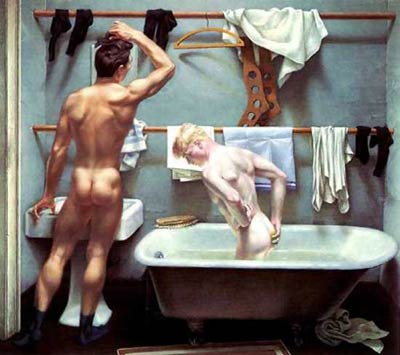
The Bath (center)
Stone Blossom: A Conversation Piece (1939)
Cadmus was a slow, meticulous worker who favored the complicated, time-consuming medium of egg tempera. He finished an average of only two paintings a year. He was more prolific in other media, including drawing, printmaking and photography. Although Cadmus stopped painting toward the end of his life, he continued to draw at his home in Weston, Connecticut, particularly portraits and figure studies of his partner Jon Andersson. Paul Cadmus died in his home in Weston in 1999, just five days short of his 95th birthday.
Subscribe to:
Posts (Atom)